
Samuel Adams Biography Quotes 11 Report mistakes
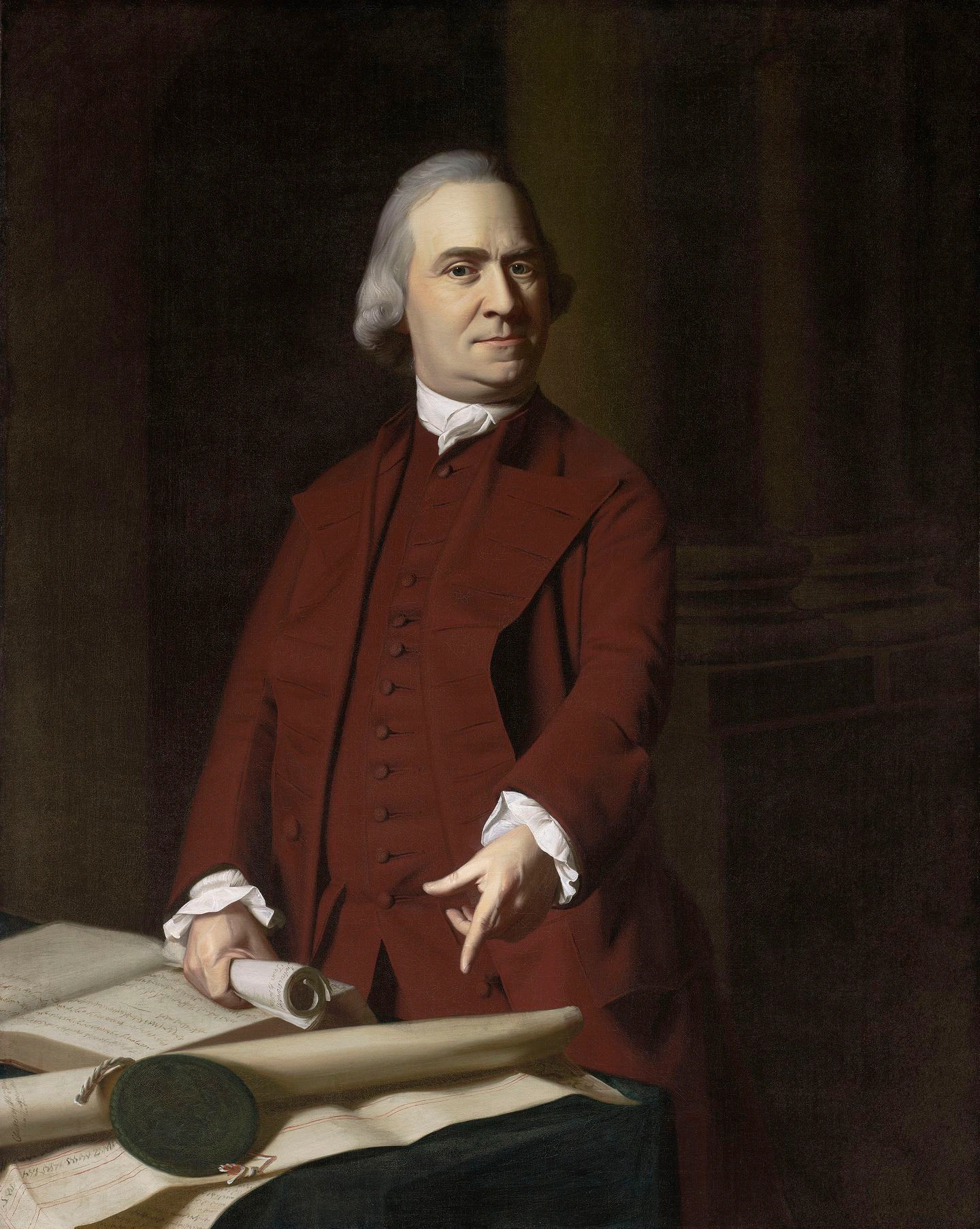
Attr: John Singleton Copley
| 11 Quotes | |
| Occup. | Revolutionary |
| From | USA |
| Born | September 27, 1722 Boston, Massachusetts, USA |
| Died | October 2, 1803 Boston, Massachusetts, USA |
| Cause | Natural Causes |
| Aged | 81 years |
| Cite | |
Citation Formats
APA Style (7th ed.)
Samuel adams biography, facts and quotes. (2026, February 11). FixQuotes. https://fixquotes.com/authors/samuel-adams/
Chicago Style
"Samuel Adams biography, facts and quotes." FixQuotes. February 11, 2026. https://fixquotes.com/authors/samuel-adams/.
MLA Style (9th ed.)
"Samuel Adams biography, facts and quotes." FixQuotes, 11 Feb. 2026, https://fixquotes.com/authors/samuel-adams/. Accessed 26 Mar. 2026.
Early Life and Background
Samuel Adams was born on September 27, 1722, in Boston, Massachusetts Bay, into a seaport town where sermons, ship manifests, and political arguments shared the same narrow streets. His father, Samuel Adams Sr., was a prosperous maltster, a deacon, and a local officeholder who moved comfortably between commerce and covenant; his mother, Mary Fifield Adams, came from the region's sturdy middling world. The household belonged to the New England tradition that treated public virtue as a personal obligation, and the boy absorbed early the idea that liberty was not a mood but a moral discipline.Boston in Adams's youth was already trained by crisis - war with France, hard currency shortages, and imperial regulation that could feel distant one year and suffocating the next. The son watched neighbors turn politics into a form of community self-defense, and he also saw how reputations could rise or collapse in a town that remembered everything. That intimacy shaped him: Adams developed a gift for organizing and persuading that did not depend on glamour, but on trust, repetition, and the slow accrual of alliances.
Education and Formative Influences
Adams graduated from Harvard College in 1740 and earned an MA in 1743, writing in the idiom of natural rights and resistance theory that New England students inherited from classical republicanism and Protestant political theology. Briefly steered toward law and then business, he proved ill-suited to private advancement, but intensely suited to argument, drafting, and committee work. The moral language of covenant - duty, corruption, vigilance - merged in him with Enlightenment talk of rights, producing a political temperament that treated power as perpetually tempted and citizens as perpetually responsible.Career, Major Works, and Turning Points
Adams entered Boston politics through local offices and, in 1765, became clerk of the Massachusetts House of Representatives, a position that put him at the nerve center of colonial legislative resistance. He helped lead opposition to the Stamp Act, then sharpened his organizing methods as customs enforcement and troops arrived; by 1772 he was a key architect of Boston's Committee of Correspondence, and in 1773 he stood near the center of the agitation that culminated in the Boston Tea Party. Elected to the Continental Congress in 1774, he pressed the case that imperial overreach had become a systemic threat rather than a policy dispute, and he supported independence once compromise looked like surrender. After the Revolution he helped frame the Massachusetts Constitution of 1780, served as lieutenant governor (1789-1794) and then governor (1794-1797), and spent his last years in Boston as a revered, sometimes austere symbol of the founding generation, dying on October 2, 1803.Philosophy, Style, and Themes
Adams's political psychology was built on a suspicion that tyranny begins as a change in language and habits before it becomes an open act. His pen returned again and again to the idea that domination relies on moral confusion, a fear he captured when he warned, “How strangely will the Tools of a Tyrant pervert the plain Meaning of Words!” This was not mere rhetoric; it reveals a mind attentive to the invisible infrastructure of power - who defines terms, who normalizes exceptions, who teaches people to call submission prudence. He wrote and spoke as if civic freedom depended on citizens recognizing the first small distortions and refusing to cooperate with them.His style fused rights talk with a pastor's insistence on character. Adams could sound analytical, but he trusted sentiment as the lever that moves publics, an insight compressed in, “Mankind are governed more by their feelings than by reason”. He therefore cultivated meetings, rituals, newspapers, and committees as emotional as well as intellectual engines. Yet his emotional appeal was anchored in an ethic of defense, not conquest: “The liberties of our country, the freedom of our civil constitution, are worth defending against all hazards: And it is our duty to defend them against all attacks”. In Adams, the revolutionary is less a romantic insurgent than a steward - vigilant, sometimes severe, convinced that liberty survives only when ordinary people accept the burdens of self-government.
Legacy and Influence
Adams endures as one of the Revolution's most consequential organizers: a master of municipal politics who translated local grievance into continental resistance and helped invent the committee system that became a template for American mobilization. Later generations sometimes reduced him to an "agitator", but his deeper legacy is procedural and moral - the belief that free institutions require networks, habits of participation, and a public language resilient against manipulation. In an American tradition that often celebrates solitary genius, Adams represents something harder to romanticize and easier to need: the disciplined builder of movements, the custodian of civic vigilance, and the reminder that revolutions are won as much in meeting rooms and printed arguments as on battlefields.Our collection contains 11 quotes written by Samuel, under the main topics: Ethics & Morality - Truth - Wisdom - Leadership - Freedom.
Other people related to Samuel: John Hancock (Politician), Benjamin Lincoln (Soldier)
Source / external links