
Samuel Beckett Biography Quotes 32 Report mistakes
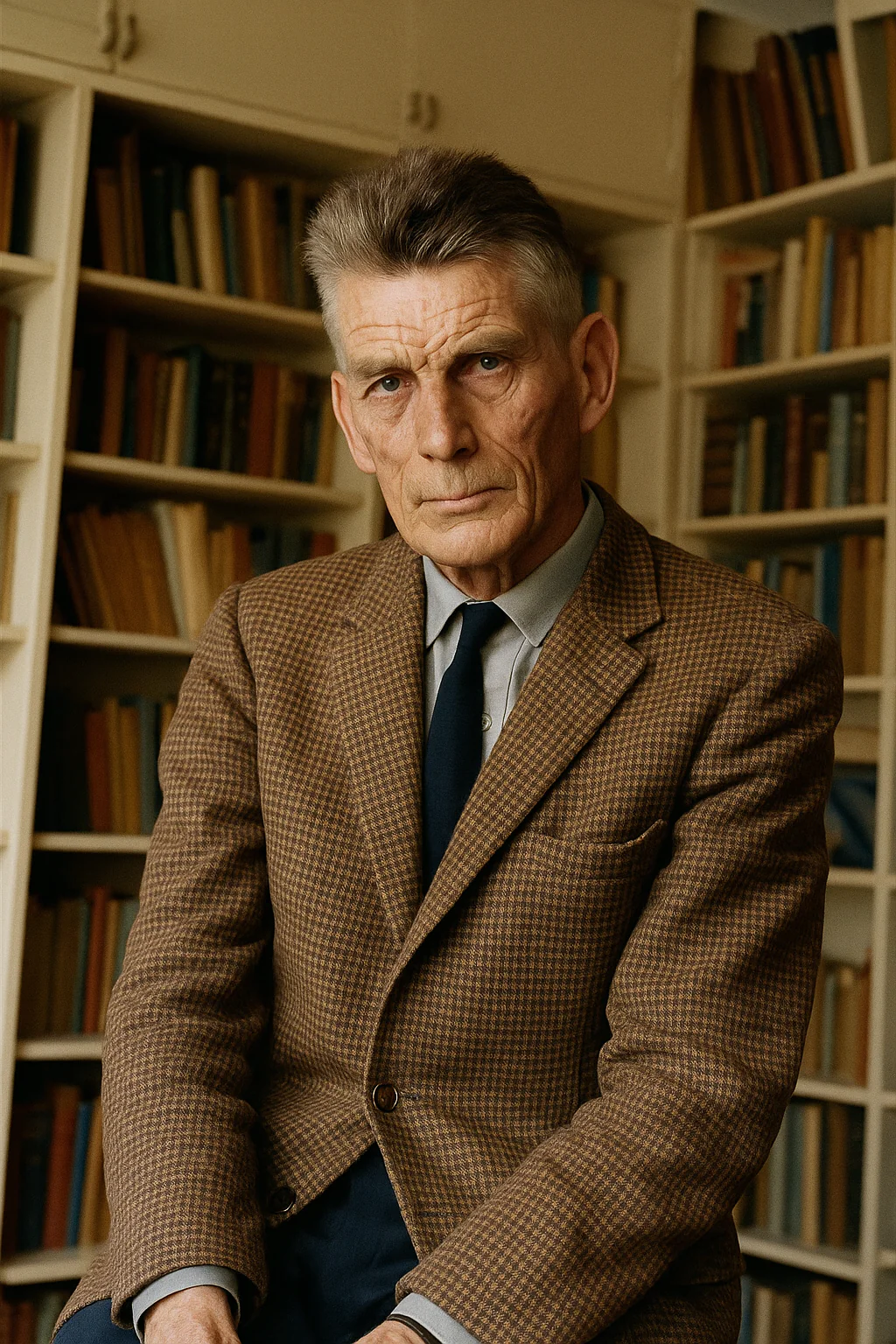
| 32 Quotes | |
| Born as | Samuel Barclay Beckett |
| Occup. | Playwright |
| From | Ireland |
| Born | April 13, 1906 Foxrock, Dublin, Ireland |
| Died | December 22, 1989 Paris, France |
| Aged | 83 years |
| Cite | |
Citation Formats
APA Style (7th ed.)
Samuel beckett biography, facts and quotes. (2026, February 2). FixQuotes. https://fixquotes.com/authors/samuel-beckett/
Chicago Style
"Samuel Beckett biography, facts and quotes." FixQuotes. February 2, 2026. https://fixquotes.com/authors/samuel-beckett/.
MLA Style (9th ed.)
"Samuel Beckett biography, facts and quotes." FixQuotes, 2 Feb. 2026, https://fixquotes.com/authors/samuel-beckett/. Accessed 20 Mar. 2026.
Early Life and Background
Samuel Barclay Beckett was born on 1906-04-13 in Foxrock, south of Dublin, into an Anglo-Irish Protestant household that prized reserve, sport, and professional steadiness. His father, William Frank Beckett, was a quantity surveyor; his mother, Maria Jones Roe, was devout, practical, and emotionally demanding in ways Beckett later transmuted into the tense mother-son bonds that haunt his fiction and drama. He grew up amid the aftershocks of the Irish revolutionary decade and the partition settlement, but his sensibility was shaped less by public rhetoric than by private atmospheres: the ordinary cruelties of family life, the pressure to perform, and the early intuition that consciousness itself could be a trap.As a boy at Earlsfort House School and later at Portora Royal School in Enniskillen - where Oscar Wilde had studied - Beckett excelled academically and athletically, especially at cricket. Yet even in youth he carried a streak of estrangement: a watcher more than a joiner, drawn to solitary walks, to the rhythms of breath and weather, to the bare facts of the body moving through time. That inwardness, sharpened by an Ireland negotiating modernity and identity, would become his lifelong laboratory: how little can be said, and how long can one endure the saying.
Education and Formative Influences
He entered Trinity College Dublin in 1923, studying French and Italian, and absorbed European modernism at a moment when Dublin still leaned on inherited certainties. The intellectual widening was decisive: Dante and the Italian humanists, the French moralists, and above all James Joyce, whose daring example Beckett both revered and resisted. After graduating (1927), he lectured in English at the Ecole Normale Superieure in Paris, entered Joyce's circle, and published the critical essay "Dante ... Bruno. Vico.. Joyce" (1929), a youthful defense of Joyce's method that already betrays Beckett's own opposite impulse - toward subtraction, silence, and the stripping away of explanatory comfort.Career, Major Works, and Turning Points
Beckett's early prose and criticism - including "Proust" (1931) and the story collection "More Pricks Than Kicks" (1934) - announced a writer testing how far irony could go before it curdled into metaphysics. A major turning point came with his decision to live primarily in Paris, his break from academic life, and his wartime choice to join the French Resistance after the Nazi occupation; he later received the Croix de Guerre and Medaille de la Resistance. After the war he pivoted into the stark, driven period that made his name: the novel trilogy "Molloy" (1951), "Malone Dies" (1951), and "The Unnamable" (1953), followed by the play "Waiting for Godot" (first performed in Paris in 1953). From there he built a repertoire of theatrical and televisual austerities - "Endgame" (1957), "Krapp's Last Tape" (1958), "Happy Days" (1961), and later late works of near-vanishing form - while the Nobel Prize in Literature (1969) confirmed his international stature without altering his essentially private, guarded life.Philosophy, Style, and Themes
Beckett's inner life was governed by a paradox: he distrusted language yet could not stop worrying it, as if each sentence were both symptom and remedy. His work treats the self as an exhausted narrator trapped in its own apparatus - memory, habit, the body's failing mechanics - while comedy remains the last reflex of dignity. The line “Nothing is funnier than unhappiness, I grant you that. Yes, yes, it's the most comical thing in the world”. is not a slogan but a psychological confession: laughter, in Beckett, is what the mind does when it recognizes there is no coherent story to stabilize pain. He pairs that with an almost clinical suspicion of speech itself - “Every word is like an unnecessary stain on silence and nothingness”. - and so his style moves by reduction: fewer motives, fewer props, fewer explanations, until the stage becomes a pressure chamber for attention.Yet Beckett is not simply a laureate of despair; he is a chronicler of persistence after meaning has failed. His characters continue not because they believe, but because stopping is not an option available to organisms that breathe and remember. “I can't go on. I'll go on”. captures the emotional engine beneath the minimalism: endurance as reflex, not heroism. This is why his landscapes feel post-apocalyptic even when nothing "happens" - the catastrophe is ordinary existence, especially time. The era that produced him - two world wars, collapsing empires, and the discrediting of grand narratives - does not explain his art, but it harmonizes with his obsession: that consciousness is a voice compelled to speak into a void, and that the void answers only with duration.
Legacy and Influence
Beckett reshaped modern theater by making emptiness productive: he proved that plot could be replaced by waiting, that character could be reduced to voice and gesture, and that comedy could bear metaphysical weight without consolation. "Waiting for Godot" became a touchstone for the Theater of the Absurd and a portable allegory across cultures - staged in prisons, war zones, and classrooms - because it dramatizes a universal condition without naming it. His later experiments in radio, television, and ultra-short stage pieces expanded what performance could be, influencing playwrights from Harold Pinter and Tom Stoppard to Caryl Churchill, as well as novelists and artists drawn to his ethics of precision. Beckett's enduring power lies in the intimacy of his rigor: he made the smallest units of experience - a breath, a pause, a remembered phrase - feel like the last evidence of being alive.Our collection contains 32 quotes written by Samuel, under the main topics: Witty One-Liners - Wisdom - Art - Dark Humor - Love.
Other people related to Samuel: Marcel Proust (Author), J. M. Coetzee (Author), Gao Xingjian (Novelist), Bert Lahr (Actor), Peter Hall (Director)
Frequently Asked Questions
- Samuel Beckett Bridge: Cable-stayed bridge over the River Liffey in Dublin, designed by Santiago Calatrava; opened 2009; harp-shaped and can rotate.
- Skuespill av Samuel Beckett: Mens vi venter på Godot; Sluttspill; Krapps siste bånd; Lykkedager; Lek; Ikke jeg.
- Samuel Beckett wife: Suzanne Déchevaux-Dumesnil.
- Plays by Samuel Beckett: Waiting for Godot; Endgame; Krapp's Last Tape; Happy Days; Play; Not I; Rockaby.
- Samuel Beckett books: Molloy; Malone Dies; The Unnamable; Murphy; Watt; How It Is; Company; Worstward Ho.
- Samuel Beckett famous works: Waiting for Godot; Endgame; Krapp's Last Tape; Happy Days; Molloy; Malone Dies; The Unnamable.
- How old was Samuel Beckett? He became 83 years old
Samuel Beckett Famous Works
- 1983 Worstward Ho (Short Story)
- 1982 Catastrophe (Play)
- 1981 Rockaby (Play)
- 1981 Ill Seen Ill Said (Short Story)
- 1980 Company (Short Story)
- 1976 That Time (Play)
- 1972 Not I (Play)
- 1965 Come and Go (Play)
- 1963 Cascando (Play)
- 1963 Play (Play)
- 1961 Happy Days (Play)
- 1958 Krapp's Last Tape (Play)
- 1957 Endgame (Play)
- 1953 Waiting for Godot (Play)
- 1953 The Unnamable (Novel)
- 1953 Watt (Novel)
- 1951 Malone Dies (Novel)
- 1951 Molloy (Novel)
- 1947 Eleutheria (Novel)
- 1938 Murphy (Novel)
Source / external links