
Scott Adams Biography Quotes 29 Report mistakes
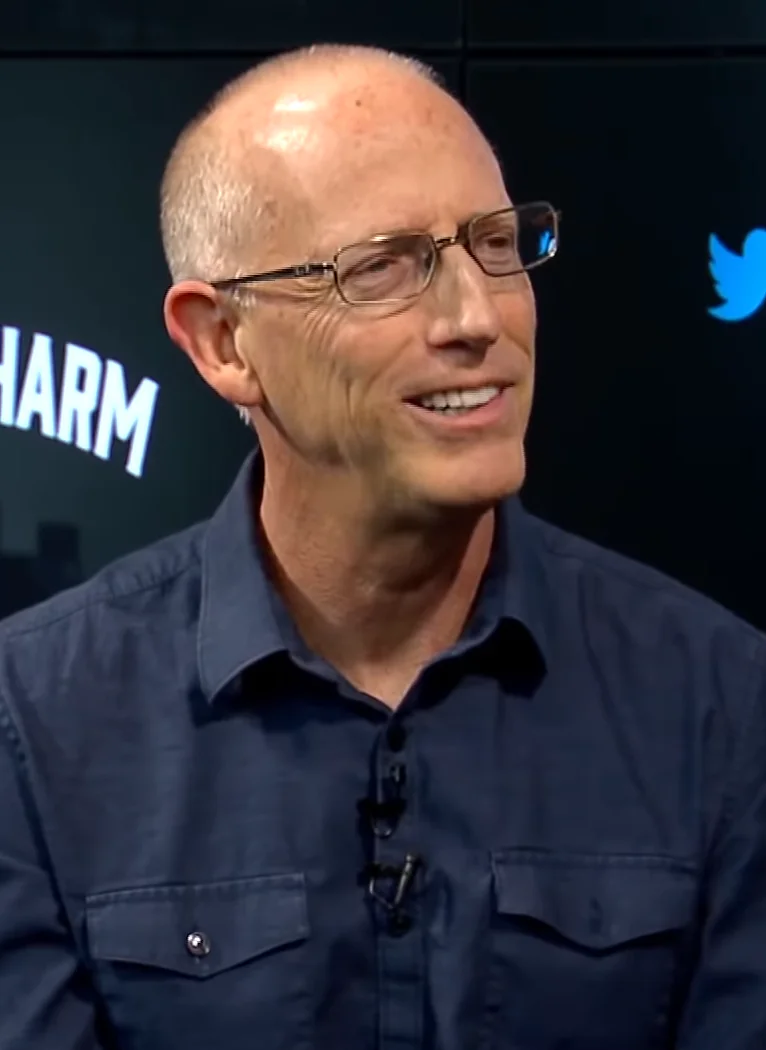
Attr: Art of Charm
| 29 Quotes | |
| Occup. | Cartoonist |
| From | USA |
| Born | September 28, 1966 Windham, New York, USA |
| Died | January 13, 2026 Pleasanton, California, USA |
| Aged | 59 years |
| Cite | |
Citation Formats
APA Style (7th ed.)
Scott adams biography, facts and quotes. (2026, February 11). FixQuotes. https://fixquotes.com/authors/scott-adams/
Chicago Style
"Scott Adams biography, facts and quotes." FixQuotes. February 11, 2026. https://fixquotes.com/authors/scott-adams/.
MLA Style (9th ed.)
"Scott Adams biography, facts and quotes." FixQuotes, 11 Feb. 2026, https://fixquotes.com/authors/scott-adams/. Accessed 25 Mar. 2026.
Early Life and Background
Scott Raymond Adams was born on September 28, 1966, in Windham, New York, and grew up in a small-town, late-Cold War America where corporate ambition and technical education were marketed as stable routes to adulthood. He has described an early fascination with drawing and with systems - the way authority works, the way rules fail, the way people rationalize their own choices - interests that later fused into office satire. The cultural backdrop of his youth included the accelerating prestige of engineering, the rise of personal computing, and the increasingly standardized language of corporate life that would soon become the raw material of his humor.His family life and upbringing did not place him in the traditional arts pipeline; instead, his early temperament reads as that of a watcher and model-builder, someone who learned by observing incentives and contradictions. That habit - treating daily life as an experiment in human behavior - became central to his later persona: a cartoonist who writes like an analyst, turning irritation, managerial doublespeak, and workplace absurdity into clean, repeatable jokes.
Education and Formative Influences
Adams attended Hartwick College and later earned an MBA from the University of California, Berkeley, a pairing that steeped him in both technical problem-solving and the logic of organizational power. The timing mattered: by the 1980s and early 1990s, American offices were becoming the stage for downsizing, reengineering, and a new cult of metrics, and Adams was absorbing the vocabulary of productivity while also noticing how often it masked insecurity, status games, and accidental incompetence.Career, Major Works, and Turning Points
After working in the corporate world, including a long stretch at Pacific Bell, Adams began submitting a strip about office life that would become Dilbert; it debuted in 1989 and entered national syndication in 1990, quickly defining a new mainstream voice for white-collar frustration. The strip expanded into best-selling collections such as The Dilbert Principle (1996), which reframed workplace misery as a system of perverse incentives and promoted Adams from cartoonist to business-culture commentator. Over time he branched into books, talks, and online writing, leveraging the early internet to build a direct audience; he also became a polarizing public figure through political commentary and social-media controversies that complicated his reputation, especially as companies and newspapers reassessed the relationship between creator and brand.Philosophy, Style, and Themes
At the core of Adams' work is a mechanistic view of human nature: people act less from noble intention than from incentives, shortcuts, and self-justifying narratives. His jokes treat organizations as machines that convert ordinary anxieties into policies, meetings, and slogans, and he often portrays intelligence as helpless inside bureaucracy. That sensibility is why his humor so often sounds like an engineer diagnosing a faulty design: “Normal people... believe that if it ain't broke, don't fix it. Engineers believe that if it ain't broke, it doesn't have enough features yet”. In Dilbert, the laugh is the recognition that overengineering is not only technical - it is social, a way of seeking control in a world that punishes candor.His line is spare, his staging repetitive in an intentional way, mirroring the loop of office life, while the punchline lands through misaligned incentives rather than slapstick. Adams frequently casts problem-making as a psychological compulsion, not a practical necessity: “Engineers like to solve problems. If there are no problems handily available, they will create their own problems”. That idea doubles as self-portrait - a mind that stays busy by inventing puzzles - and as critique of corporate cultures that reward activity over usefulness. Beneath the cynicism, his most durable theme is that perception drives behavior, a deterministic undercurrent that explains both managerial nonsense and employee compliance: “Free will is an illusion. People always choose the perceived path of greatest pleasure”.
Legacy and Influence
Adams' lasting achievement is that Dilbert became a lingua franca for late-20th-century corporate life, giving office workers a shared, quotable way to describe the gap between stated goals and lived reality. He helped popularize the idea that management fads and workplace rituals can be mapped, predicted, and mocked as systems, influencing subsequent webcomics, sitcom workplaces, and business satire that treats the office as an ecosystem of incentives rather than a moral drama. Yet his legacy is also braided with the risks of celebrity in the attention economy: as his public commentary drew scrutiny, the distance between the strip's everyman frustration and the creator's contentious public role became part of the story, ensuring that his influence is discussed not only in terms of jokes, but in terms of how modern audiences renegotiate art, authorship, and accountability.Our collection contains 29 quotes written by Scott, under the main topics: Witty One-Liners - Funny - Art - Dark Humor - Sarcastic.
Source / external links