
Shavkat Mirziyoyev Biography Quotes 11 Report mistakes
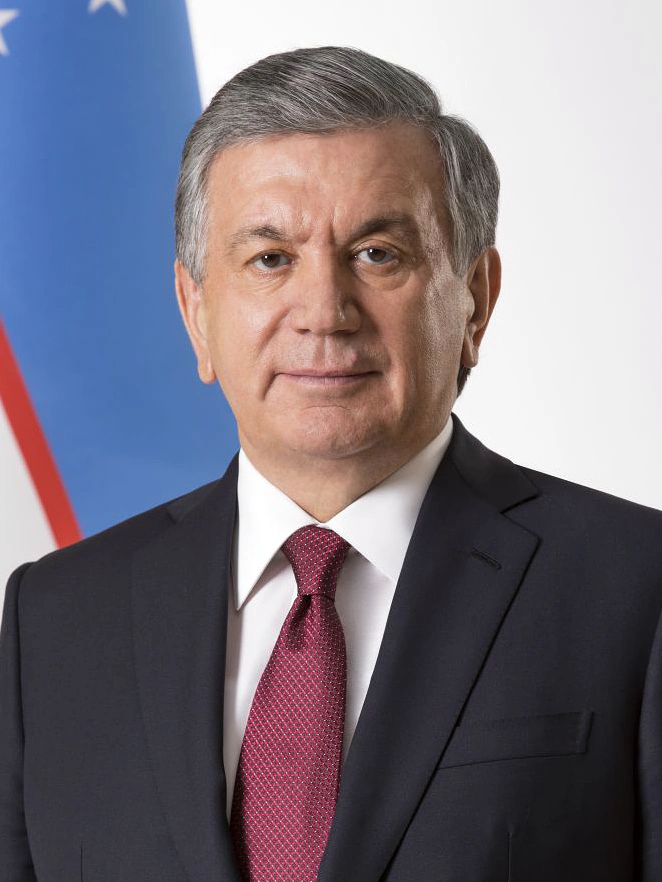
| 11 Quotes | |
| Born as | Shavkat Miromonovich Mirziyoyev |
| Native name | Шавкат Миромонович Мирзиёев |
| Occup. | President |
| From | Uzbekistan |
| Spouse | Ziroatkhon Hoshimova |
| Born | July 24, 1957 Zaamin District, Jizzakh Region, Uzbek SSR, Soviet Union |
| Age | 68 years |
| Cite | |
Citation Formats
APA Style (7th ed.)
Shavkat mirziyoyev biography, facts and quotes. (2026, March 7). FixQuotes. https://fixquotes.com/authors/shavkat-mirziyoyev/
Chicago Style
"Shavkat Mirziyoyev biography, facts and quotes." FixQuotes. March 7, 2026. https://fixquotes.com/authors/shavkat-mirziyoyev/.
MLA Style (9th ed.)
"Shavkat Mirziyoyev biography, facts and quotes." FixQuotes, 7 Mar. 2026, https://fixquotes.com/authors/shavkat-mirziyoyev/. Accessed 7 Mar. 2026.
Early Life and Background
Shavkat Miromonovich Mirziyoyev was born on July 24, 1957, in the Jizzakh region of the Uzbek Soviet Socialist Republic, then part of the USSR. He came of age in a provincial Soviet environment shaped by cotton agriculture, bureaucratic hierarchy, and the moral aftershocks of war and reconstruction. His father worked in medicine, and the household was marked by the stern upward discipline typical of Soviet professional families: education was a path to security, the state was omnipresent, and personal advancement required administrative fluency as much as talent. Those early conditions mattered. Mirziyoyev's later political manner - practical, managerial, often severe in cadence yet attentive to local grievance - bears the imprint of a world where authority was not abstract but lived through district officials, production plans, and public institutions.His youth unfolded during the mature Soviet decades, when Uzbekistan was formally modernizing yet structurally constrained by Moscow's command system. The cotton monoculture, water mismanagement, and ritualized official optimism of the era produced a political culture of compliance on the surface and improvisation underneath. Mirziyoyev learned to operate inside that duality. Unlike dissidents or intellectual reformers, he emerged from the administrative strata that kept the republic functioning. This helps explain the paradox that would later define him: he became a reformer not by repudiating the state from outside, but by mastering its inherited mechanisms and then redirecting them after independence.
Education and Formative Influences
Mirziyoyev studied at the Tashkent Institute of Irrigation and Agricultural Mechanization Engineers, graduating in the early 1980s and later earning a Candidate of Sciences degree in technical fields related to irrigation and melioration. That training was more than vocational. In Central Asia, water management was never merely technical; it was political economy in concentrated form, linking land, labor, regional power, and the failures of Soviet planning. An engineer educated in that system learned to think in terms of infrastructure, targets, bottlenecks, and territorial administration. Mirziyoyev's later governing style - focused on execution, agricultural restructuring, public reception offices, and measurable state campaigns - reflects the mindset of an administrator formed by the material problems of irrigation society rather than by ideology alone.Career, Major Works, and Turning Points
After working in academic and administrative posts, Mirziyoyev rose through local government in newly independent Uzbekistan under President Islam Karimov, serving as hokim of Jizzakh region in the mid-1990s, then of the strategically important Samarkand region from 2001 to 2003. In 2003 he was appointed prime minister, a position he held for thirteen years, making him one of the central executors of Karimov-era governance. That period gave him deep command over the bureaucracy but also associated him with a hard, centralized system criticized for coercive labor practices and limited political openness. Karimov's death in September 2016 created the decisive turning point. Mirziyoyev became interim president, then won the presidency in December 2016, and over subsequent terms recast Uzbekistan's domestic and foreign posture. He liberalized currency rules, reduced some barriers to business, opened the country more fully to neighbors and investors, sought to curb the most notorious abuses of forced cotton labor, expanded state responsiveness through virtual and physical public reception mechanisms, and advanced constitutional and administrative changes under the banner of a "New Uzbekistan". His presidency has combined genuine reform energy with strong executive control: a state still heavily managed, but more porous, more outward-looking, and more aware that legitimacy now depends on delivery as much as command.Philosophy, Style, and Themes
Mirziyoyev's public philosophy is developmental, paternal, and intensely state-centered. He presents the nation as a society in need of renewal through competence, education, and disciplined opportunity rather than through abrupt ideological rupture. His speeches return repeatedly to youth, teachers, languages, and national rebirth - not as decorative themes but as tools for building a more competitive post-Soviet state. “Our core idea is to dignify the value of a person. I am here today to listen to your wishes and concerns”. That line captures a central feature of his political psychology: he seeks authority through responsiveness, portraying the leader not only as commander but as receiver of complaint. Yet this human-centered language operates within a vertical system. His notion of dignity is not radically individualist; it is mediated by institutions, order, and the state's capacity to hear, channel, and solve.The same pattern appears in his rhetoric about education and national destiny. “Working with youth should be the main task for all of us - from the President to the minister, from the hokim to the mahalla chairperson”. “We are setting the Third Renaissance building in our country as a strategic task and bringing it up to the level of a national idea”. These are not casual slogans. They reveal a leader who frames reform as moral mobilization, linking neighborhood structures, ministries, and civilizational memory into one vertical project. The invocation of a "Third Renaissance" places contemporary Uzbekistan in a longer Islamic and Central Asian lineage, suggesting that modernization is not foreign imitation but historical restoration. His style is therefore hybrid: technocratic in method, national in symbolism, and pedagogical in tone. He often speaks as if the country can be coached into modernity by exhortation backed with administrative pressure.
Legacy and Influence
Mirziyoyev's historical significance lies in having led Uzbekistan through its first major post-Karimov transition without state fracture while altering the republic's image from closed stronghold to cautious reformer. He has reopened regional diplomacy in Central Asia, widened space for economic initiative, and made the Uzbek state more service-oriented than it had long been. At the same time, his legacy remains contested because liberalization has been selective, opposition politics constrained, and real pluralism limited by the enduring strength of presidential power. Even so, he has already changed the grammar of governance in Uzbekistan: less fear-based isolation, more performance legitimacy, more international engagement, and a national story organized around renewal rather than mere stability. If Karimov founded the independent state in defensive terms, Mirziyoyev has tried to give it a second life - more confident, more pragmatic, and more open to the world, but still unmistakably steered from the top.Our collection contains 11 quotes written by Shavkat.
Source / external links