
Shirley Chisholm Biography Quotes 11 Report mistakes
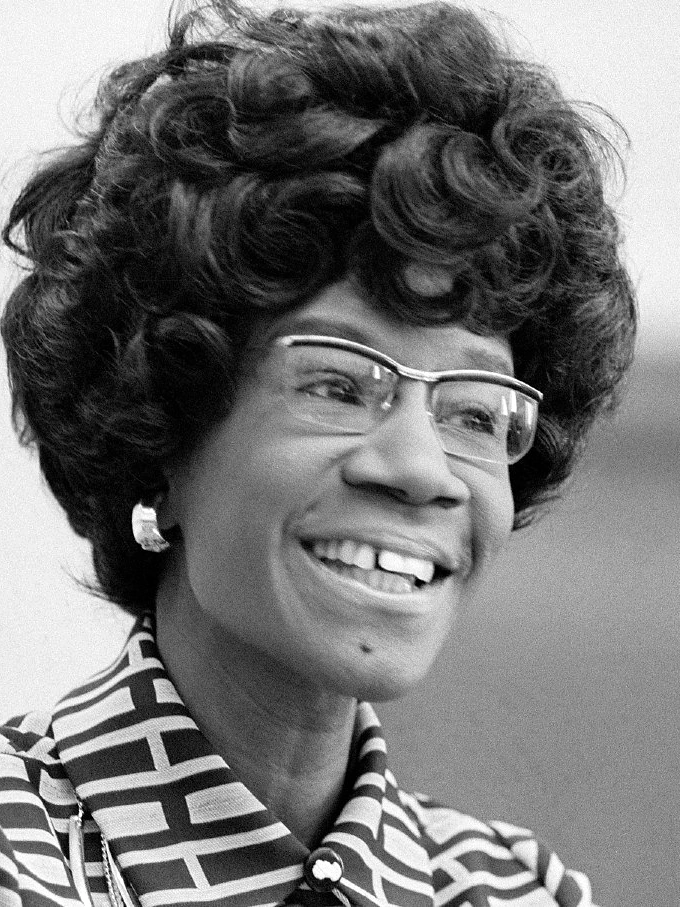
Attr: thenation.com
| 11 Quotes | |
| Born as | Shirley Anita St. Hill |
| Occup. | Politician |
| From | USA |
| Born | November 3, 1924 Brooklyn, New York, United States |
| Died | January 1, 2005 Ormond Beach, Florida, United States |
| Cause | stroke |
| Aged | 80 years |
| Cite | |
Citation Formats
APA Style (7th ed.)
Shirley chisholm biography, facts and quotes. (2026, February 16). FixQuotes. https://fixquotes.com/authors/shirley-chisholm/
Chicago Style
"Shirley Chisholm biography, facts and quotes." FixQuotes. February 16, 2026. https://fixquotes.com/authors/shirley-chisholm/.
MLA Style (9th ed.)
"Shirley Chisholm biography, facts and quotes." FixQuotes, 16 Feb. 2026, https://fixquotes.com/authors/shirley-chisholm/. Accessed 6 Mar. 2026.
Early Life and Background
Shirley Anita St. Hill was born on November 30, 1924, in Brooklyn, New York, the eldest of four daughters in a Black immigrant family from Barbados. Her father, Charles St. Hill, worked in factory and service jobs; her mother, Ruby Seale St. Hill, labored as a domestic worker and instilled an exacting sense of dignity and self-reliance. Chisholm grew up amid the churn of interwar New York, where housing segregation, job ceilings, and political machines shaped the daily geometry of ambition.From ages five to about twelve she lived largely in Barbados with her maternal grandmother, absorbing a rigorous British-influenced school discipline and a West Indian tradition of blunt speech and high expectations. Returning to Brooklyn in the late 1930s, she carried both the cadence of Caribbean frankness and the lived knowledge that class, color, and gender could quietly decide who was heard. That early cross-Atlantic upbringing hardened her against condescension and helped form the independent temperament that later both attracted allies and unsettled party gatekeepers.
Education and Formative Influences
Chisholm attended Brooklyn College, graduating in 1946 with honors in sociology and a reputation as a formidable debater; she later earned a Master of Arts in early childhood education from Teachers College, Columbia University, in 1951. Working in child care and community programs while studying, she learned to translate ideals into institutions - budgets, staff, and measurable outcomes - and she also learned how public policy reached families first through schools, housing, and health. Those years coincided with the postwar expansion of the welfare state and the intensifying civil rights struggle, sharpening her belief that citizenship was not abstract but operational.Career, Major Works, and Turning Points
After rising from nursery school teacher to director within New York City child care and the citywide Day Care Council, Chisholm entered Democratic club politics in Brooklyn and won election to the New York State Assembly in 1964. In 1968 she became the first Black woman elected to the U.S. House of Representatives, representing a newly drawn Brooklyn district; she quickly defied seniority norms, fought to leave the Agriculture Committee for Education and Labor, and built a legislative identity around the people most excluded from postwar prosperity. She helped found the Congressional Black Caucus in 1971 and co-founded the National Women's Political Caucus that same year. In 1972 she ran for the Democratic presidential nomination, the first Black woman to do so, campaigning under the banner "Unbought and Unbossed" (also the title of her 1970 memoir) and insisting on a multiracial, feminist coalition even when party leaders treated her as symbolic. After seven terms she retired from Congress in 1983, later teaching and continuing public advocacy; she died on January 1, 2005.Philosophy, Style, and Themes
Chisholm's inner life was defined by a practical moral urgency: politics was not theater but a rent-paying obligation to others. She framed public life as reciprocal duty rather than personal elevation, a stance captured in her insistence that “Service is the rent that you pay for room on this earth”. That ethic, rooted in immigrant striving and community work, explains her impatience with procedural delay and her preference for legislation that touched daily survival - food assistance, education funding, child care, minimum-wage standards. Her voice in Congress was direct, sometimes abrasive by the era's expectations for women, and she used that friction as an organizing tool, forcing colleagues and reporters to confront who was allowed to sound authoritative.Her themes returned repeatedly to the compounded architecture of discrimination, with gender operating as an omnipresent, often underestimated barrier. She argued from lived experience rather than abstraction, stating, “Of my two handicaps, being female put many more obstacles in my path than being black”. She also treated sexism as an early, institutionalized conditioning, not merely personal prejudice: “The emotional, sexual, and psychological stereotyping of females begins when the doctor says: It's a girl”. These lines reveal a psychology both unsentimental and hopeful - unsentimental about the roots of inequality, hopeful that naming mechanisms could loosen their grip. Her style paired moral clarity with coalition realism: she courted Black voters, women, labor, and antiwar activists without surrendering her independence, accepting the loneliness that came with refusing to be managed.
Legacy and Influence
Chisholm's enduring influence lies less in a single bill than in a redefinition of political possibility: she made it normal to imagine a Black woman as a national contender and to demand policy attention to those outside the center of power. Her presidential run helped widen the Democratic Party's conversation about race, gender, and representation, and her example became a touchstone for later generations of candidates who framed ambition as public service rather than personal exception. In memory she remains "unbought and unbossed" not as a slogan but as a biography of principled stubbornness - a life that proved independence can be a method, not merely a temperament.Our collection contains 11 quotes written by Shirley, under the main topics: Motivational - Ethics & Morality - Justice - Leadership - Equality.
Other people related to Shirley: Florynce R. Kennedy (Lawyer), Louis Stokes (Politician), Major R. Owens (Politician), Barbara Lee (Politician), Liz Carpenter (Writer), John Conyers (Politician)
Source / external links