
Sigmund Freud Biography Quotes 64 Report mistakes
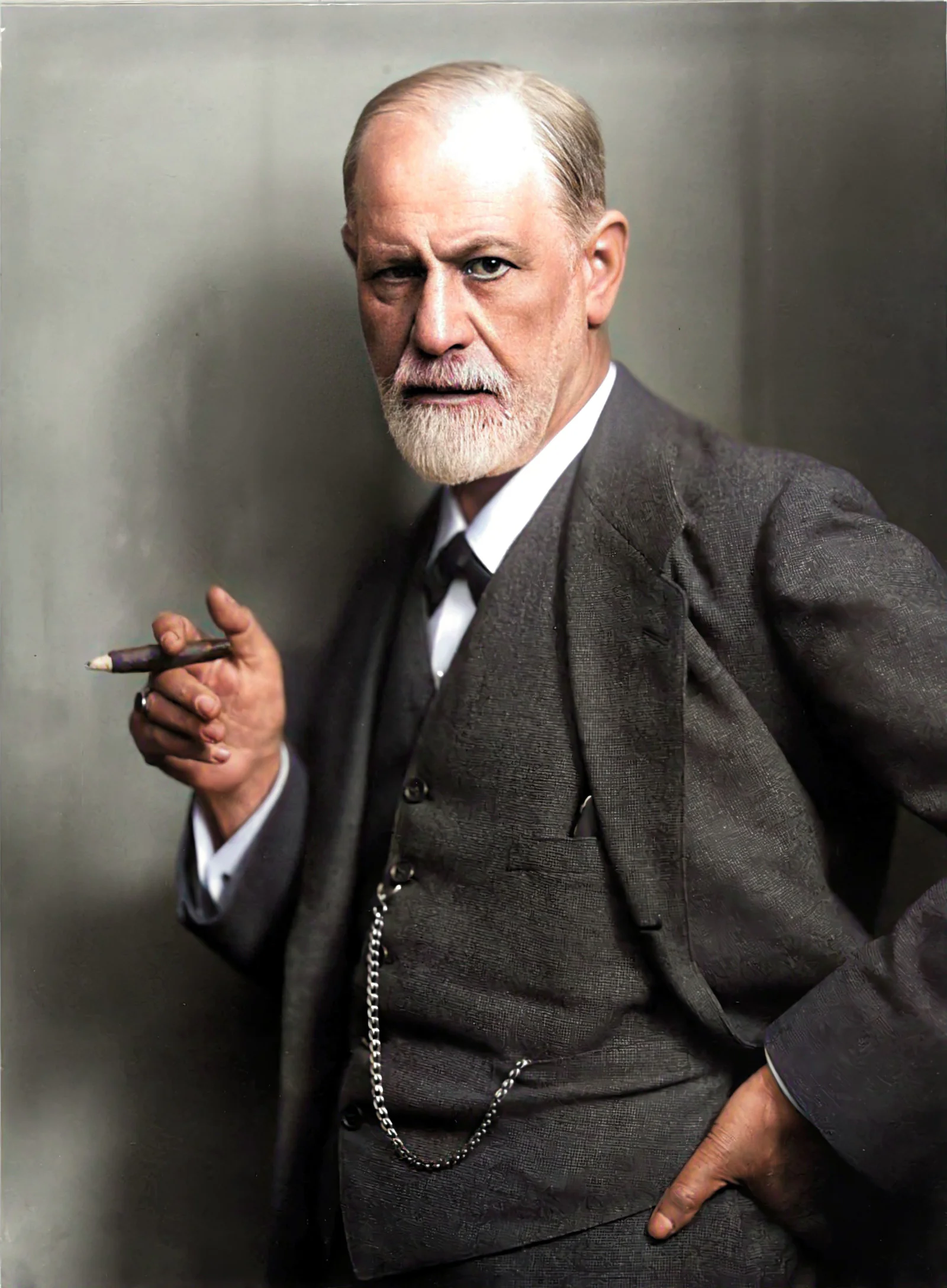
Attr: Max Halberstadt
| 64 Quotes | |
| Occup. | Psychologist |
| From | Austria |
| Born | May 6, 1856 Freiberg, Moravia, Austrian Empire |
| Died | September 23, 1939 London, England |
| Cause | Euthanasia due to cancer |
| Aged | 83 years |
| Cite | |
Citation Formats
APA Style (7th ed.)
Sigmund freud biography, facts and quotes. (2026, February 2). FixQuotes. https://fixquotes.com/authors/sigmund-freud/
Chicago Style
"Sigmund Freud biography, facts and quotes." FixQuotes. February 2, 2026. https://fixquotes.com/authors/sigmund-freud/.
MLA Style (9th ed.)
"Sigmund Freud biography, facts and quotes." FixQuotes, 2 Feb. 2026, https://fixquotes.com/authors/sigmund-freud/. Accessed 6 Mar. 2026.
Early Life and Background
Sigmund Freud was born on 1856-05-06 in Freiberg, Moravia (then in the Austrian Empire; now Pribor, Czech Republic), the first child of the wool merchant Jakob Freud and Amalia Nathansohn. The household was Jewish, economically precarious, and intellectually ambitious - a mix that later sharpened Freud's sensitivity to status, exclusion, and the private compensations people build when public belonging is uncertain. His family moved first to Leipzig and then, in 1860, to Vienna, where he would spend most of his life under the long shadow of Habsburg bureaucracy, Catholic majorities, and rising political antisemitism.Vienna offered Freud both the stimulus and the pressure of a modern metropolis: medical schools, salons, newspapers, and the anxious pace of fin-de-siecle life. He grew into a driven, competitive youth, attached to his mother and conscious of his father's gentler authority, an early domestic geometry that later helped him imagine family life as a theater of rivalries and prohibitions. From the beginning, Freud read his world for hidden motives - not out of mysticism, but out of a realist's suspicion that polite speech conceals more than it reveals.
Education and Formative Influences
Freud studied medicine at the University of Vienna (1873-1881), training in physiology and neurology in Ernst Brucke's laboratory, where mechanistic science and disciplined observation were treated as moral virtues. He also absorbed Darwin, German philosophy, and the era's debates about heredity and degeneration, learning to think of mind as a natural phenomenon with lawful processes. After early work on neuroanatomy and aphasia, he trained clinically at Vienna General Hospital and traveled to Paris in 1885-1886 to study with Jean-Martin Charcot at the Salpetriere, where hysteria and hypnosis suggested that symptoms could be meaningful rather than purely organic - a formative shock that redirected his ambition from nerves to narratives.Career, Major Works, and Turning Points
Back in Vienna, Freud entered private practice and, with Josef Breuer, published Studies on Hysteria (1895), developing the "talking cure" while breaking from hypnosis toward free association and the analysis of resistance. His self-analysis, conducted amid professional isolation and the pressure to prove a new model, produced The Interpretation of Dreams (1899/1900), which treated dreams as structured wish-fulfillment and introduced the dynamic unconscious. Over the next decades he formalized psychoanalysis through The Psychopathology of Everyday Life (1901), Three Essays on the Theory of Sexuality (1905), the case histories (including "Dora", the "Rat Man", and the "Wolf Man"), and institutional building: the Wednesday Psychological Society (1902), the International Psychoanalytic Association (1910), and the fraught succession dramas with Alfred Adler and Carl Jung. After World War I he revised his metapsychology in Beyond the Pleasure Principle (1920) and The Ego and the Id (1923), even as cancer of the jaw (diagnosed 1923) brought years of painful surgeries. The Nazi annexation of Austria in 1938 forced exile to London; after the arrest of his daughter Anna and the looting of Jewish Vienna, Freud left, dying on 1939-09-23 after requesting morphine to end suffering.Philosophy, Style, and Themes
Freud's central wager was that human beings are interpretable: symptoms, slips, dreams, and habits form a language whose grammar is conflict. He denied that consciousness rules the self, insisting that “The ego is not master in its own house”. This was not merely a theory but a temperament - the stance of a clinician who repeatedly watched intelligent patients act against their declared interests, then defend those self-defeating patterns as if they were treasures. His famous remark that “Neurotics complain of their illness, but they make the most of it, and when it comes to talking it away from them they will defend it like a lioness her young”. captures both his clinical impatience and his compassion: the symptom is a compromise, a small fortress built to protect a person from a larger terror.His prose mixes laboratory exactness with literary craft, moving from clinical detail to myth and back again, as if only multiple registers could approach the psyche's duplicity. Freud made sexuality and aggression foundational not to scandalize but to explain how culture is purchased through renunciation, leaving residues that return as guilt, ritual, and obsession. In that framework, the body is never neutral; it is lived, interpreted, and recruited into identity - distilled in the blunt aphorism “Anatomy is destiny”. Yet Freud's "destiny" was rarely simple determinism; it was a map of constraints within which fantasy, repression, and the search for love improvise their own tragedies.
Legacy and Influence
Freud's legacy is double-edged: many specific claims have been contested or discarded, yet the interpretive attitude he championed reshaped psychiatry, psychotherapy, literature, film, and everyday self-understanding. He helped normalize the idea that childhood matters, that memory is unstable, and that speech can heal by making conflict thinkable. Psychoanalysis also exposed the hazards of authority - the analyst as storyteller, judge, and mirror - prompting later reforms and critiques from within (Anna Freud, Melanie Klein, Winnicott, Lacan) and from outside (behaviorism, neuroscience, feminist and postcolonial theory). Whatever one makes of his system, Freud permanently expanded the modern imagination's interior space, teaching a century to listen for what is said not only with words, but with silences, detours, and repetitions.Our collection contains 64 quotes written by Sigmund, under the main topics: Witty One-Liners - Ethics & Morality - Wisdom - Truth - Justice.
Other people related to Sigmund: Alfred Adler (Psychologist), Viktor E. Frankl (Psychologist), Egon Schiele (Artist), Lucian Freud (Artist), Wilhelm Reich (Psychologist), David Cronenberg (Director), Leonard Woolf (Author), Lionel Trilling (Critic), Theodor Reik (Psychologist), Peter Gay (Historian)
Source / external links