
Simone de Beauvoir Biography Quotes 30 Report mistakes
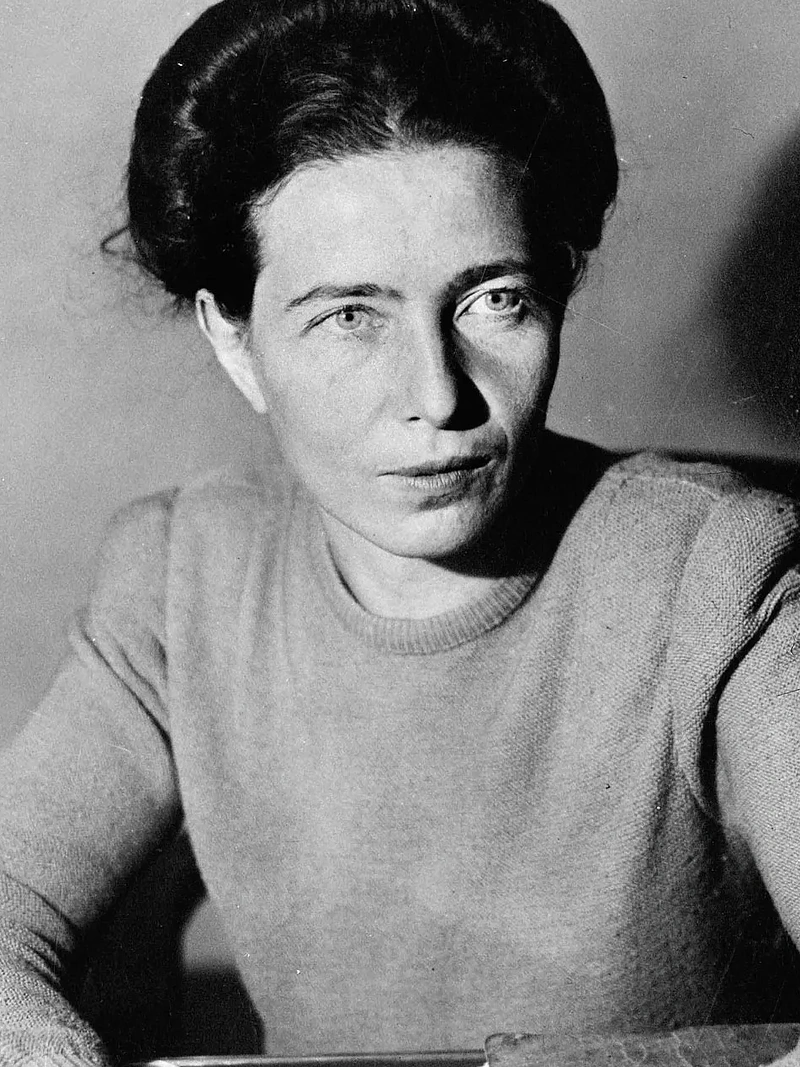
| 30 Quotes | |
| Born as | Simone Lucie Ernestine Marie Bertrand de Beauvoir |
| Occup. | Writer |
| From | France |
| Born | January 9, 1908 Paris, France |
| Died | April 14, 1986 Paris, France |
| Cause | pneumonia |
| Aged | 78 years |
| Cite | |
Citation Formats
APA Style (7th ed.)
Simone de beauvoir biography, facts and quotes. (2026, February 11). FixQuotes. https://fixquotes.com/authors/simone-de-beauvoir/
Chicago Style
"Simone de Beauvoir biography, facts and quotes." FixQuotes. February 11, 2026. https://fixquotes.com/authors/simone-de-beauvoir/.
MLA Style (9th ed.)
"Simone de Beauvoir biography, facts and quotes." FixQuotes, 11 Feb. 2026, https://fixquotes.com/authors/simone-de-beauvoir/. Accessed 26 Mar. 2026.
Early Life and Background
Simone Lucie Ernestine Marie Bertrand de Beauvoir was born on January 9, 1908, in Paris into a family poised uneasily between Catholic propriety and post-World War I decline. Her father, Georges de Beauvoir, an amateur of theater and literature, cultivated her verbal brilliance and ambition; her mother, Francoise Brasseur, pressed piety and bourgeois feminine ideals. The clash produced the early pattern of her inner life: a fierce hunger for intellectual sovereignty coupled with a watchful anger at the roles offered to girls of her class.The family lost much of its fortune after the war, narrowing her prospects and quietly widening her freedom: without a dowry, marriage became less certain, and study more urgent. In diaries and later memoirs, she recalled a childhood of passionate friendships, erotic curiosity, and an early revolt against the promise of salvation. By adolescence she had renounced faith, choosing instead a moral life grounded in responsibility and lucidity rather than obedience.
Education and Formative Influences
She studied at the Institut Catholique and the Cours Desir, then pursued philosophy at the Sorbonne and the elite ecosystem of Parisian intellectual life. In 1929 she placed second in the agregation de philosophie, just behind Jean-Paul Sartre, whom she met while preparing for the exam; their lifelong partnership, forged in argument, desire, and a shared wager on freedom, became both a private experiment and a public symbol. The interwar years fed her through Hegel, Kierkegaard, Husserl, and Heidegger, while French rationalism and the legacy of the Dreyfusard moral intellectual sharpened her sense that ideas must answer to history.Career, Major Works, and Turning Points
Teaching in Marseille, Rouen, and Paris in the 1930s, she wrote fiction that tested existential ethics in lived situations, then committed fully to writing and political engagement during and after the Occupation. With Sartre and others she helped found Les Temps Modernes in 1945, making literature a tool for moral inquiry and civic intervention. Her novels - notably She Came to Stay (1943) and The Mandarins (1954, Prix Goncourt) - anatomized intimacy, jealousy, and political disillusion in the milieu of writers and militants. The decisive turning point was The Second Sex (1949), a vast synthesis of philosophy, history, biology, and testimony that transformed her from prominent existentialist to architect of modern feminism; later memoirs (including Memoirs of a Dutiful Daughter, 1958) and her account of aging (The Coming of Age, 1970) extended the same method: describe the structures that shape a life, then locate the margin where choice remains.Philosophy, Style, and Themes
De Beauvoir built her thought around existential freedom under constraint: the self is not a fixed essence but an ongoing project, always threatened by "bad faith" and by social systems that turn people into objects. Her prose is analytical, concrete, and argumentative even in fiction, driven by scenes that force moral decisions rather than decorate them. She returned obsessively to reciprocity - the need to be recognized as a subject - and to the political dangers of making any group "the Other". Her travel writing and reportage on the United States, China, and Algeria show the same impulse: to test Parisian abstractions against real institutions, labor, race, and empire.Her feminist psychology begins from formation rather than destiny: “One is not born, but rather becomes, a woman”. The sentence condenses her lifelong outrage at the way femininity is manufactured through education, romance, work, and myth until it feels natural, even to its victims. She argued that patriarchal culture universalizes the male viewpoint - “Representation of the world, like the world itself, is the work of men; they describe it from their own point of view, which they confuse with the absolute truth”. What reads as neutral reason becomes, in her diagnosis, a subtle emotional economy: men secured as subjects, women trained toward immanence, self-surveillance, and gratitude. Hence her cutting observation of the double standard of humanity: “Man is defined as a human being and a woman as a female - whenever she behaves as a human being she is said to imitate the male”.
Legacy and Influence
De Beauvoir died in Paris on April 14, 1986, after decades in which her books, interviews, and activism helped shift private life into public argument. The Second Sex provided the conceptual toolkit for second-wave feminism across Europe and the Americas, influencing thinkers from Betty Friedan to later theorists who contested and extended her categories. Her memoirs remain a master class in intellectual self-portraiture, exposing how love, ambition, compromise, and history braid together in a writer's life. Enduring controversies - her pact with Sartre, her ethics of desire, her political judgments - have not diminished her central achievement: she made freedom measurable against the pressure of institutions, and she taught generations to recognize how a society builds a "nature" and then calls it fate.Our collection contains 30 quotes written by Simone, under the main topics: Truth - Art - Justice - Love - Mortality.
Other people related to Simone: Søren Kierkegaard (Philosopher), Nelson Algren (Novelist), Maurice Merleau-Ponty (Philosopher), Alice S. Rossi (Sociologist)
Simone de Beauvoir Famous Works
- 1972 All Said and Done (Autobiography)
- 1970 The Coming of Age (Non-fiction)
- 1967 The Woman Destroyed (Collection)
- 1966 The Beautiful Images (Novel)
- 1964 A Very Easy Death (Memoir)
- 1963 The Force of Circumstances (Autobiography)
- 1958 Memoirs of a Dutiful Daughter (Autobiography)
- 1954 The Mandarins (Novel)
- 1949 The Second Sex (Non-fiction)
- 1948 America Day by Day (Non-fiction)
- 1946 All Men Are Mortal (Novel)
- 1945 The Blood of Others (Novel)
- 1944 Pyrrhus and Cinéas (Essay)
- 1943 She Came to Stay (Novel)