
Simone Weil Biography Quotes 66 Report mistakes
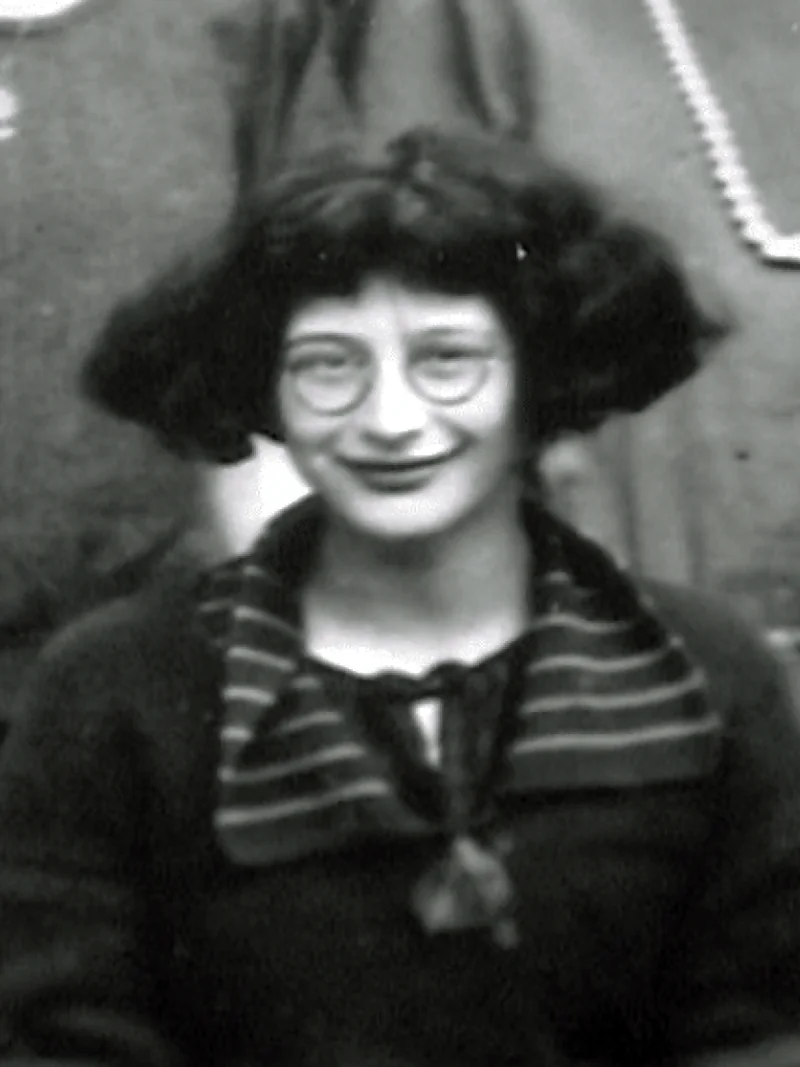
Attr: Le Jour du Seigneur
| 66 Quotes | |
| Occup. | Philosopher |
| From | France |
| Born | February 3, 1909 Paris, France |
| Died | August 24, 1943 Ashford, Kent, England |
| Aged | 34 years |
| Cite | |
Citation Formats
APA Style (7th ed.)
Simone weil biography, facts and quotes. (2026, February 2). FixQuotes. https://fixquotes.com/authors/simone-weil/
Chicago Style
"Simone Weil biography, facts and quotes." FixQuotes. February 2, 2026. https://fixquotes.com/authors/simone-weil/.
MLA Style (9th ed.)
"Simone Weil biography, facts and quotes." FixQuotes, 2 Feb. 2026, https://fixquotes.com/authors/simone-weil/. Accessed 18 Feb. 2026.
Early Life and Background
Simone Weil was born in Paris on 1909-02-03 into a secular, assimilated Jewish family whose privileges sat uneasily beside her early, almost physical sensitivity to suffering. Her father, Bernard Weil, was a physician; her mother, Selma (nee Reinherz), cultivated a rigorous, protective household that nevertheless could not keep the world out. The First World War, shortages, and the public visibility of wounded soldiers formed her first moral landscape, and she responded with a precocious refusal to accept comfort as morally neutral.From childhood she displayed a combination of intellectual ferocity and self-denial that would later look less like temperament than vocation. She was close to her gifted brother Andre, yet determined to earn her own authority, and she developed a habit of fasting, overwork, and voluntary hardship that framed her ethics in bodily terms. France in the 1920s and early 1930s was a nation still haunted by mass death and political fracture, and Weil grew into a young woman who treated politics not as opinion but as contact with affliction - what she would call malheur, a crushing of the person that is social as well as spiritual.
Education and Formative Influences
Weil studied at the Lycee Henri-IV and then the Ecole Normale Superieure, where her brilliance was notorious and her severity toward herself unsettled friends. She passed the agregation in philosophy (1931) and absorbed Greek thought, Christian mysticism, and modern social theory with equal appetite, yet resisted any system that dulled attention to concrete misery. Her early reading ranged from Plato and the Stoics to Marx; her intellectual model was not mastery but obligation - the idea that truth is owed to the real, especially to the defeated.Career, Major Works, and Turning Points
Appointed to teach philosophy in provincial lycees, she simultaneously became a militant ally of workers and the unemployed, writing political essays and joining strikes. The decisive turn came in 1934-1935 when she left teaching to work incognito on factory lines at Alsthom and then Renault, an experiment in truth-telling that shattered any romantic view of labor and supplied the lived basis for her later critiques of force and bureaucracy. In 1936 she went to Spain and briefly joined an anarchist militia aligned with the POUM; an accident and the brutal logic of civil war sent her back disabused. After 1938, a series of intense religious experiences - including at Solesmes during Holy Week and later at Assisi - drew her toward Christianity without formal conversion. During World War II she fled with her family to the south of France and then to New York, but refused safety as a final answer; she reached London in 1942 to work for the Free French and drafted her most influential late writings, including "The Need for Roots" and the notes later published as "Gravity and Grace". Tuberculosis, compounded by self-imposed rationing in solidarity with occupied France, ended her life on 1943-08-24 in Ashford, Kent.Philosophy, Style, and Themes
Weil wrote as if thought were a form of conscience: compressed, luminous, often aphoristic, allergic to consolations. Her central category is attention - a disciplined receptivity that refuses to replace the world with wish. Inwardly she distrusted the ego, viewing it as a counterfeit center that feeds on fantasies of deserving; this is why she could write that “All sins are attempts to fill voids”. The sentence reads like a psychological diagnosis and a confession: for her, moral failure is not primarily wickedness but an evasion of emptiness, a flight from the ache that should keep the soul truthful.Her political and spiritual writings meet in an unsparing analysis of force, necessity, and the way institutions turn people into things. She insisted that oppression works not only through fear but through the mind's capitulation to what seems inevitable: “Evil, when we are in its power, is not felt as evil, but as a necessity, even a duty”. This insight, sharpened by factory exhaustion and wartime propaganda, made her suspicious of slogans, including those of liberation, whenever they excused cruelty. She pushed the critique further into language itself - the medium of ideology and self-justification - warning that “A mind enclosed in language is in prison”. Her own style, therefore, aims to break the spell: to name reality without adorning it, and to make room for what she called grace, an unearned good that arrives when the will stops grasping.
Legacy and Influence
Published largely after her death, Weil's work became a touchstone for readers seeking a moral vocabulary adequate to total war, industrial suffering, and the spiritual hunger of modernity. Thinkers as different as Albert Camus, theologians, labor activists, and later feminist and postcolonial critics found in her a rare fusion of radical sympathy and radical scrutiny. She endures not as a system-builder but as a witness: a philosopher who tested ideas against pain, who treated attention as an ethical act, and whose life - brilliant, difficult, self-consuming - continues to provoke the question she never stopped asking: what does it mean to be responsible for the afflicted in a world ruled by force?Our collection contains 66 quotes written by Simone, under the main topics: Ethics & Morality - Wisdom - Truth - Art - Justice.
Other people related to Simone: Andre Weil (Mathematician)
Simone Weil Famous Works
- 1956 Notebooks (Book)
- 1955 Oppression and Liberty (Book)
- 1950 Waiting for God (Book)
- 1949 The Need for Roots (Book)
- 1947 Gravity and Grace (Book)