
Sitting Bull Biography Quotes 34 Report mistakes
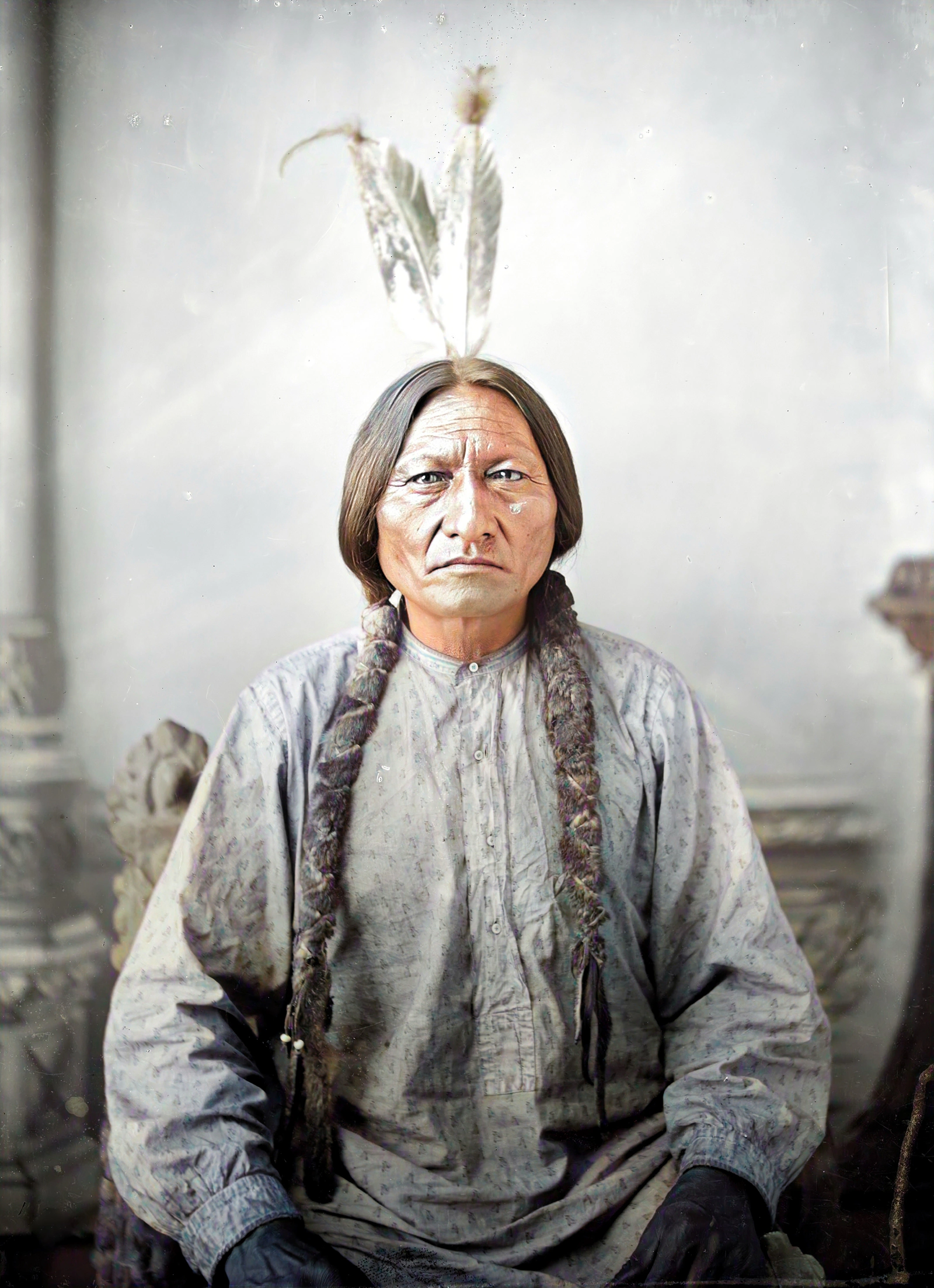
Attr: David F. Barry
| 34 Quotes | |
| Born as | Tȟatȟáŋka Íyotake |
| Known as | Tatanka Iyotanka |
| Occup. | Statesman |
| From | USA |
| Born | July 2, 1831 Grand River, Dakota Territory |
| Died | December 15, 1890 Standing Rock Indian Reservation, South Dakota |
| Cause | Assassination |
| Aged | 59 years |
| Cite | |
Citation Formats
APA Style (7th ed.)
Sitting bull biography, facts and quotes. (2026, February 11). FixQuotes. https://fixquotes.com/authors/sitting-bull/
Chicago Style
"Sitting Bull biography, facts and quotes." FixQuotes. February 11, 2026. https://fixquotes.com/authors/sitting-bull/.
MLA Style (9th ed.)
"Sitting Bull biography, facts and quotes." FixQuotes, 11 Feb. 2026, https://fixquotes.com/authors/sitting-bull/. Accessed 27 Mar. 2026.
Early Life and Background
Sitting Bull (Lakota: Tatanka Iyotake) was born July 2, 1831, near the Grand River in what is now South Dakota, into the Hunkpapa Lakota, a people whose political life was organized less by centralized office than by earned authority - kinship, generosity, spiritual power, and courage. His father, also known as Jumping Badger, was a respected warrior; his mother is often identified in oral tradition as Her-Holy-Door (or similar renderings), though records vary, reflecting how outsiders flattened Lakota naming and family systems. The northern Plains were already an arena of pressure and opportunity: the fur trade, intertribal conflict, and the growing reach of U.S. forts and roads were reshaping what it meant to keep a people fed, mobile, and free.As a boy he gained notice early for daring in raids and hunts, a temperament that combined calculation with fearlessness. He earned the name "Sitting Bull" after a successful coup in his teens, and his public identity formed in the ceremonial life of the Lakota - councils, giveaways, and the spiritual responsibilities that bound leaders to the welfare of the camp. These were years when the buffalo economy still held, yet the horizon was changing; treaties and survey lines approached a world built on seasonal movement. Sitting Bull grew into adulthood with an acute sense that survival depended not only on war skill but on keeping the moral center of the Hunkpapa intact under accelerating outside intrusion.
Education and Formative Influences
His education was the education of a Plains statesman: oral history, counsel from elders, mastery of protocol in councils, and training in sacred obligations through ceremonies such as the Sun Dance, where endurance and vision were not private experiences but public commitments. He was shaped by the Lakota ethic that a leader must be both protector and provider, accountable to relatives, widows, and the poor, and by a spiritual worldview in which the land was not property but a living field of reciprocal duties. The era also taught him to read Americans as a political force - to weigh traders, soldiers, and agents not as a single "white" mind but as competing institutions whose promises could be tested against outcomes.Career, Major Works, and Turning Points
By the 1860s Sitting Bull had become a principal war leader of the Hunkpapa in resistance to U.S. military roads and forts on the northern Plains, including conflicts surrounding the Bozeman Trail and the chain of posts that followed. He rejected treaties that ceded hunting grounds and, after the 1868 Fort Laramie Treaty, remained among the leaders who insisted the Black Hills and the Powder River country were not negotiable. His greatest turning point came in 1876: after a Sun Dance vision interpreted as foretelling soldiers falling into the Lakota camp, he helped unify Lakota and Cheyenne forces that defeated George A. Custer at the Little Bighorn. The victory brought relentless retaliation; in 1877 he led followers into exile in Canada, attempting to preserve independence as hunger and political isolation tightened. In 1881 he surrendered at Fort Buford and endured years of confinement, later appearing briefly with Buffalo Bill's Wild West in 1885 - a controlled spectacle that monetized his fame while underscoring how thoroughly U.S. power now framed the terms of his visibility. The final turn was tragic: amid panic over the Ghost Dance movement, Indian agents and police moved to arrest him; he was killed on December 15, 1890, at Standing Rock during the struggle.Philosophy, Style, and Themes
Sitting Bull's public life reads as a sustained argument about obligation - to ancestors, to the buffalo, to the future - against a colonial order built on paperwork, fences, and coercion. He spoke with a moral literalness that treated treaties as vows rather than tactics, and he understood betrayal not as a misunderstanding but as a system. His critique was political and psychological: he saw in U.S. expansion a hunger that could not be sated by one more boundary line, and he resisted the pressure to turn his people into copies of their conquerors. “It is not necessary for eagles to be crows”. The sentence is compact, but it carries a whole theory of dignity - that adaptation need not mean self-erasure, and that identity is not a costume to be exchanged for rations.His inner life, as reconstructed from accounts of his speeches and choices, shows a leader wary of sentimentality and yet driven by tenderness for collective continuity. He was willing to suffer material loss to keep decision-making in Lakota hands, and he returned again and again to the question of what kind of life could still be built under occupation. “Let us put our minds together and see what life we can make for our children”. This is not defeatism; it is strategic intimacy, a plea to keep thinking as a people when institutions conspire to fragment them. Even his readiness for war was framed as civic defense rather than glory. “If we must die, we die defending our rights”. The tone is resigned but not fatalistic - it is a boundary statement, revealing a psychology that preferred clear costs to slow moral surrender.
Legacy and Influence
Sitting Bull endures as both symbol and study: a statesman without a state, whose authority rested on persuasion, sacrifice, and spiritual credibility rather than office. For Native nations he remains a touchstone of sovereignty and cultural self-respect, invoked in struggles over the Black Hills, treaty rights, religious freedom, and the meaning of land beyond commodity. For historians of the United States, his life exposes how expansion operated through broken agreements, managed dependency, and the violent policing of Indigenous autonomy - even as it produced icons it tried to domesticate. His legacy is not merely the drama of Little Bighorn, but the harder lesson of a leader who insisted that political survival begins with refusing to become what conquest demands.Our collection contains 34 quotes written by Sitting, under the main topics: Justice - Nature - Freedom - Learning - Parenting.
Source / external links