
Soichiro Honda Biography Quotes 6 Report mistakes
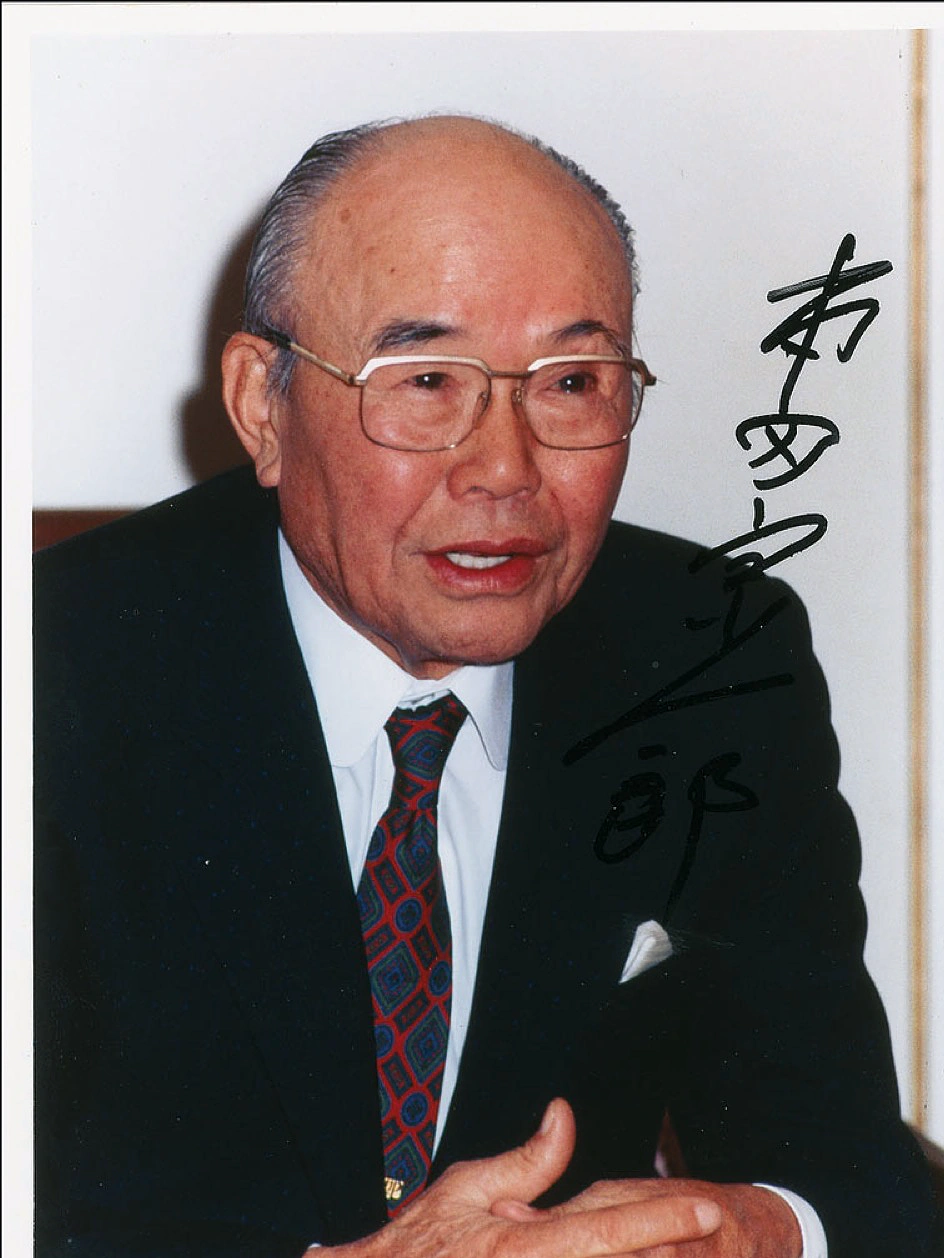
| 6 Quotes | |
| Occup. | Businessman |
| From | Japan |
| Born | November 17, 1906 Hamamatsu, Shizuoka, Japan |
| Died | August 5, 1991 Tokyo, Japan |
| Aged | 84 years |
| Cite | |
Citation Formats
APA Style (7th ed.)
Soichiro honda biography, facts and quotes. (2026, February 12). FixQuotes. https://fixquotes.com/authors/soichiro-honda/
Chicago Style
"Soichiro Honda biography, facts and quotes." FixQuotes. February 12, 2026. https://fixquotes.com/authors/soichiro-honda/.
MLA Style (9th ed.)
"Soichiro Honda biography, facts and quotes." FixQuotes, 12 Feb. 2026, https://fixquotes.com/authors/soichiro-honda/. Accessed 12 Feb. 2026.
Early Life and Background
Soichiro Honda was born on 1906-11-17 in the village of Komyo (now part of Hamamatsu), Shizuoka Prefecture, a region where craft, agriculture, and small workshops met the first vibrations of Japans motor age. His father, Gihei Honda, repaired bicycles and handled metalsmith work; his mother, Mika, was a weaver. The household economy depended on hand skills and improvisation, and the boy absorbed an ethic of making-do that later became a corporate habit: test, break, fix, repeat.Japans Taisho-then-early-Showa decades offered a harsh education in scarcity and ambition. Honda grew up as trains and trucks began to cut through rural life, and he was captivated by speed, noise, and the idea that machines could liberate ordinary people. He was not naturally suited to classroom discipline; his early reputation was more for curiosity and stubbornness than polish. That temperament, formed in a small shop where reputation traveled by word of mouth, became the basis for his later impatience with bureaucracy and his devotion to practical proof.
Education and Formative Influences
Honda left formal schooling early and moved to Tokyo as a teenager, apprenticing at Art Shokai, an auto repair garage that also built racing cars; there he learned precision, customer reality, and the pride culture of craftsmen who sign their work with performance. The 1923 Great Kanto Earthquake interrupted the citys rhythms and sharpened his sense that systems fail and must be rebuilt quickly. Returning to Hamamatsu, he opened a branch shop and began racing and inventing, discovering both the exhilaration of engineering and the discipline of measurement - the habit of treating failure as data rather than shame.Career, Major Works, and Turning Points
In the 1930s Honda pursued manufacturing through Tokai Seiki, producing piston rings for Toyota; repeated rejection forced him into study, tooling improvements, and relentless iteration before acceptance, a formative lesson in industrial standards. Wartime brought shortages and bombing; Tokai Seiki was damaged, then sold, and Honda used the proceeds to found the Honda Technical Research Institute in 1946, fitting surplus engines to bicycles for a nation desperate for transport. In 1948 he incorporated Honda Motor Co., and in 1949 released the Dream D-Type motorcycle, soon followed by mass-market models that aligned light weight, reliability, and affordability. Partnering with the astute Takeo Fujisawa, Honda scaled manufacturing, entered global racing, and pushed exports, culminating in the 1958 Super Cub and the decision to challenge foreign markets directly. The U.S. entry in 1959 and the 1963 launch of the T360 mini-truck and S500 sports car signaled a company that refused to remain a motorcycle specialist; later milestones included high-revving engines, an obsession with emissions solutions, and a culture that treated competition as laboratory. Honda stepped back from day-to-day management in the 1970s, but remained a guiding presence until his death on 1991-08-05.Philosophy, Style, and Themes
Honda lived as an engineer-entrepreneur whose inner life was propelled by wonder and intolerance for complacency. His origin story is not boardroom mythology but physical pursuit: "I could not understand how it could move under its own power. And when it had driven past me, without even thinking why I found myself chasing it down the road, as hard as I could run". That childlike chase never quite ended; even as a corporate leader he gravitated to workshops, test tracks, and races, places where a hypothesis meets friction. Psychologically, he sought the moment when curiosity becomes embodied - the instant a machine answers back.His leadership style fused rigorous experimentation with an unusually democratic respect for talent, even when it was personally abrasive. He warned against comfort hiring because it shrinks the ceiling: "If you hire only those people you understand, the company will never get people better than you are. Always remember that you often find outstanding people among those you don't particularly like". He also turned humiliation into a method, insisting that learning is proportional to the number of broken parts and rejected prototypes: "Success represents the 1% of your work which results from the 99% that is called failure". In that triad - wonder, talent without conformity, and failure as tuition - Hondas themes converge: technology as a moral practice, not just a product, and speed not as spectacle but as feedback.
Legacy and Influence
Soichiro Honda helped reframe postwar Japanese industry from imitation to confident invention, proving that a firm born from bicycle engines could compete through design discipline, manufacturing ingenuity, and a global sporting presence. Honda Motor Co. became a template for pairing engineering leadership with professional management, and for treating racing and emissions regulation alike as arenas for problem-solving. His personal legacy endures in a corporate culture that prizes genba reality, measurable learning, and the belief that mobility should be reliable, efficient, and emotionally stirring - a makers ideal scaled to millions of engines worldwide.Our collection contains 6 quotes written by Soichiro, under the main topics: Meaning of Life - Failure - Success - Technology - Team Building.