
Søren Kierkegaard Biography Quotes 48 Report mistakes
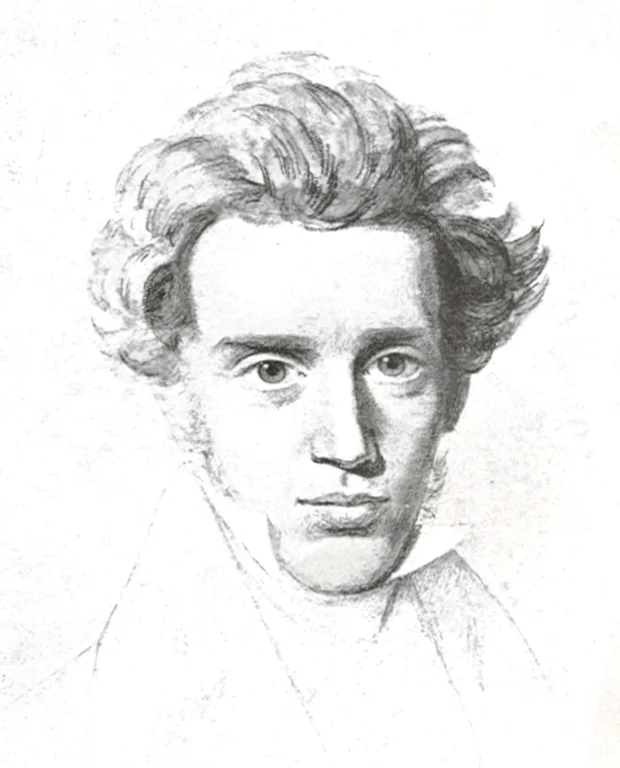
| 48 Quotes | |
| Born as | Søren Aabye Kierkegaard |
| Occup. | Philosopher |
| From | Denmark |
| Born | May 5, 1813 Copenhagen, Denmark |
| Died | November 11, 1855 Copenhagen, Denmark |
| Aged | 42 years |
| Cite | |
Citation Formats
APA Style (7th ed.)
Søren kierkegaard biography, facts and quotes. (2026, February 7). FixQuotes. https://fixquotes.com/authors/soren-kierkegaard/
Chicago Style
"Søren Kierkegaard biography, facts and quotes." FixQuotes. February 7, 2026. https://fixquotes.com/authors/soren-kierkegaard/.
MLA Style (9th ed.)
"Søren Kierkegaard biography, facts and quotes." FixQuotes, 7 Feb. 2026, https://fixquotes.com/authors/soren-kierkegaard/. Accessed 2 Apr. 2026.
Early Life and Background
Soren Aabye Kierkegaard was born on 1813-05-05 in Copenhagen, Denmark, a city reshaped by the Napoleonic aftermath, British bombardment, and a precarious Danish state. He grew up in a household where private anguish met stern piety. His father, Michael Pedersen Kierkegaard, a self-made former shepherd turned prosperous hosiery merchant, carried a heavy, almost Old Testament sense of guilt and providence that he transmitted to his youngest son as both psychological inheritance and spiritual weather. Soren would later anatomize how inner dread can be more decisive than public circumstance, but the first laboratory was the family home.Family life was marked by loss and foreboding: several of Kierkegaard's siblings died young, and he was raised with the expectation that he too might die early. The result was a temperament simultaneously theatrical and exacting - an acute observer of mood, conscience, and self-deception, but also a satirist of Copenhagen respectability. The citys salons, churches, and promenades became his field sites, and his own isolation - partly chosen, partly endured - trained him to hear the tremors beneath everyday conversation.
Education and Formative Influences
Kierkegaard entered the University of Copenhagen in 1830, studying theology while ranging widely through philosophy and literature; he absorbed Socratic irony, Lutheran devotional tradition, and the rising prestige of German idealism, especially Hegel, whose system promised to reconcile history, faith, and reason. Yet Kierkegaard learned as much from collisions as from doctrines: the tension between his fathers severe Christianity and his own aesthetic wit, the citys polite religiosity against the New Testaments demand, and the romantic era's cult of feeling against the discipline of inward choice. He finished his theological studies, but his education was ultimately an apprenticeship in how a person becomes a self under pressure from family, church, and public opinion.Career, Major Works, and Turning Points
A decisive turning point came with his courtship and abrupt breaking of his engagement to Regine Olsen (1841), an act he treated as both personal necessity and spiritual experiment, and which haunted his authorship as a case study in sacrifice, secrecy, and the ethics of intimacy. After taking his magister degree with The Concept of Irony (1841), he published at an astonishing pace: Either/Or (1843), Fear and Trembling (1843), Repetition (1843), Philosophical Fragments (1844), The Concept of Anxiety (1844), Stages on Lifes Way (1845), Concluding Unscientific Postscript (1846), and, later, the explicitly Christian Works of Love (1847) and The Sickness Unto Death (1849). Much of this appeared under carefully chosen pseudonyms to dramatize competing ways of living rather than to deliver a single doctrinal voice. In the mid-1840s he was bruised by public ridicule in the satirical paper The Corsair, an episode that sharpened his contempt for crowd-psychology. In his final years he launched a relentless attack on Denmarks state church and its comfortable bishops, insisting that official Christianity had become a cultural habit rather than a costly discipleship; he collapsed in 1855 and died on 1855-11-11 in Copenhagen.Philosophy, Style, and Themes
Kierkegaards core project was to rescue existence from abstraction. Against systems that explain everything, he asked what it means for a single individual to choose, suffer, and stand before God. He wrote in multiple voices - seducer, judge, humorist, pastor, philosopher - not as a trick but as a method: indirect communication that forces the reader to locate themselves. His themes orbit decision, inwardness, and the painful dignity of responsibility. “Anxiety is the dizziness of freedom”. Anxiety, for him, is not mere pathology but the vertigo that accompanies possibility, the moment when the self realizes it must become itself through commitment.That is why he treats courage and selfhood as existential tasks rather than inherited facts. “To dare is to lose one's footing momentarily. Not to dare is to lose oneself”. The line captures his psychology: he feared that a life without risk is not safe but annihilating, a slow disappearance into convention. Even love, in his mature Christian writings, becomes less a mood than a transformation of the lover: “Love does not alter the beloved, it alters itself”. His style mirrors these convictions - aphoristic, dramatic, sometimes mercilessly comic - because he wanted to unsettle readers out of passive agreement. Paradox is not decoration but the shape of a faith that cannot be reduced to civic morality or philosophical proofs.
Legacy and Influence
Kierkegaard died largely as a contentious Copenhagen writer, yet his posthumous reach became global: he helped found existentialism, reshaped Protestant theology, and influenced thinkers as different as Karl Barth, Martin Heidegger, Jean-Paul Sartre, Simone de Beauvoir, and later psychologists of anxiety and selfhood. His insistence on the "single individual" anticipated modern debates about authenticity, media-driven conformity, and the ethics of personal commitment. More than a builder of concepts, he remains a diagnostician of inner life - a writer who made philosophy answerable to choice, guilt, love, and the trembling freedom of becoming a self.Our collection contains 48 quotes written by Søren, under the main topics: Witty One-Liners - Truth - Wisdom - Love - Mortality.
Søren Kierkegaard Famous Works
- 1849 The Sickness Unto Death (Book)
- 1846 Concluding Unscientific Postscript to Philosophical Fragments (Book)
- 1844 The Concept of Anxiety (Book)
- 1843 Fear and Trembling (Book)
- 1843 Either/Or (Book)
Source / external links