
Spiro T. Agnew Biography Quotes 13 Report mistakes
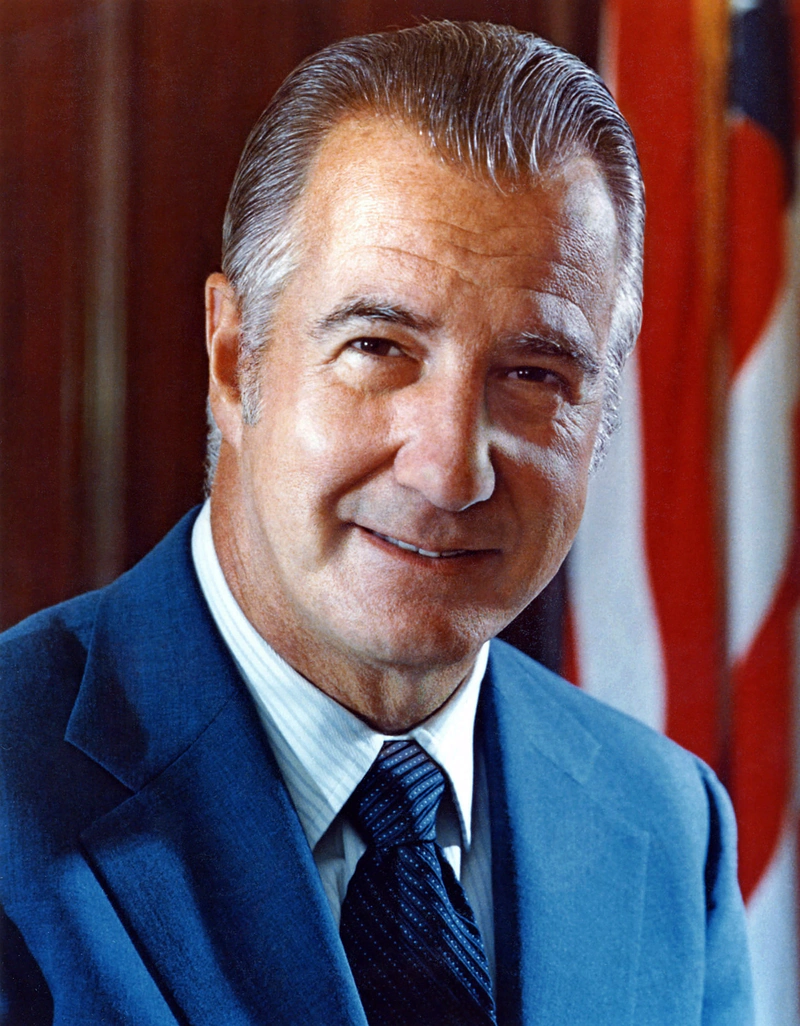
| 13 Quotes | |
| Born as | Spiro Theodore Agnew |
| Known as | Spiro Agnew |
| Occup. | Politician |
| From | USA |
| Born | November 9, 1918 Baltimore, Maryland, United States |
| Died | September 17, 1996 Berlin, Maryland, United States |
| Aged | 77 years |
| Cite | |
Citation Formats
APA Style (7th ed.)
Spiro t. agnew biography, facts and quotes. (2026, February 11). FixQuotes. https://fixquotes.com/authors/spiro-t-agnew/
Chicago Style
"Spiro T. Agnew biography, facts and quotes." FixQuotes. February 11, 2026. https://fixquotes.com/authors/spiro-t-agnew/.
MLA Style (9th ed.)
"Spiro T. Agnew biography, facts and quotes." FixQuotes, 11 Feb. 2026, https://fixquotes.com/authors/spiro-t-agnew/. Accessed 5 Mar. 2026.
Early Life and Background
Spiro Theodore Agnew was born Spiro Theodore Anagnostopoulos on November 9, 1918, in Baltimore, Maryland, the only child of Theodore Agnew, a Greek immigrant who had anglicized the family name, and Margaret Marian Akers, of Virginia Episcopalian stock. The hyphenated identity he inherited - immigrant ambition on one side, established American respectability on the other - became a private engine: he wanted to be accepted as thoroughly American without surrendering the hard-edged striving that had brought his father from Greece to a small restaurant and later a modest business life in Baltimore.Baltimore in the interwar years was a city of machine politics, ethnic neighborhoods, and sharp lines of class and race. Agnew grew up observing how institutions conferred belonging and how quickly they could withdraw it. That sensitivity to status - to who got listened to and who got dismissed - later surfaced as both fuel and vulnerability. He could sound like an outsider attacking elites, yet he also craved the insider's seal of legitimacy, a tension that shaped his rise and, eventually, his fall.
Education and Formative Influences
Agnew attended public schools and then Johns Hopkins University, graduating in 1940, before moving to the University of Baltimore School of Law. His studies were interrupted by World War II; he served in the U.S. Army, including in Europe, and returned with the veteran's belief in order, hierarchy, and earned advancement. In 1942 he married Elinor Judefind, a steadying presence throughout his political ascent. After the war he completed his law degree and entered legal practice in Baltimore County, where courthouse routines and suburban growth politics taught him that government was less theory than leverage - zoning, contracts, patronage, and the language of respectability that made power seem natural.Career, Major Works, and Turning Points
Agnew entered politics as a Baltimore County official, winning election as county executive in 1962 and cultivating an image of managerial competence. He rose to national notice as Republican governor of Maryland (1967-1969) when he forcefully criticized Black leaders after the 1968 Baltimore riots, positioning himself as a law-and-order modernizer in an era of urban unrest and cultural fracture. Richard Nixon chose him as a running mate in 1968 partly for geographic balance and partly because Agnew could articulate the administration's cultural counterattack with a bluntness Nixon preferred not to display himself. As vice president (1969-1973), Agnew became the spear tip of White House rhetoric against antiwar protest, liberal media, and perceived establishment condescension. The turning point came in 1973, when a federal investigation into corruption in Baltimore County and Maryland politics culminated in Agnew pleading no contest to tax evasion, resigning the vice presidency on October 10, 1973, and leaving office disgraced in a moment when public trust was already collapsing under Watergate.Philosophy, Style, and Themes
Agnew's public philosophy was less a coherent ideology than an emotional map of late-1960s America: a majoritarian plea for stability, deference, and national cohesion against what he portrayed as cultural sabotage from radicals and gatekeepers. He spoke for the "silent majority" not by offering programs so much as by validating resentment - the feeling that rules still applied to ordinary citizens while elites rewrote them for themselves. His most famous lines were crafted with speechwriter William Safire and delivered with a prosecutor's relish, turning politics into a morality play where order and legitimacy faced constant insult from the loud and the fashionable.That rhetorical aggressiveness revealed his psychology: a man who feared being patronized and therefore struck first. When he mocked critics as “the nattering nabobs of negativism”. , he was not only attacking journalists and liberals; he was asserting that disdain itself was a form of power to be resisted. His suspicion of credentialed authority surfaced in quips like “An intellectual is a man who doesn't know how to park a bike”. , a joke that flattened expertise into impractical vanity and invited listeners to trust instinct over analysis. Yet Agnew also voiced an anxious insight about modern media: “The American people should be made aware of the trend toward monopolization of the great public information vehicles and the concentration of more and more power over public opinion in fewer and fewer hands”. In that sentence, the combative vice president briefly became a diagnostician of informational power - even as he used that diagnosis to delegitimize adversarial coverage and rally his side.
Legacy and Influence
Agnew's legacy is inseparable from the paradox of his era: he helped pioneer the politics of cultural polarization and media confrontation, then became a cautionary tale about personal corruption and institutional fragility. His resignation, the first by a U.S. vice president under the pressure of criminal proceedings, hardened public cynicism and reshaped the standards of vetting and accountability for national tickets. Rhetorically, he left an enduring template for politicians who portray the press as an unelected opposition and who convert social unease into a story of besieged normalcy. Even in disgrace, Agnew marked a turning in American political language toward sharper contempt and more theatrical division - an influence that outlasted his career and, in many ways, eclipsed it.Our collection contains 13 quotes written by Spiro, under the main topics: Witty One-Liners - Justice - Sarcastic - Freedom - Sports.
Other people related to Spiro: William Safire (Author), Edmund S. Muskie (Politician)
Frequently Asked Questions
- What happened to Spiro Agnew: He became the 39th vice president of the United States but resigned in 1973 amid a corruption investigation and a no-contest plea to tax evasion.
- Spiro Agnew children: He and his wife, Elinor Agnew, had four children: Pamela, James, Susan, and Kimberly.
- Spiro T Agnew resignation: He resigned as vice president of the United States on October 10, 1973, after facing federal investigation and pleading no contest to a tax evasion charge.
- Spiro Agnew cause of death: He died of leukemia on September 17, 1996.
- How old was Spiro T. Agnew? He became 77 years old
Source / external links