
Stephen Hawking Biography Quotes 18 Report mistakes
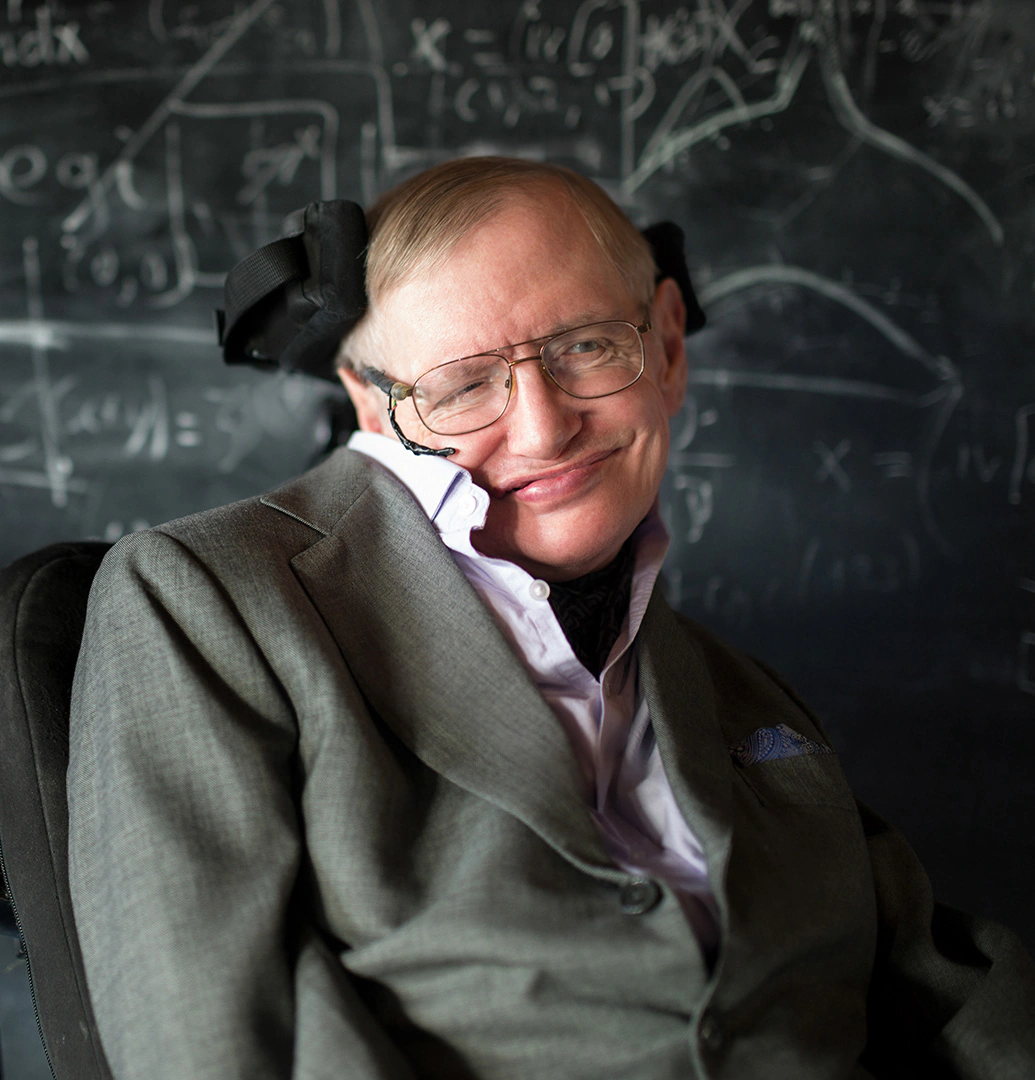
| 18 Quotes | |
| Born as | Stephen William Hawking |
| Occup. | Physicist |
| From | United Kingdom |
| Spouse | Jane Wilde (1965–1995) Elaine Mason (1995–2006) |
| Born | January 8, 1942 Oxford, England |
| Died | March 14, 2018 Cambridge, England |
| Cause | Amyotrophic lateral sclerosis |
| Aged | 76 years |
| Cite | |
Citation Formats
APA Style (7th ed.)
Stephen hawking biography, facts and quotes. (2026, February 11). FixQuotes. https://fixquotes.com/authors/stephen-hawking/
Chicago Style
"Stephen Hawking biography, facts and quotes." FixQuotes. February 11, 2026. https://fixquotes.com/authors/stephen-hawking/.
MLA Style (9th ed.)
"Stephen Hawking biography, facts and quotes." FixQuotes, 11 Feb. 2026, https://fixquotes.com/authors/stephen-hawking/. Accessed 24 Mar. 2026.
Early Life and Background
Stephen William Hawking was born on January 8, 1942, in Oxford, England, into a family of bookish pragmatists shaped by war and austerity. His father, Frank Hawking, was a tropical disease researcher; his mother, Isobel, had studied at Oxford and cultivated a household where ideas mattered more than comforts. Britain was still rationed, its empire thinning, its universities retooling for a new age of science. Hawking grew up with the sense that intellect was a route out of limits - social, physical, even cosmic.Raised largely in St Albans, he was known as "Einstein" at school more as a tease than a compliment, because his brilliance hid behind a messy, contrarian style. He built model trains and makeshift computers with friends, but he also learned early that being underestimated can be useful: it forced him to rely on clarity of thought and stubborn persistence rather than polish. That temperament - humorous, competitive, resistant to authority - would later help him live inside a body that increasingly refused him, without surrendering the ambition to outthink the universe.
Education and Formative Influences
At University College, Oxford (entered 1959), Hawking read physics, often coasting on raw ability until competition woke him up; he graduated with a first and moved to Cambridge for graduate work in cosmology under Dennis Sciama, a catalyst who urged him toward the frontier where general relativity met astrophysics. Around 1963, during the period when he was also finding his adult identity, he was diagnosed with motor neurone disease (ALS) and given a short life expectancy - a prognosis that compressed his time horizon and sharpened his taste for foundational questions, even as it demanded new disciplines of patience, planning, and collaboration.Career, Major Works, and Turning Points
Hawking joined the Cambridge Department of Applied Mathematics and Theoretical Physics and became, by the early 1970s, a central figure in the revival of relativistic cosmology. With Roger Penrose he developed singularity theorems showing that, under general conditions, the universe (and black holes) imply spacetime singularities - results that made the Big Bang less a philosophical option than a mathematical consequence. In 1974 he delivered the shock: black holes are not perfectly black but emit thermal radiation due to quantum effects near the event horizon - Hawking radiation - linking gravity, quantum theory, and thermodynamics, and inaugurating the modern "information loss" debate. As his speech deteriorated and a 1985 tracheotomy removed his natural voice, he adopted a speech synthesizer and turned constraint into reach, publishing A Brief History of Time (1988) with an editor's eye for the public imagination, later expanding his ideas in works such as Black Holes and Baby Universes and Other Essays (1993), The Universe in a Nutshell (2001), and (with Leonard Mlodinow) The Grand Design (2010), while holding the Lucasian Professorship at Cambridge from 1979 to 2009.Philosophy, Style, and Themes
Hawking's inner life fused audacity with a dry, self-protecting wit: he could be playful about fame, yet ruthless about ideas. He treated physics as a moral discipline - a way of being honest in the face of mystery - and his style favored minimal assumptions, hard calculation, and the willingness to let equations offend common sense. “One cannot really argue with a mathematical theorem”. In that sentence is his psychological refuge: when the body and the world are unstable, proof is a place to stand. His willingness to pursue consequences - singularities, horizons, quantum creation - even when they were culturally unsettling, made him both a scientific celebrity and a target in metaphysical debates.At the same time, he refused the romance of human centrality while defending the dignity of understanding. "We are just an advanced breed of monkeys on a minor planet of a very average star. But we can understand the Universe. That makes us something very special" [QuoteID=
Our collection contains 18 quotes written by Stephen, under the main topics: Witty One-Liners - Wisdom - Deep - Meaning of Life - Reason & Logic.
Other people related to Stephen: John D. Barrow (Scientist)
Stephen Hawking Famous Works
- 2013 My Brief History (Memoir)
- 2010 The Grand Design (Book)
- 2007 George's Secret Key to the Universe (Novel)
- 2005 God Created the Integers: The Mathematical Breakthroughs That Changed History (Book)
- 2002 On the Shoulders of Giants (Book)
- 2001 The Universe in a Nutshell (Book)
- 1993 Black Holes and Baby Universes and Other Essays (Book)
- 1988 A Brief History of Time (Book)
Source / external links