
Steve Nash Biography Quotes 21 Report mistakes
| 21 Quotes | |
| Occup. | Athlete |
| From | Canada |
| Born | February 7, 1974 |
| Age | 52 years |
| Cite | |
Citation Formats
APA Style (7th ed.)
Steve nash biography, facts and quotes. (2026, February 11). FixQuotes. https://fixquotes.com/authors/steve-nash/
Chicago Style
"Steve Nash biography, facts and quotes." FixQuotes. February 11, 2026. https://fixquotes.com/authors/steve-nash/.
MLA Style (9th ed.)
"Steve Nash biography, facts and quotes." FixQuotes, 11 Feb. 2026, https://fixquotes.com/authors/steve-nash/. Accessed 27 Mar. 2026.
Early Life and Background
Steve Nash was born on February 7, 1974, in Johannesburg, South Africa, to Welsh parents, John and Jean Nash, at a moment when the country was still defined by apartheid and its strict racial ordering. His father was a professional soccer player and later a coach, and sport arrived in Nash's life not as spectacle but as family tradecraft - a daily language of movement, touch, and space. When Nash was still young, the family left South Africa and eventually settled in Canada, where the cultural weather was different: less mythic about basketball, more open to kids sampling multiple games without immediately being sorted into "types".He grew up in British Columbia, in and around Victoria, in a household that valued curiosity as much as competition. Nash played soccer, hockey, and basketball, and he absorbed the Canadian pragmatism of showing up, practicing, and not assuming the world would notice. That mix - immigrant mobility, a coach-father's precision, and the outsider's calm - formed a temperament that later read on court as unhurried control: an athlete comfortable being underestimated because he had learned early that identity could be rewritten by craft.
Education and Formative Influences
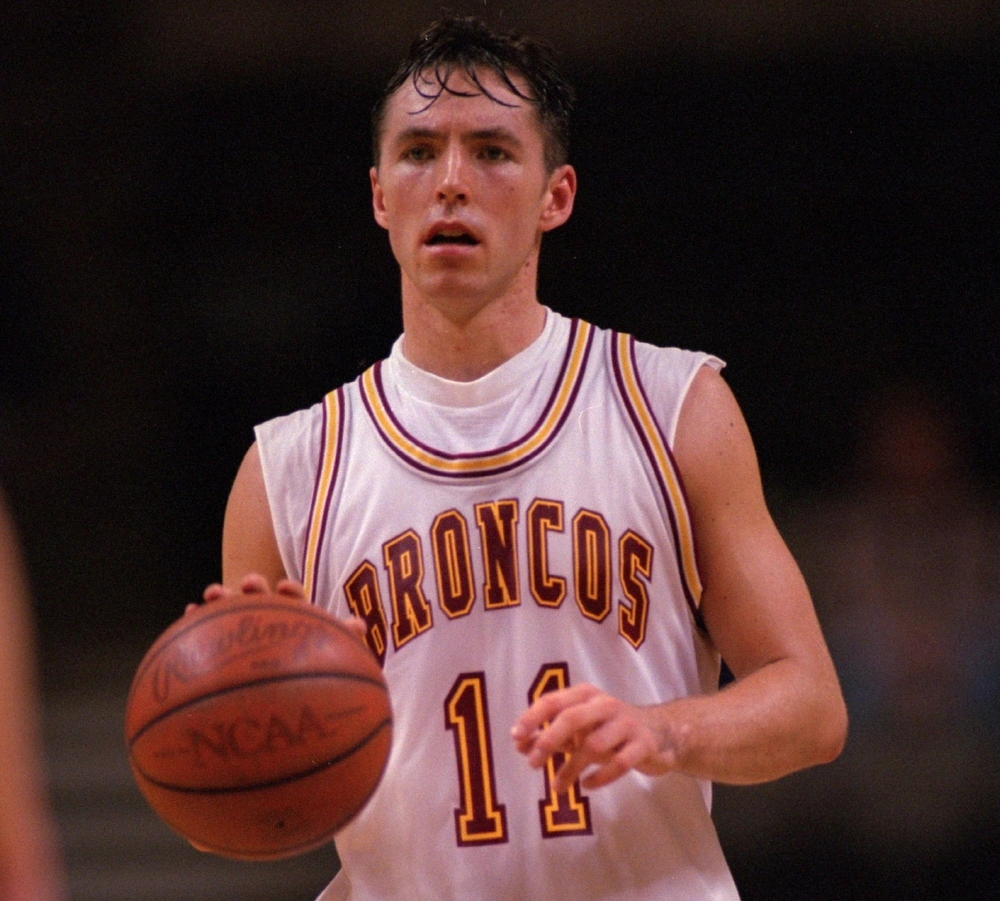
Nash attended St. Michaels University School in Victoria, where his flair for improvisation in soccer and his feel for angles in basketball began to converge into a single intelligence: manipulating defenders with pace changes and deception. Recruited lightly by major U.S. programs, he chose Santa Clara University and played for Dick Davey, becoming a two-time West Coast Conference Player of the Year and leading the Broncos to NCAA tournament upsets that made his name as a point guard who could both orchestrate and score. In the 1990s, when the NBA increasingly prized size and isolation scoring, Nash was quietly building a different ideal - one grounded in passing geometry, conditioning, and the belief that a team could be made smarter, not just stronger.Career, Major Works, and Turning Points
Selected 15th overall in the 1996 NBA Draft by the Phoenix Suns, Nash spent two developmental seasons learning the league's speed and physicality before being traded to the Dallas Mavericks in 1998, where alongside Dirk Nowitzki and Michael Finley he helped pioneer a high-octane, spacing-driven attack under Don Nelson. After returning to Phoenix in 2004, he became the engine of Mike D'Antoni's "Seven Seconds or Less" Suns, winning back-to-back NBA MVP awards (2005, 2006) and turning the pick-and-roll into a nightly referendum on defensive discipline. Though a championship eluded him - with near-misses in the Western Conference and a body that absorbed escalating wear - his late-career stints with the Los Angeles Lakers were followed by a second act in leadership: he served as a player development consultant with Golden State and became head coach of the Brooklyn Nets in 2020, steering superstar egos through injuries and volatility until his dismissal in 2022.Philosophy, Style, and Themes
Nash's basketball was built on contradiction: he played with a sprinter's conditioning but a chess player's patience, turning chaos into order by inviting defenders to commit and then punishing the commitment. His signature was not simply the assist totals, but the way he created assists - dribbling deep under the rim, pivoting along the baseline, "snaking" a screen, or slipping a bounce pass into a seam that existed for half a second. He treated spacing as moral clarity: the court should be honest, open, and legible, so decisions could be made at full speed. That idea shaped the modern NBA's spread pick-and-roll orthodoxy, and he articulated it in plain terms: “Our centers spread the floor, shoot the three and block shots. We can play pick and pop”. It was not theory for theory's sake; it was the practical architecture of freedom.Psychologically, Nash combined a long memory for detail with a short memory for outcomes, a trait that protected him from both praise and failure. “What happened in the past is just that, the past. Champion or not”. That sentence reads like self-defense forged from years of being judged by body type, by draft slot, by the brutal scoreboard of rings culture. Underneath the calm was a stubborn autonomy: “People have always doubted whether I was good enough to play this game at this level. I thought I was, and I thought I could be. What other people thought was really always irrelevant to me”. The result was a style that looked generous - ball movement, shared credit - yet was powered by a private insistence that craft could outrun skepticism.
Legacy and Influence
Nash stands as one of the defining point guards of the post-1990s era: an MVP-level playmaker who helped normalize pace, space, and the three-point shot as not just options but organizing principles. In Canada, he became a catalytic figure - a proof of concept that elite basketball could be made there - and his national-team commitment and later work with Basketball Canada strengthened the sport's infrastructure and imagination. In the NBA, his influence is visible in the league-wide premium on pick-and-roll reading, early offense, and big men who screen, pass, and shoot; whole systems now assume the geometry Nash once had to argue for. His enduring image is not a trophy but a method: a model of leadership that persuades by clarity, conditioning, and the quiet confidence of someone who never needed the world to agree in order to be right.Our collection contains 21 quotes written by Steve, under the main topics: Friendship - Victory - Life - Sports - Overcoming Obstacles.
Other people related to Steve: Grant Hill (Athlete)
Source / external links