
Sundar Pichai Biography Quotes 5 Report mistakes
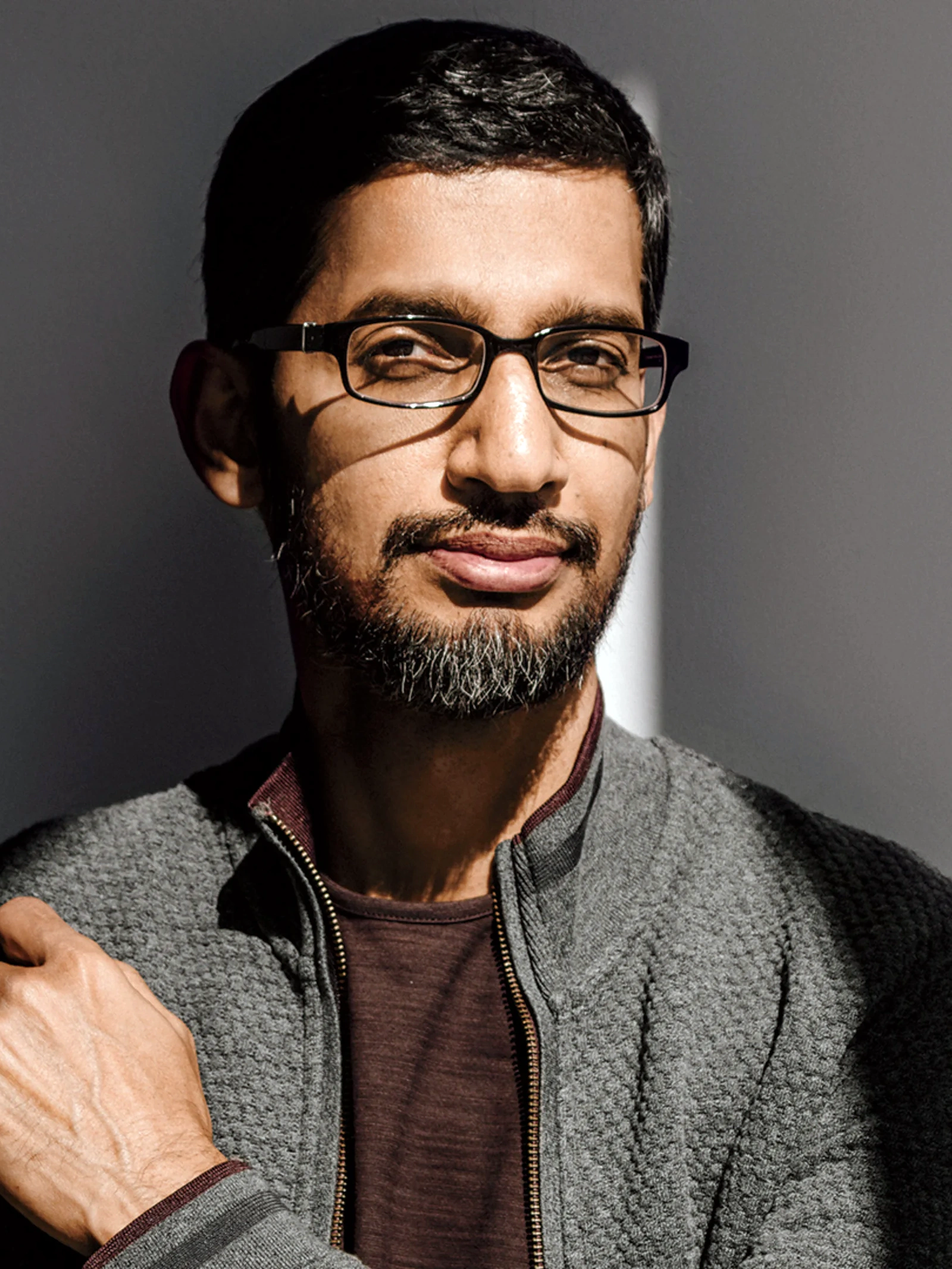
Attr: Fast Company
| 5 Quotes | |
| Born as | Pichai Sundararajan |
| Occup. | Entrepreneur |
| From | India |
| Spouse | Anjali Pichai |
| Born | June 10, 1972 Madurai, Tamil Nadu, India |
| Age | 53 years |
| Cite | |
Citation Formats
APA Style (7th ed.)
Sundar pichai biography, facts and quotes. (2026, April 3). FixQuotes. https://fixquotes.com/authors/sundar-pichai/
Chicago Style
"Sundar Pichai biography, facts and quotes." FixQuotes. April 3, 2026. https://fixquotes.com/authors/sundar-pichai/.
MLA Style (9th ed.)
"Sundar Pichai biography, facts and quotes." FixQuotes, 3 Apr. 2026, https://fixquotes.com/authors/sundar-pichai/. Accessed 3 Apr. 2026.
Early Life and Background
Sundar Pichai was born Pichai Sundararajan on June 10, 1972, in Madurai, Tamil Nadu, and grew up largely in Chennai, then Madras, in a middle-class household shaped by aspiration, scarcity, and technical curiosity. His father, Regunatha Pichai, worked as an electrical engineer and managed a factory that made electrical components; his mother, Lakshmi, had trained as a stenographer before devoting herself to the family. The home was modest - by Pichai's own recollections the family did not own a telephone or a car for much of his childhood - yet it was intellectually alive. Engineering drawings, factory stories, and practical discussions of materials and systems made technology feel not abstract but intimate, a force that altered ordinary lives.That background mattered because Pichai's later public style - calm, empirical, low-ego, and quietly ambitious - was forged less in elite display than in disciplined observation. Friends and teachers remembered an exceptional memory, especially for numbers, and a reserve that was not passivity but concentration. The India of his youth was still heavily regulated, economically constrained, and only beginning to imagine the liberalization that would transform its professional classes in the 1990s. For a gifted student from Chennai, education was both ladder and passport. Pichai absorbed that ethic deeply: advancement came through mastery, not theatrics, and the point of technical skill was usefulness at scale.
Education and Formative Influences
He attended Jawahar Vidyalaya and later Vana Vani School on the campus of the Indian Institute of Technology Madras, an environment that normalized scientific ambition. He then entered IIT Kharagpur, where he studied metallurgical engineering and graduated near the top of his class. Professors saw a student with unusual analytic breadth, equally drawn to the properties of materials and the larger systems in which technology circulated. A scholarship took him to Stanford University for an M.S. in materials science and engineering, a move that placed him at the heart of Silicon Valley during the long afterglow of the early internet boom. He later earned an MBA from the Wharton School of the University of Pennsylvania, where he was named a Siebel Scholar and a Palmer Scholar. Between those institutions he acquired a rare triangulation: rigorous engineering training, exposure to frontier innovation, and formal business education. Early work at Applied Materials and then at McKinsey reinforced the habit that would define him as an executive - understanding products not only as technical artifacts but as platforms shaped by cost, adoption, user behavior, and timing.Career, Major Works, and Turning Points
Pichai joined Google in 2004, when the company was still defining itself beyond search. He first worked on the Google Toolbar, a seemingly modest product that helped users access Google through Microsoft's Internet Explorer and revealed to him the strategic vulnerability of relying on other companies' browsers. That insight fed one of the decisive bets of his career: Chrome. Launched in 2008, Google Chrome combined speed, simplicity, and security in a way that reshaped web use and eventually became the world's dominant browser. Pichai then oversaw Chrome OS, Google Drive, Gmail, Maps, and later Android, unifying much of Google's consumer product ecosystem under one disciplined product philosophy. In 2015, when Google reorganized under the Alphabet holding structure, Larry Page named him CEO of Google; in 2019 he also became CEO of Alphabet. His ascent was notable not for founder mythology but for institutional trust: he became the executive who could manage immense scale, internal complexity, regulatory pressure, and epochal platform shifts - especially mobile computing and artificial intelligence - without losing sight of user adoption.Philosophy, Style, and Themes
Pichai's worldview has been consistently technological but not triumphalist. He tends to speak of computing as an enabling layer, not a theater for personal charisma. That helps explain both his managerial style and his public rhetoric: he projects steadiness in moments when Silicon Valley often rewards spectacle. His core belief is that the most important technologies should become ordinary in the best sense - widely accessible, quietly reliable, and globally distributed. This outlook reflects the distance he traveled from a childhood without routine access to modern consumer conveniences to the leadership of a company whose products reach billions. The through line is democratization: reducing friction so that capability spreads beyond elites.His language around AI reveals both ambition and moral framing. “We're still in the early days, yet I already believe AI will be the most profound shift of our lifetimes”. That sentence captures his instinct for historical scale while also acknowledging uncertainty. He balances that horizon view with a socially expansive ideal: “In all we do, Google will continue to strive to make sure that remains true, to build technology for everyone”. And when he argues, “Ultimately, where I see the technology will have the most application, no different from what the internet did, is to be a deep collaborator to help people reach their full potential, whatever line of work they do”. , he reveals the psychology beneath the executive message - a belief that tools matter most when they augment human capacity rather than merely automate tasks. In that sense Pichai's signature theme is not disruption for its own sake but scaled empowerment, governed by patience, broad access, and institutional responsibility.
Legacy and Influence
Sundar Pichai's legacy is still unfolding, but several contours are already clear. He stands as one of the most consequential Indian-born executives in global corporate history and as a central steward of the internet's transition from desktop search to mobile ecosystems and now to AI-mediated computing. His influence is visible in Chrome's dominance, Android's planetary reach, and Google's evolution from a search company into a layered infrastructure of everyday digital life. Just as important, he helped define a model of twenty-first-century leadership that is less founder-centric and more systems-oriented: operationally fluent, globally literate, and attuned to the politics of scale. Admirers see in him a disciplined technologist committed to access; critics see the dilemmas of concentrated platform power embodied in his office. Both judgments testify to his significance. He did not merely rise within Silicon Valley's institutions - he became one of the figures through whom their ambitions, contradictions, and future are now understood.Our collection contains 5 quotes written by Sundar.
Source / external links