
T. S. Eliot Biography Quotes 56 Report mistakes
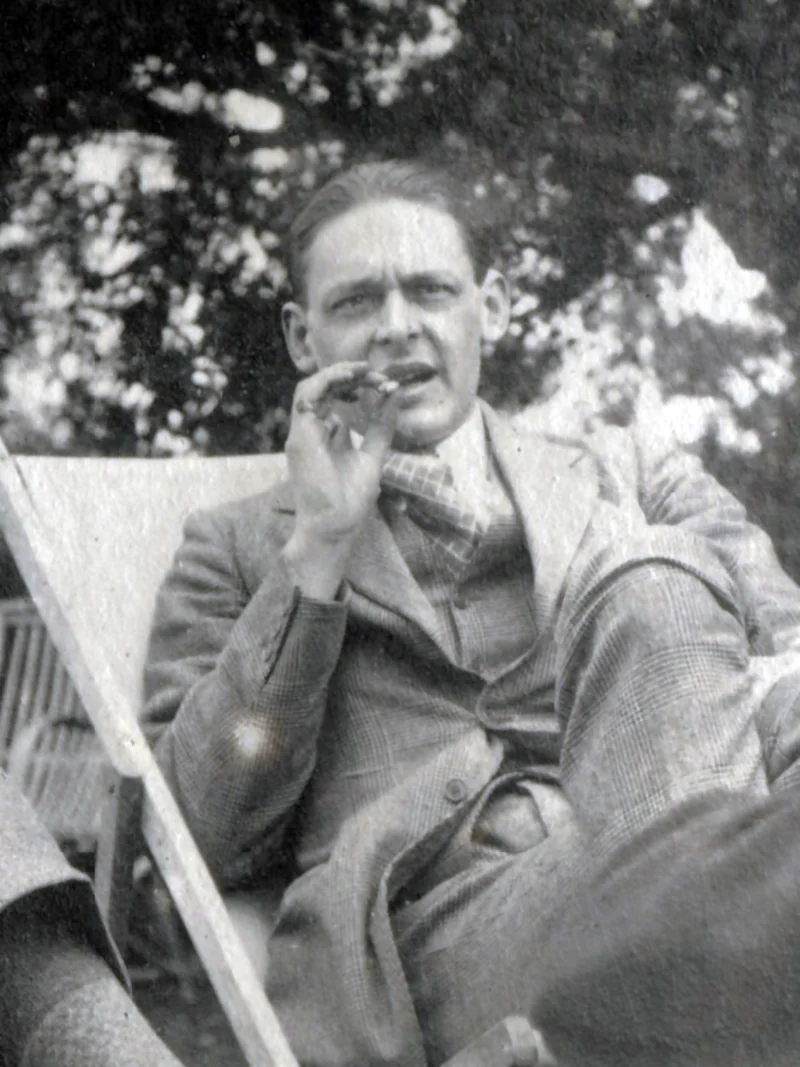
Attr: Lady Ottoline Morrell
| 56 Quotes | |
| Born as | Thomas Stearns Eliot |
| Occup. | Poet |
| From | USA |
| Born | September 26, 1888 St. Louis, Missouri, USA |
| Died | January 4, 1965 London, England, UK |
| Aged | 76 years |
| Cite | |
Citation Formats
APA Style (7th ed.)
T. s. eliot biography, facts and quotes. (2026, February 2). FixQuotes. https://fixquotes.com/authors/t-s-eliot/
Chicago Style
"T. S. Eliot biography, facts and quotes." FixQuotes. February 2, 2026. https://fixquotes.com/authors/t-s-eliot/.
MLA Style (9th ed.)
"T. S. Eliot biography, facts and quotes." FixQuotes, 2 Feb. 2026, https://fixquotes.com/authors/t-s-eliot/. Accessed 31 Mar. 2026.
Early Life and Background
Thomas Stearns Eliot was born on September 26, 1888, in St. Louis, Missouri, into a prominent Unitarian family whose civic and intellectual commitments were part of the citys Protestant elite. His father, Henry Ware Eliot, was a successful businessman, and his mother, Charlotte Champe Stearns, wrote poetry and was active in reform causes. In a household that prized duty, restraint, and public service, Eliot absorbed an early sense that private emotion should be disciplined into form - a tension that later powered his art.Childhood illness and physical timidity sharpened his inwardness. He read voraciously, listened for cadence and diction, and developed the habit of turning feeling into observation. St. Louis also gave him a lifelong double vision: the American Midwest as a place of practicality and moral confidence, and the older, more stratified worlds of Europe that he would later adopt as spiritual and aesthetic reference points.
Education and Formative Influences
Eliot attended Smith Academy in St. Louis and Milton Academy near Boston before entering Harvard in 1906, where he studied philosophy and literature and encountered the French Symbolists, Dante, and the metaphysical poets. A formative year in Paris (1910-1911) exposed him to modern urban life and to Henri Bergsons thought; graduate work at Harvard deepened his interest in F. H. Bradleys idealism. He later studied at Oxford, but the decisive formation was intellectual rather than institutional: Eliot learned to treat consciousness as layered, unstable, and historically saturated, and to make style carry the burden of thought.Career, Major Works, and Turning Points
In 1914 Eliot settled in London, met Ezra Pound, and rapidly became a central voice of literary modernism; Pound championed "The Love Song of J. Alfred Prufrock" (published 1915), whose anxious self-scrutiny announced a new poetic psychology. Eliot married Vivienne Haigh-Wood in 1915, a union that deteriorated into illness and estrangement, while he supported himself at Lloyds Bank. After editing The Egoist, he joined Faber and Gwyer (later Faber and Faber), becoming an influential editor and cultural arbiter. The postwar crisis and personal strain culminated in "The Waste Land" (1922), shaped by Pound and informed by Eliots 1921 breakdown; it made fragmentation, allusion, and cultural exhaustion into a public idiom. In 1927 he became a British subject and converted to Anglicanism, turning toward religious drama and meditative lyric: "Ash-Wednesday" (1930), "Murder in the Cathedral" (1935), and the culminating "Four Quartets" (1943). He received the Nobel Prize in Literature in 1948 and, after Viviennes death, remarried in 1957 to Valerie Fletcher, finding late-life steadiness until his death in London on January 4, 1965.Philosophy, Style, and Themes
Eliots work is often described as impersonal, yet it is driven by a very personal dread: the fear that inner life, left unshaped, dissolves into noise. His famous doctrine of the "objective correlative" was not a ban on emotion but a demand that feeling earn its form through precise images and rhythms. The modern city in his poems is not merely a setting; it is an epistemology - a way of knowing that breaks experience into glimpses, overheard speech, and sudden memories. Hence the diagnostic edge of his question, “Where is all the knowledge we lost with information?” It reads like cultural criticism, but it also reveals the poets own anxiety that consciousness can be flooded by data without becoming wise.Conversion did not end Eliots modernism; it redirected it toward time, repentance, and the possibility of renewal within limitation. “What we call the beginning is often the end. And to make an end is to make a beginning. The end is where we start from”. In the Quartets, this is not a neat paradox but a spiritual discipline: the self must be unmade to be remade, and history must be endured to be understood. Even his lyrical affirmations remain conditional and urgent, as in the line “You are the music while the music lasts”. That sentence holds Eliots central psychological insight: identity is not possession but participation, a temporary alignment of will, attention, and grace, always threatened by distraction, fatigue, and despair.
Legacy and Influence
Eliot reshaped 20th-century poetry in English: his montage technique, his fusion of colloquial speech with high allusion, and his insistence that the present converses with the dead became templates for generations. As an editor at Faber he helped publish and promote major writers, and as a critic he influenced debates about tradition, faith, and the function of art. His work also provoked lasting argument - about elitism, about his representations of gender and culture, and about the authority he came to embody. Yet the best measure of his endurance is that his poems still offer a language for modern disorientation and for the hard-won hope that form, memory, and belief can make a shattered world intelligible.Our collection contains 56 quotes written by S. Eliot, under the main topics: Motivational - Ethics & Morality - Truth - Wisdom - Art.
Other people related to S. Eliot: John Donne (Poet), Andrew Marvell (Writer), Leonard Woolf (Author), Gerard Manley Hopkins (Poet), James Laughlin (Poet), Josiah Royce (Philosopher), Conrad Aiken (Author), Giorgos Seferis (Poet), Michael Tippett (Composer), Paul Elmer More (Critic)
T. S. Eliot Famous Works
- 1949 The Cocktail Party (Play)
- 1948 Notes Towards the Definition of Culture (Essay)
- 1943 Four Quartets (Poetry)
- 1942 Little Gidding (Poetry)
- 1941 The Dry Salvages (Poetry)
- 1940 East Coker (Poetry)
- 1939 Old Possum's Book of Practical Cats (Poetry)
- 1936 Burnt Norton (Poetry)
- 1935 Murder in the Cathedral (Play)
- 1934 After Strange Gods (Essay)
- 1933 The Use of Poetry and the Use of Criticism (Essay)
- 1930 Ash Wednesday (Poetry)
- 1927 Journey of the Magi (Poetry)
- 1925 The Hollow Men (Poetry)
- 1922 The Waste Land (Poetry)
- 1919 Gerontion (Poetry)
- 1919 Tradition and the Individual Talent (Essay)
- 1917 Prufrock and Other Observations (Collection)
- 1915 The Love Song of J. Alfred Prufrock (Poetry)