
Themistocles Biography Quotes 8 Report mistakes
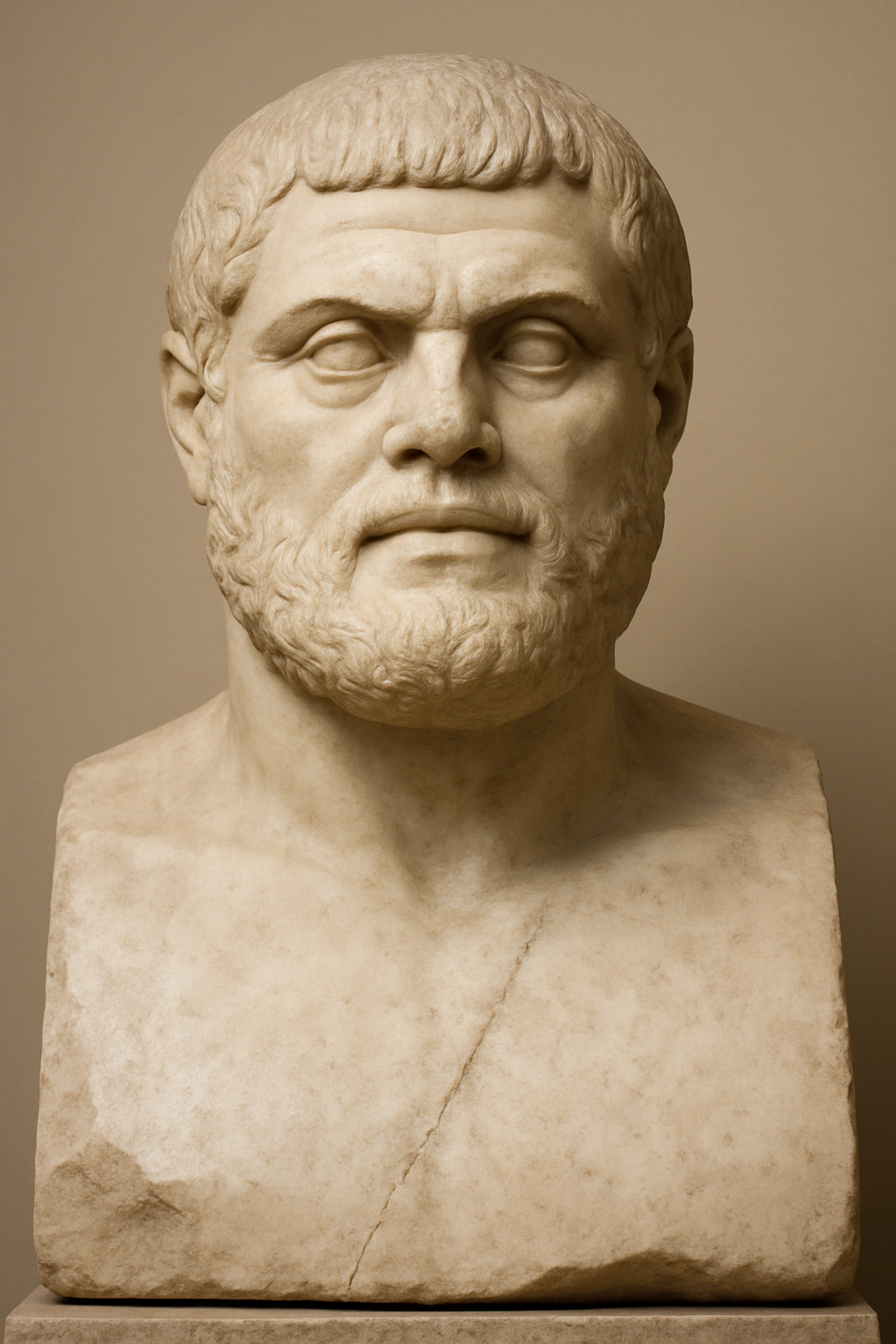
| 8 Quotes | |
| Occup. | Soldier |
| From | Greece |
| Born | 525 BC Athens, Attica, Greece |
| Died | 460 BC Magnesia, Aydın, Turkey |
| Cause | Traditionally suicide by poison; possibly natural causes |
| Cite | |
Citation Formats
APA Style (7th ed.)
Themistocles biography, facts and quotes. (2026, February 11). FixQuotes. https://fixquotes.com/authors/themistocles/
Chicago Style
"Themistocles biography, facts and quotes." FixQuotes. February 11, 2026. https://fixquotes.com/authors/themistocles/.
MLA Style (9th ed.)
"Themistocles biography, facts and quotes." FixQuotes, 11 Feb. 2026, https://fixquotes.com/authors/themistocles/. Accessed 5 Mar. 2026.
Early Life and Background
Themistocles was born around 525 BCE in the Athenian deme of Phrearrhioi, at a moment when Athens was shedding aristocratic monarchy for the harsher, more competitive freedom of the polis. Ancient tradition makes his father Neocles an Athenian of modest standing and his mother a foreigner or at least socially marginal, a detail later biographers used to explain his lifelong sensitivity to status and his instinct for mass politics. Whether that genealogy is exact matters less than the social truth it conveys: he rose in a city where lineage still counted, but where new institutions increasingly rewarded audacity, argument, and practical intelligence.He came of age during the reforms of Cleisthenes and the consolidation of the democratic tribes and demes, learning early that power in Athens no longer belonged solely to birth. The Persian threat framed his youth as a public drama - Ionia in revolt, the memory of Marathon (490 BCE), and the sense that the next invasion would be larger. In that climate, Themistocles developed a temperament that mixed impatience with calculation: he was drawn to the loud center of civic life, yet he also trained himself to see beyond immediate applause to the strategic horizon.
Education and Formative Influences
Themistocles was not remembered as a philosophical student in the aristocratic mode, but as a natural political intellect shaped by assembly debate, lawcourt combat, and the practical schooling of naval Athens. He learned the languages of persuasion and fear that democratic leadership required, and he studied the city itself - its harbor, its revenues, its factional seams. Rivalry sharpened him: Aristides, the emblem of old-fashioned rectitude, became his foil, and their contest clarified Themistocles' belief that survival demanded policy, not posture.Career, Major Works, and Turning Points
Elected archon in 493/2 BCE, he began the transformation of Athens by promoting the harbor at Piraeus over the older roadstead of Phaleron, turning geography into strategy. His decisive turning point came after the discovery of silver at Laurion (circa 483 BCE): instead of distributing windfall profits, he drove the building of a fleet of triremes, arguing that Athens' security and future lay at sea. That choice set the stage for the Persian Wars. In 480 BCE, when Xerxes invaded, Themistocles helped force the Greek stand at Salamis; through bluff, intelligence, and ruthlessness, he engineered a battle in the narrows where Persian numbers became a liability and Athenian seamanship a weapon. Afterward he pressed to fortify Athens and, crucially, to build the Long Walls linking city and port, making Athens a maritime fortress. Yet the same traits that saved the polis - ambition, manipulation, impatience with rivals - later fueled backlash. Ostracized around 471 BCE, he drifted through Greece and ultimately took refuge with Persia, living under royal patronage in Asia Minor until his death around 460 BCE, a final irony for the architect of Greek resistance.Philosophy, Style, and Themes
Themistocles' inner life is best read through the hard grammar of his choices: he trusted leverage more than virtue-signaling, and he treated politics as the art of converting weak positions into decisive ones. His most revealing self-portrait is pragmatic rather than poetic: “I cannot fiddle, but I can make a great state from a little city”. It is a confession of insecurity turned into a program - the sense of being excluded from old prestige becomes the drive to manufacture new forms of greatness, measurable in ships, walls, and alliances. In his mind, Athens did not need to be nobler than its rivals; it needed to be unkillable.His style fused democratic performance with coercive clarity. “Strike, if you will, but listen”. The line captures a man who expected hostility and still insisted on being heard, using the very threat of violence to underline the necessity of deliberation. Beneath the bravado lay a strategic creed: “He who commands the sea has command of everything”. This was not only naval doctrine but a philosophy of power - mobility over landlocked honor, supply lines over speeches, and the ability to choose the battlefield over the illusion of control. Even his later exile fits the pattern: when the city he remade turned on him, he sought the one court powerful enough to guarantee his survival, proving that for him loyalty was inseparable from circumstance.
Legacy and Influence
Themistocles endures as the founder of imperial Athens in embryo - the statesman who turned a vulnerable city-state into a maritime power capable of leading Greece and later dominating it. Salamis became a template for asymmetric strategy, and the Piraeus-Long Walls system became a model of integrating economy, defense, and politics into a single architecture of power. His story also became a warning embedded in democratic memory: the same audacity that can rescue a community can also outgrow its patience, and a leader who depends on persuasion and pressure may eventually be judged by the methods that once made him indispensable.Our collection contains 8 quotes written by Themistocles, under the main topics: Witty One-Liners - Friendship - Leadership - Vision & Strategy - Decision-Making.
Other people related to Themistocles: Cornelius Nepos (Roman)
Frequently Asked Questions
- Themistocles books: Plutarch’s Life of Themistocles; Herodotus’ Histories (Bk 7–8); Thucydides, History of the Peloponnesian War (Bk 1).
- Themistocles movie: 300: Rise of an Empire (2014).
- Themistocles education: Athenian upbringing; largely self-taught in politics and rhetoric.
- Themistocles pronunciation: thuh-MIS-tuh-kleez (θə-MIS-tə-kleez).
- Themistocles children: Several; sources name sons Neocles, Cleophantus, Archeptolis, and daughters incl. Mnesiptolema.
- Themistocles cause of death: Traditionally suicide by poison in exile (accounts vary).
- Themistocles 300: Protagonist of 300: Rise of an Empire (2014), played by Sullivan Stapleton.
- Themistocles died: c. 459–460 BC, in Magnesia (Asia Minor).
Source / external links