
Theodor Herzl Biography Quotes 27 Report mistakes
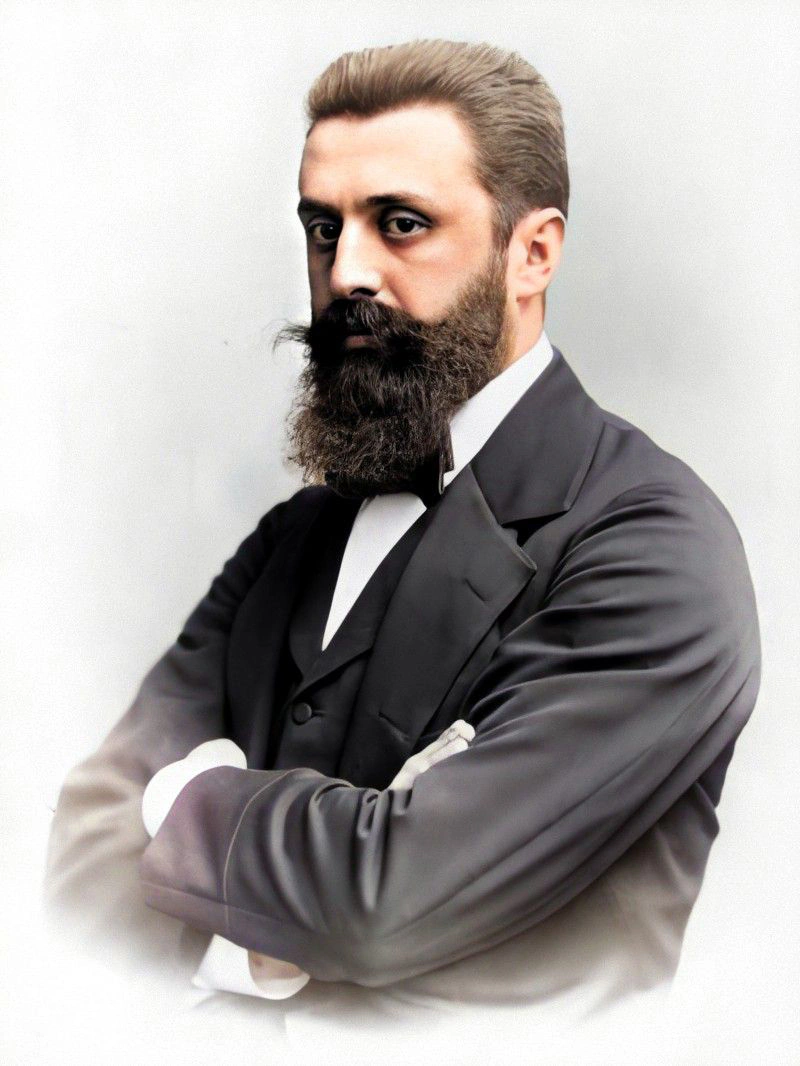
Attr: Carl Pietzner
| 27 Quotes | |
| Occup. | Journalist |
| From | Hungary |
| Born | May 2, 1860 Budapest, Hungary |
| Died | July 3, 1904 Edlach, Austria |
| Cause | Heart Attack |
| Aged | 44 years |
| Cite | |
Citation Formats
APA Style (7th ed.)
Theodor herzl biography, facts and quotes. (2026, February 11). FixQuotes. https://fixquotes.com/authors/theodor-herzl/
Chicago Style
"Theodor Herzl biography, facts and quotes." FixQuotes. February 11, 2026. https://fixquotes.com/authors/theodor-herzl/.
MLA Style (9th ed.)
"Theodor Herzl biography, facts and quotes." FixQuotes, 11 Feb. 2026, https://fixquotes.com/authors/theodor-herzl/. Accessed 12 Feb. 2026.
Early Life and Background
Theodor Herzl was born on May 2, 1860, in Pest in the Kingdom of Hungary, then part of the Habsburg Empire, into a German-speaking, acculturated Jewish family that valued bourgeois respectability and upward mobility. His father, Jakob, worked in commerce; his mother, Jeanette, gave him a cultivated home life shaped by the theater, literature, and the confident universalism many Central European Jews embraced after emancipation. The city around him was modernizing quickly, but it also carried the older, stubborn reflexes of ethnic suspicion that would puncture the promise of full belonging.A decisive early wound came with family bereavement and displacement. After the death of his beloved sister Pauline in 1878, the family moved to Vienna, the imperial capital whose liberal facade masked a growing politics of mass resentment. Herzl came of age amid the paradox of fin-de-siecle Central Europe - extraordinary cultural brilliance and a sharpening racialized antisemitism that made Jewish success simultaneously visible and precarious. That tension would become the emotional engine of his later public life.
Education and Formative Influences
In Vienna, Herzl studied law at the University of Vienna and briefly practiced before choosing writing, drawn less to courtroom argument than to the power of narrative and public persuasion. He absorbed the era's faith in rational administration, the prestige of constitutional politics, and the theatricality of urban life; he also watched antisemitic movements professionalize themselves into modern parties. His early ambitions were literary - plays, essays, feuilletons - and his self-conception was that of a European man of letters, not a national revolutionary, until events forced him to reconsider what "integration" could realistically mean.Career, Major Works, and Turning Points
Herzl became the Paris correspondent for Vienna's Neue Freie Presse, one of the most influential liberal newspapers of the day, and there his political awakening accelerated. The Dreyfus Affair (1894-1906) did not merely shock him with street-level hatred; it demonstrated how quickly a modern state could turn a Jewish officer into a symbol of national betrayal. By 1896 he published Der Judenstaat (The Jewish State), arguing that the "Jewish question" was political, not charitable, and required a sovereign solution; a year later he convened the First Zionist Congress in Basel (1897), creating a durable organizational framework and a program aimed at international recognition. In the short, relentless arc that followed, he met rulers and ministers, sought great-power patronage, promoted institutions like the Jewish Colonial Trust, and pursued multiple diplomatic avenues - including proposals involving East Africa - while keeping Palestine as the movement's lodestar. Worn by travel, pressure, and illness, he died in Edlach, Austria, on July 3, 1904, having transformed a scattered yearning into a disciplined political project.Philosophy, Style, and Themes
Herzl's thought fused romantic nationalism with a distinctly modern confidence in bureaucracy, finance, and public relations. He spoke as a journalist trained to compress complexity into slogans and programs, and as a dramatist attuned to staging - congresses, protocols, delegations - that could convert a vulnerable minority into a visible political actor. His most famous line, "If you will it, it is no dream". is not mere uplift; it reveals a psyche battling despair with voluntarism, insisting that collective intention can discipline history itself. For Herzl, will was a technology: it organized emotions into institutions, and institutions into legitimacy.Just as revealing is his impatience with solutions that soothed suffering without altering power. "Philanthropic colonization is a failure. National colonization will succeed". The sentence carries both moral urgency and an accountant's clarity: charity treats symptoms, while national organization reallocates agency. He imagined migration not as a romantic exodus but as a managed transfer of lives, capital, and skills, guided by law and international guarantees. Beneath the strategic prose lies a private terror of Jewish vulnerability becoming permanent, paired with a hard-won belief that security requires a public, legal status rather than private tolerance. His language repeatedly returns to visibility - the need to be recognized, to negotiate openly, to build in daylight.
Legacy and Influence
Herzl did not live to see statehood, but he defined the movement's grammar: congress politics, fundraising mechanisms, diplomatic lobbying, and the insistence that Jewish safety was inseparable from political self-determination. Later Zionist factions contested his tactics, and the realities of settlement, conflict, and empire far exceeded his early scenarios, yet his central innovation endured: converting dispersed historical memory and modern antisemitic pressure into a program with institutions, leadership norms, and an international address. Reburied in Jerusalem in 1949, he became both symbol and instrument - a founder whose life illustrated how a single writer, working under the pressures of his age, could turn reportage into strategy and longing into a durable political horizon.Our collection contains 27 quotes written by Theodor, under the main topics: Motivational - Ethics & Morality - Justice - Freedom - Work Ethic.
Other people related to Theodor: Chaim Weizmann (Leader), Max Nordau (Critic), Arthur Hertzberg (Theologian)
Theodor Herzl Famous Works
- 1902 The Old New Land (Novel)
- 1896 The Jewish State (Book)
Source / external links