
Theodore Roosevelt Biography Quotes 71 Report mistakes
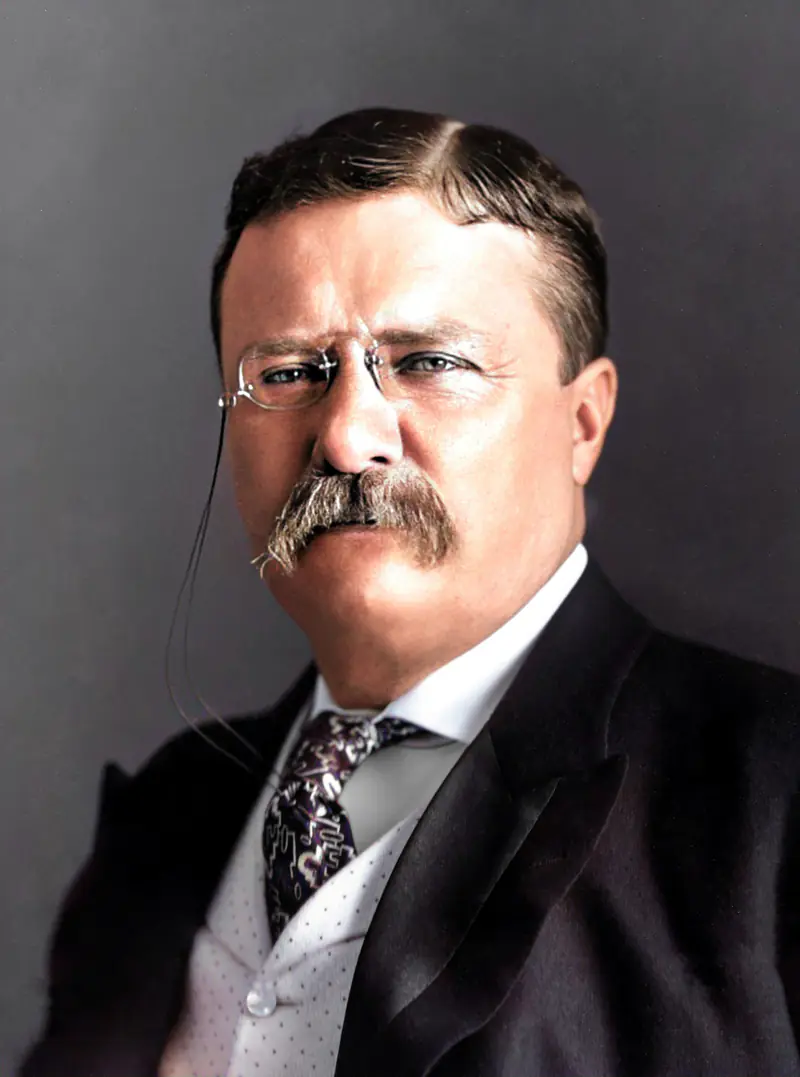
Attr: Pach Bros.
| 71 Quotes | |
| Known as | Teddy Roosevelt |
| Occup. | President |
| From | USA |
| Spouse | Alice Hathaway Lee |
| Born | October 27, 1858 New York City, New York, USA |
| Died | January 6, 1919 Oyster Bay, New York, USA |
| Cause | Coronary embolism |
| Aged | 60 years |
Theodore Roosevelt was born on October 27, 1858, in Manhattan, New York City, into a wealthy, politically connected family whose comforts did not spare him physical suffering. A frail child with severe asthma, he learned early that willpower could be a form of medicine. His father, Theodore Roosevelt Sr., modeled civic duty and tenderness; his mother, Martha "Mittie" Bulloch, brought a romantic Southern lineage that later complicated his feelings during and after the Civil War. The boy who wheezed in a brownstone bedroom also devoured natural history and trained himself into toughness, building a private museum and a private creed: endurance as identity.
The deaths that punctured his early adulthood shaped his inner weather. In 1884, within hours, he lost his mother and his young wife, Alice Hathaway Lee Roosevelt, shortly after the birth of their daughter. He recorded the moment with a stark "light has gone out of my life", then fled east-coast society for the Dakota Territory, seeking grief-work in cold air, cattle, and danger. The West did not erase sorrow, but it refashioned it into a public energy that would later read as exuberance - a man who kept moving because stillness invited pain.
Education and Formative Influences
Educated at home by tutors before entering Harvard College (graduating 1880), Roosevelt absorbed the era's arguments about science, character, and national purpose. He read widely - from Darwinian debates to histories of empire - and translated book knowledge into bodily discipline, practicing boxing and long hikes to conquer what he called his "weakness". Columbia Law School bored him; politics did not. His early historical writing, including The Naval War of 1812 (1882), revealed a mind drawn to institutions, force, and statecraft, while his friendships with reformers and clubmen alike trained him to operate inside elite networks without being owned by them.
Career, Major Works, and Turning Points
Roosevelt entered the New York State Assembly in 1882, quickly becoming a combative reform Republican, then served in an expanding circuit of posts: U.S. Civil Service Commissioner (1889-1895), New York City Police Commissioner (1895-1897), and Assistant Secretary of the Navy (1897-1898). The Spanish-American War made him a national symbol when he resigned to form the Rough Riders and fought at San Juan Hill. As New York governor (1899-1900) he confronted corporate power; party bosses moved him onto the vice-presidency, only for President William McKinley's assassination in 1901 to elevate him at 42, the youngest president. In office he pursued the Square Deal, busted certain trusts (not all), strengthened federal mediation in the 1902 coal strike, created national forests and monuments, and helped launch the modern conservation state. Abroad, he advanced the Roosevelt Corollary, helped engineer the Panama Canal zone, mediated the Russo-Japanese War (Nobel Peace Prize, 1906), then later broke with William Howard Taft, ran as a Progressive in 1912, and watched the split usher Woodrow Wilson into power; by his death on January 6, 1919, the strenuous crusader had become an emblem of an older nationalism facing a new, harsher century.
Philosophy, Style, and Themes
Roosevelt's inner life fused moral intensity with theatrical confidence. He feared passivity more than error, treating action as the antidote to both weakness and despair - a psychology forged in childhood asthma and adulthood bereavement. "Get action. Seize the moment. Man was never intended to become an oyster". This was not mere pep talk; it was self-prescription. His public style - quick laughter, aggressive rhetoric, plain talk salted with historical analogy - performed courage as a civic virtue, inviting Americans to imagine politics as an arena where character mattered. The same drive that made him a builder of institutions also made him impatient with compromise, and at times dangerously certain that national vigor justified national intrusion.
Yet he was not simply a man of force; he was also a moralist of democratic accountability and personal responsibility. He insisted that leadership must face scrutiny: "To announce that there must be no criticism of the president... is morally treasonable to the American public". That sentence exposes a defining tension in his temperament - an appetite for authority paired with a belief that authority must be contested to stay legitimate. When confronting opponents, he preferred a clean blow to evasive civility, turning conflict into a kind of ethical hygiene: "The unforgivable crime is soft hitting. Do not hit at all if it can be avoided; but never hit softly". Behind the bravado lay a man trying to keep faith with his own standards, using combativeness to ward off the chaos he felt in private.
Legacy and Influence
Roosevelt helped invent the modern American presidency as a moral megaphone and administrative engine: he expanded executive power, legitimized federal regulation of big business, and embedded conservation into national policy through parks, forests, and monuments. His legacy is also a contested map of the United States at high tide of industrial capitalism and imperial ambition - admired for vigor, reform energy, and stewardship, criticized for racial attitudes, interventionism, and the precedents of an assertive state. Still, later leaders from Franklin Roosevelt to John F. Kennedy and beyond borrowed his language of service, toughness, and public purpose, and his life remains a case study in how private struggle can be alchemized into public action.
Our collection contains 71 quotes who is written by Theodore, under the main topics: Witty One-Liners - Motivational - Ethics & Morality - Wisdom - Truth.
Other people realated to Theodore: Franklin D. Roosevelt (President), Eleanor Roosevelt (First Lady), Alice Roosevelt Longworth (Author), Upton Sinclair (Author), Henry B. Adams (Historian), Andrew Carnegie (Businessman), Brené Brown (Author), Booker T. Washington (Educator), John Burroughs (Author), Samuel Gompers (Activist)
Theodore Roosevelt Famous Works
- 1913 Theodore Roosevelt: An Autobiography (Book)
- 1910 African Game Trails (Book)
- 1900 The Strenuous Life (Book)
- 1899 The Rough Riders (Book)
- 1889 The Winning of the West (Book)
Source / external links