
Thomas Edison Biography Quotes 50 Report mistakes
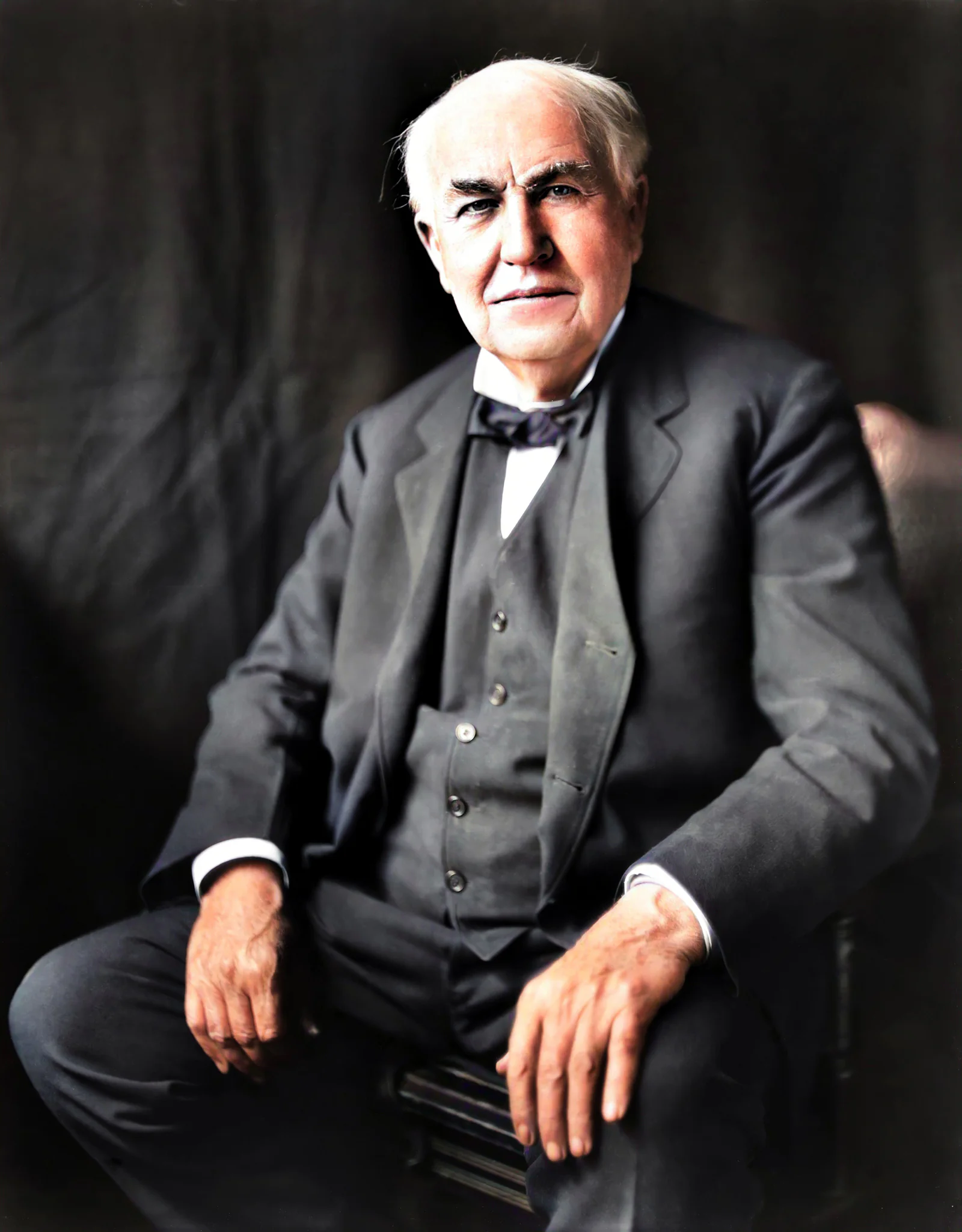
| 50 Quotes | |
| Born as | Thomas Alva Edison |
| Known as | Thomas A. Edison |
| Occup. | Inventor |
| From | USA |
| Born | February 11, 1847 Milan, Ohio, U.S. |
| Died | October 18, 1931 West Orange, New Jersey, U.S. |
| Aged | 84 years |
| Cite | |
Citation Formats
APA Style (7th ed.)
Thomas edison biography, facts and quotes. (2026, February 2). FixQuotes. https://fixquotes.com/authors/thomas-edison/
Chicago Style
"Thomas Edison biography, facts and quotes." FixQuotes. February 2, 2026. https://fixquotes.com/authors/thomas-edison/.
MLA Style (9th ed.)
"Thomas Edison biography, facts and quotes." FixQuotes, 2 Feb. 2026, https://fixquotes.com/authors/thomas-edison/. Accessed 5 Mar. 2026.
Early Life and Background
Thomas Alva Edison was born on February 11, 1847, in Milan, Ohio, a canal-and-commerce town already feeling the tug of new rail lines that would reorder the Midwest. His parents, Samuel Ogden Edison Jr. and Nancy Matthews Elliott, gave him a household shaped by migration, politics, and self-reliance: Samuel had fled Canada after the 1837 rebellion, while Nancy, a former teacher, carried a habit of instruction into daily life. The family moved to Port Huron, Michigan, in 1854, where the Great Lakes economy and the telegraph-connected world of shipping made technology feel less like abstraction than livelihood.Edison was famously difficult to fit into conventional childhood categories. He was curious to the point of defiance, inclined to test boundaries with chemicals and contraptions, and he grew partially deaf in youth - likely from illness and then compounded by hard living on trains and in depots. Rather than romanticize the deafness as a gift, it is more accurate to see it as a social filter: it narrowed distractions, thickened his interior monologue, and pushed him toward workspaces where the loudest conversation was the one between hand and material.
Education and Formative Influences
His formal schooling was brief; the deeper education came from his mother, from voracious reading, and from the marketplace. As a teenager he sold newspapers and candy on the Grand Trunk Railway, turning transit time into a moving storefront and, eventually, a moving laboratory. A small press let him publish the Grand Trunk Herald, and the telegraph - the era's nervous system - became his obsession after he learned it through station operators and relentless practice. The telegrapher's discipline of signals, timing, and troubleshooting trained the habits that would later define him: treat errors as data, master systems end-to-end, and translate curiosity into a paying service.Career, Major Works, and Turning Points
After years as an itinerant telegrapher, Edison broke through with improvements to telegraphy and finance communications, including a stock ticker, leading to the money and confidence to found his own research-and-production enterprise. In 1876 he established his laboratory at Menlo Park, New Jersey - a deliberately staffed "invention factory" that married experiment, skilled machinists, and aggressive patenting. There he and his teams produced the phonograph (1877), practical improvements to telephone transmission (including the carbon microphone), and most consequentially a complete electric-lighting system. The incandescent lamp he made commercially viable in 1879 was only a piece; the turning point was his insistence on power generation, distribution, meters, switches, and safety as a unified network, culminating in the Pearl Street Station in Manhattan (1882). The later decades brought both expansion and bruising conflict: the "War of Currents" pitted his direct-current approach against alternating-current systems promoted by George Westinghouse and Nikola Tesla, and though AC won the grid, Edison remained a decisive architect of modern electrification. In parallel he built industries - the Edison Manufacturing Company for motion pictures, the West Orange, New Jersey laboratories after 1887, batteries for vehicles and industry, and a vast portfolio of patents - while navigating celebrity, lawsuits, and the managerial burdens of scale.Philosophy, Style, and Themes
Edison's inner life is best read through his work ethic and his appetite for uncertainty. He cultivated an identity not as a lone genius but as a professional finder of workable answers, a stance that protected him psychologically against disappointment and made persistence a moral posture. “I have not failed. I've just found 10, 000 ways that won't work”. That sentence is less a slogan than a coping strategy: it converts frustration into inventory, and it reveals a mind that sought control not by avoiding risk but by exhausting possibilities until the problem yielded.His style was physical, iterative, and system-minded - invention as labor performed in public time. “There is no substitute for hard work”. Even his bravado carried a pragmatic edge, because he distrusted rules that slowed momentum: “Hell, there are no rules here - we're trying to accomplish something”. The theme running through his career is that an idea is incomplete until it can survive the market, the factory, and the user. That conviction made him brilliant at building infrastructures - laboratories, supply chains, power stations - and it also made him combative, impatient with rivals, and willing to press ethics and publicity into service of winning.
Legacy and Influence
Edison died on October 18, 1931, in West Orange, New Jersey, after living long enough to see electricity and recorded sound become ordinary. His legacy is not reducible to any single device: it is the modern model of industrial research, where discovery, engineering, capital, and intellectual property move together. He helped normalize the laboratory as a production engine, influenced corporate R-and-D from General Electric onward, and shaped how the 20th century imagined the inventor - tireless, practical, and commercially alert. The contradictions remain part of the inheritance: he could be visionary yet territorial, collaborative yet possessive, humane in building tools for everyday life yet ruthless in technological rivalry. But the enduring influence is unmistakable - he made invention a scalable profession and taught an electrified civilization how to turn experiments into systems that people could actually live with.Our collection contains 50 quotes written by Thomas, under the main topics: Witty One-Liners - Motivational - Ethics & Morality - Wisdom - Art.
Other people related to Thomas: Napolean Hill (Author), George Westinghouse (Inventor), Charles Edison (Businessman), Henry Villard (Journalist), John Ambrose Fleming (Inventor)
Frequently Asked Questions
- Thomas Edison Battery: Thomas Edison developed the nickel-iron battery in 1901, which was a rechargeable battery with a longer life and higher energy density compared to other batteries at that time.
- Thomas Edison Movie Camera: Thomas Edison and his assistant, William Dickson, developed the movie camera called the Kinetograph in the 1890s, which captured a series of images on a strip of celluloid film to create motion pictures.
- Thomas Edison Phonograph: Thomas Edison invented the phonograph in 1877, which was a device used to mechanically record and reproduce sound through a stylus and rotating cylinder.
- Thomas Edison Light Bulb: Thomas Edison invented the incandescent light bulb in 1879, changing the world by providing a practical and affordable way to illuminate homes and businesses.
- Where did Thomas Edison live? Born in Milan, Ohio, lived in Menlo Park & West Orange, New Jersey
- How many inventions did Thomas Edison make? 1,093 US patents and more globally
- How old was Thomas Edison? He became 84 years old
Source / external links