
Thomas Hardy Biography Quotes 34 Report mistakes
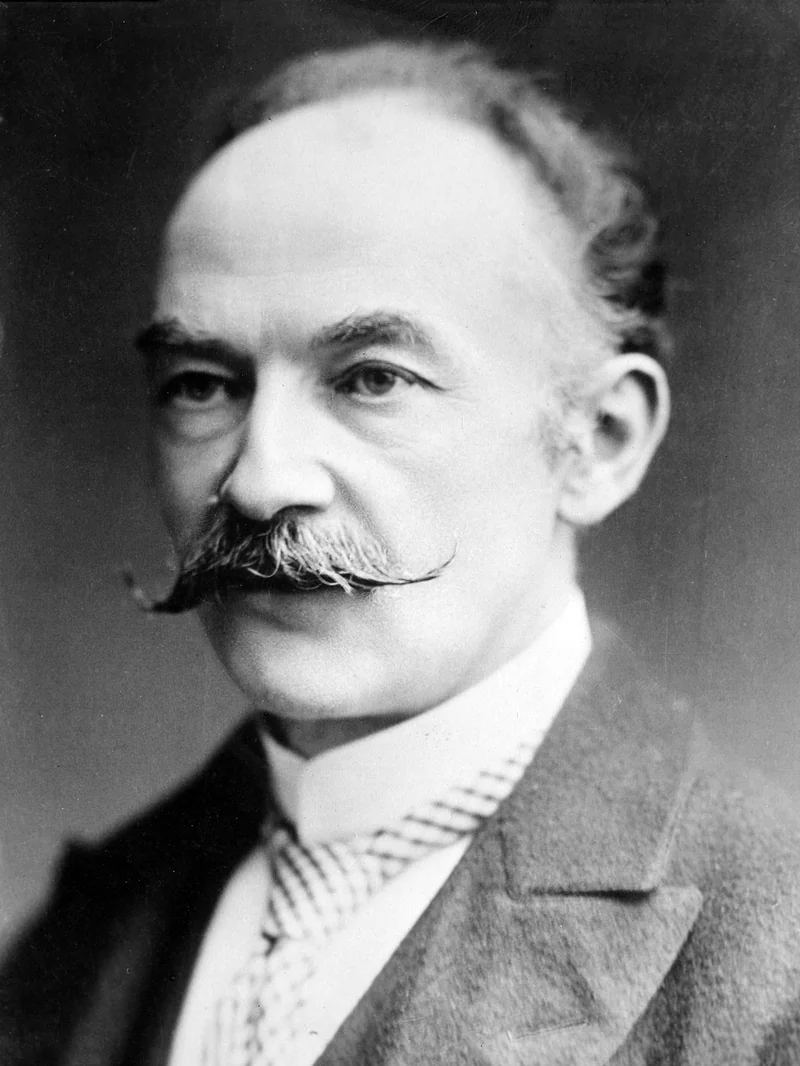
| 34 Quotes | |
| Occup. | Novelist |
| From | England |
| Born | June 2, 1840 Higher Bockhampton, Dorset, England |
| Died | January 11, 1928 Dorchester, Dorset, England |
| Aged | 87 years |
| Cite | |
Citation Formats
APA Style (7th ed.)
Thomas hardy biography, facts and quotes. (2026, February 11). FixQuotes. https://fixquotes.com/authors/thomas-hardy/
Chicago Style
"Thomas Hardy biography, facts and quotes." FixQuotes. February 11, 2026. https://fixquotes.com/authors/thomas-hardy/.
MLA Style (9th ed.)
"Thomas Hardy biography, facts and quotes." FixQuotes, 11 Feb. 2026, https://fixquotes.com/authors/thomas-hardy/. Accessed 31 Mar. 2026.
Early Life and Background
Thomas Hardy was born on 2 June 1840 in Higher Bockhampton, a hamlet near Dorchester in Dorset, a landscape of heaths, copses, and smallholdings that became the imaginative map of his fiction as "Wessex". His father, Thomas Hardy Sr., was a stonemason and fiddler; his mother, Jemima (nee Hand), prized reading and memory, and fed her son a blend of local lore, ballad rhythms, and practical nonconformity. The household sat at the seam between rural labor and artisanal aspiration, and Hardy absorbed the speech, customs, and social gradations of a countryside already being tugged by railways, agricultural change, and the long shadow of Victorian respectability.Early on he developed the double vision that later defined him: intimate knowledge of village life paired with the outsider's awareness of how fragile its codes were. Dorset's class boundaries were felt in small humiliations and small solidarities - at church, at hiring fairs, at the public house - and Hardy watched how reputation could become a kind of destiny. He also grew up amid a dense culture of music and seasonal ritual, experiences that gave his later writing its sense of communal time, where private longing plays out against ancient calendars and indifferent weather.
Education and Formative Influences
Hardy attended local schools in Bockhampton and Dorchester and read widely beyond formal instruction, taking in Shakespeare, the Bible, and the poets while training his eye as a draughtsman. In 1856 he was apprenticed to Dorchester architect John Hicks, learning disciplined observation, proportion, and the patient logic of building - skills that later reappeared as the structural clarity of his novels. Moving to London in 1862 to work for Arthur Blomfield, he encountered the metropolis' pace, skepticism, and intellectual pluralism, and he quietly tested the era's faith against geology, evolutionary thinking, and historical criticism, returning often in mind to Dorset as both refuge and laboratory.Career, Major Works, and Turning Points
After illness and disillusionment with London life, Hardy returned to Dorset in 1867 and turned decisively toward literature, publishing "Desperate Remedies" (1871) and "Under the Greenwood Tree" (1872) before finding wide success with "Far from the Madding Crowd" (1874). That same year he married Emma Gifford, whom he had met while working on a church restoration in Cornwall - a relationship that began in romantic idealization and ended in estrangement, then in grief-haunted rediscovery after her death in 1912. Hardy's major novels - "The Return of the Native" (1878), "The Mayor of Casterbridge" (1886), "Tess of the d'Urbervilles" (1891), and "Jude the Obscure" (1895) - enlarged English realism into tragedy shaped by social law, chance, and inner compulsion. The hostile reception to "Jude", and the sense that Victorian moral gatekeeping made honest fiction impossible, pushed him to abandon the novel and devote his remaining decades to poetry, including "Wessex Poems" (1898), "Poems of the Past and the Present" (1901), and the epic drama "The Dynasts" (1904-1908). He died on 11 January 1928; his ashes were interred in Westminster Abbey, while his heart was buried in Dorset, an emblem of the split between national monument and local belonging.Philosophy, Style, and Themes
Hardy's inner life was marked by a tension between tenderness and a hard-won pessimism. He was not a nihilist so much as a moralist without guarantees: he insisted on looking directly at suffering and asking what forms of sympathy remain when providence feels absent. His work repeatedly argues that any "way to the better" begins in unsparing perception: “If way to the better there be, it exacts a full look at the worst”. That stance was psychological as much as philosophical - a method of self-protection against sentimental lies, and a discipline of attention that turns pain into knowledge without pretending to redeem it.In style, Hardy fused panoramic description with intimate irony, giving landscape an almost sentient presence while letting small accidents topple lives. His characters are often trapped less by villains than by timing, convention, and their own late awakenings, as in the grim wisdom: “A resolution to avoid an evil is seldom framed till the evil is so far advanced as to make avoidance impossible”. He also wrote with acute awareness of gendered constraint, dramatizing how women are forced to translate experience into a male-coded public language, and why that translation fails: “It is difficult for a woman to define her feelings in language which is chiefly made by men to express theirs”. The result is a fiction where moral judgment is replaced by moral pressure - the felt weight of class, law, sexuality, and reputation - and where compassion becomes the only credible resistance to the machinery of circumstance.
Legacy and Influence
Hardy helped steer the English novel from Victorian confidence toward modern uncertainty, laying groundwork for later psychological and social realism while proving that rural life could carry classical tragic force. His "Wessex" created a durable imaginative geography, influencing writers from D.H. Lawrence to contemporary regionalists, and his poetry - once treated as secondary - is now central to the modern canon for its plainspoken music, philosophical bite, and emotional candor. Across decades of controversy and acclaim, Hardy's enduring influence lies in his refusal to flatter either human desire or social piety, and in his insistence that clear sight and sympathy are not opposites but partners in any honest art.Our collection contains 34 quotes written by Thomas, under the main topics: Witty One-Liners - Ethics & Morality - Truth - Wisdom - Nature.
Other people related to Thomas: Michael Winterbottom (Director), Gerald Finzi (Composer), Minnie Maddern Fiske (Actress), James Payn (Novelist), Frederic Raphael (Screenwriter), Alan Bates (Actor)
Thomas Hardy Famous Works
- 1901 Poems of the Past and the Present (Poetry)
- 1897 The Well-Beloved (Novel)
- 1895 Jude the Obscure (Novel)
- 1894 Life's Little Ironies (Collection)
- 1891 A Group of Noble Dames (Collection)
- 1891 Tess of the d'Urbervilles (Novel)
- 1888 Wessex Tales (Collection)
- 1887 The Woodlanders (Novel)
- 1886 The Mayor of Casterbridge (Novel)
- 1882 Two on a Tower (Novel)
- 1881 A Laodicean (Novel)
- 1880 The Trumpet-Major (Novel)
- 1878 The Return of the Native (Novel)
- 1876 The Hand of Ethelberta (Novel)
- 1874 Far from the Madding Crowd (Novel)
- 1873 A Pair of Blue Eyes (Novel)
- 1872 Under the Greenwood Tree (Novel)
- 1871 Desperate Remedies (Novel)