
Thomas Hobbes Biography Quotes 34 Report mistakes
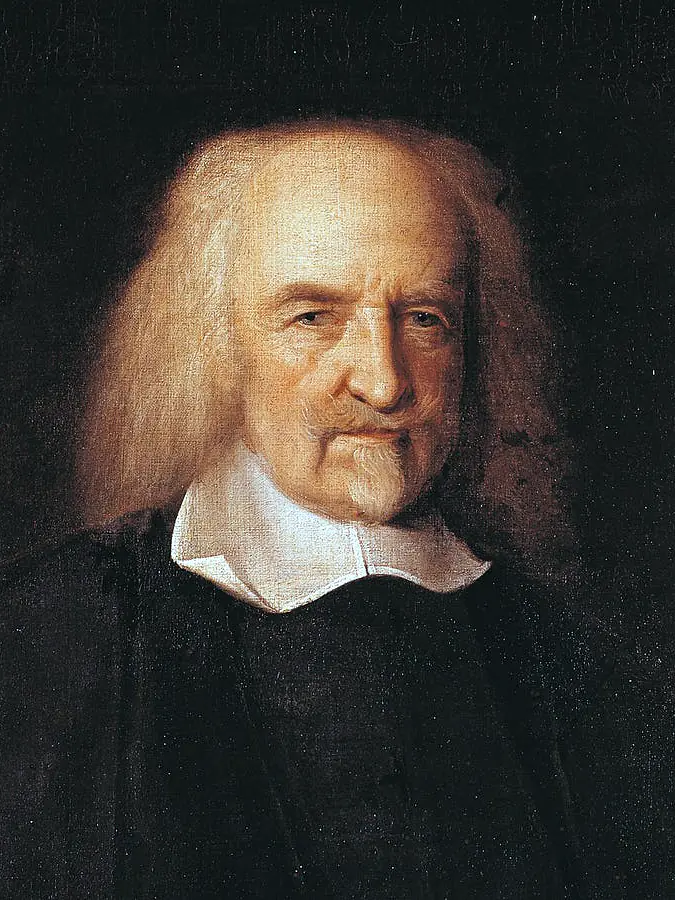
Attr: biography.com
| 34 Quotes | |
| Occup. | Philosopher |
| From | England |
| Born | April 5, 1588 Westport, Wiltshire, England |
| Died | December 4, 1679 Hardwick Hall, Derbyshire, England |
| Aged | 91 years |
| Cite | |
Citation Formats
APA Style (7th ed.)
Thomas hobbes biography, facts and quotes. (2026, February 2). FixQuotes. https://fixquotes.com/authors/thomas-hobbes/
Chicago Style
"Thomas Hobbes biography, facts and quotes." FixQuotes. February 2, 2026. https://fixquotes.com/authors/thomas-hobbes/.
MLA Style (9th ed.)
"Thomas Hobbes biography, facts and quotes." FixQuotes, 2 Feb. 2026, https://fixquotes.com/authors/thomas-hobbes/. Accessed 9 Feb. 2026.
Early Life and Background
Thomas Hobbes was born on 5 April 1588 in Westport, near Malmesbury in Wiltshire, England, as the Spanish Armada approached the Channel - a coincidence he later turned into autobiography as a birth under the sign of fear. His father, a Church of England vicar also named Thomas, was impulsive and absenting; after a brawl at the church door he disappeared from the family, leaving Hobbes to be raised largely under the care of an uncle, Francis Hobbes, a glover and prosperous townsman. The early wound was not merely domestic. It trained him to look for stable authority not in personal virtue but in institutions strong enough to contain human volatility.Malmesbury was provincial, yet it sat in an England of accelerating literacy, religious dispute, and the first tremors of the constitutional crisis that would become civil war. Hobbes grew up amid sermons about obedience and sin, and amid the everyday negotiations of market life where language, credit, and reputation mattered. He learned early that social peace is a human artifact, not a natural given - and that a boy without a father must make his own protections by attaching himself to patrons, books, and methods.
Education and Formative Influences
Exceptionally precocious, Hobbes attended Malmesbury school and then Magdalen Hall, Oxford (BA 1608), trained in scholastic logic even as he came to distrust its verbalism. Immediately after graduating he entered the household of William Cavendish, later 2nd Earl of Devonshire, as tutor and secretary - a connection that became the spine of his life. Through the Cavendishes he traveled on the Continent (notably 1610-1615 and later), encountered the new mathematical and mechanical sciences, and met leading minds; in Paris he moved near the circle of Marin Mersenne, and he read Galileo with the excitement of someone who felt philosophy could be rebuilt on clear definitions and motion. Thucydides, whom he translated into English in 1629, also taught him that faction and rhetoric can dissolve a city faster than foreign arms.Career, Major Works, and Turning Points
The English Civil Wars turned Hobbes from an acute observer into a system-builder. Alarmed by parliamentary challenge to monarchy and by religious militancy, he wrote political theory first in fragments for patrons, then publicly: The Elements of Law (1640, circulated in manuscript), De Cive (1642), and his culminating Leviathan (1651). He spent much of the 1640s in Paris, effectively an exile, teaching mathematics to the future Charles II while watching Europe fracture along confessional and dynastic lines. Leviathan made him famous and suspect: royalists disliked its subordination of church to state, parliamentarians its defense of undivided sovereignty. Returning to England in 1651, he lived under shifting regimes and, after the Restoration, under the personal protection of Charles II yet under intermittent clerical hostility; in old age he published translations of Homer and late polemics, still arguing that civil peace requires intellectual clarity and political muscle.Philosophy, Style, and Themes
Hobbes built an anthropology from nerves and appetites, not angels. The ground note is fear - not cowardice, but the rational anticipation of vulnerability. In the state of nature, he insists, "The condition of man... is a condition of war of everyone against everyone". This is less a claim that men are always fighting than that without a common power, distrust makes even peaceable people behave as if conflict is imminent. From that premise he derives the social contract: individuals authorize a sovereign to represent their wills so that life becomes predictable enough for industry, learning, and ordinary affection.His prose is deliberately hard-edged, designed to strip politics of pious fog. He treats law as a technology of command and coordination: "It is not wisdom but Authority that makes a law". Yet he is not a worshipper of tyranny for its own sake; he makes protection the measure of legitimacy, writing that "The obligation of subjects to the sovereign is understood to last as long, and no longer, than the power lasteth by which he is able to protect them". The psychological picture is stark: humans desire power after power because power is future security; language can illuminate but also enchant; religion can console but also mobilize factions. Hobbes feared ecclesiastical rival sovereignty as a recipe for civil relapse, and his critique of papal politics was a way of warning England about imported authority structures.
Legacy and Influence
Hobbes died on 4 December 1679 at Hardwick Hall, Derbyshire, still tied to the Cavendish family, and still certain that philosophy must begin with what people are, not what they should be. His political absolutism became a permanent provocation: rejected by many as morally thin, yet indispensable to later debates about sovereignty, consent, and the nature of the state. Modern political realism, parts of contract theory, and even the vocabulary of international relations owe him a template for thinking about insecurity and order. Equally enduring is his method: define terms, reduce to mechanisms, and treat peace as an achievement - a human construction as fragile, and as necessary, as the common power that maintains it.Our collection contains 34 quotes written by Thomas, under the main topics: Ethics & Morality - Wisdom - Truth - Justice - Mortality.
Other people related to Thomas: Joseph Glanvill (Writer), Kenelm Digby (Celebrity), William Davenant (Poet), Giambattista Vico (Philosopher), Bernard de Mandeville (Philosopher), A. P. Martinich (Philosopher), William Petty (Economist), John Aubrey (Writer)
Thomas Hobbes Famous Works
- 1681 A Dialogue between a Philosopher and a Student of the Common Laws of England (Essay)
- 1681 Behemoth, or The Long Parliament (Non-fiction)
- 1658 De Homine (Book)
- 1658 De Homine: Of Man (English excerpts and translations) (Book)
- 1656 The Questions Concerning Liberty, Necessity and Chance (Essay)
- 1655 De Corpore (Book)
- 1651 Leviathan (Book)
- 1650 The Elements of Law, Natural and Politic (Book)
- 1642 De Cive (Book)
- 1629 The Peloponnesian War (translation of Thucydides) (Book)