
Thomas Huxley Biography Quotes 65 Report mistakes
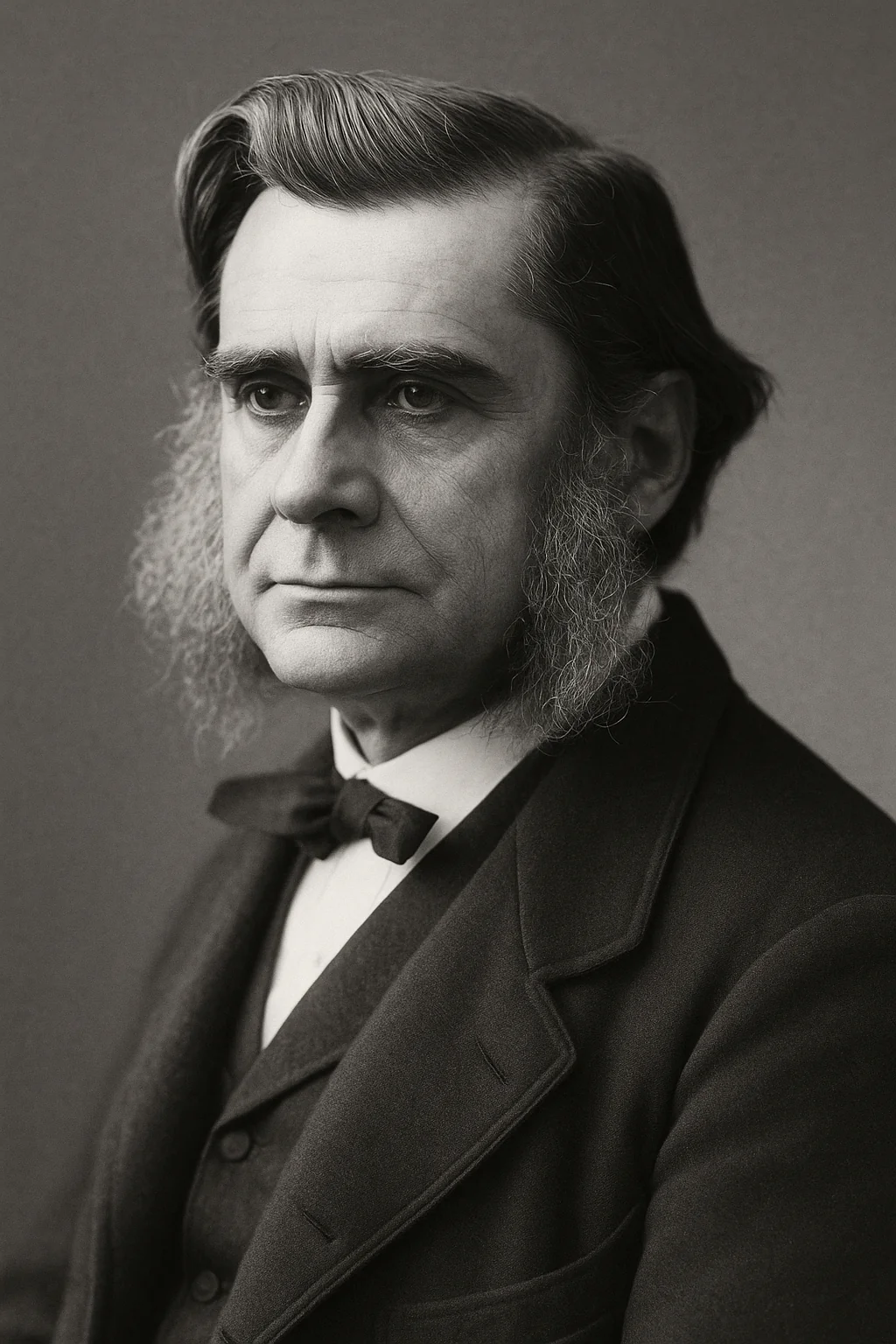
| 65 Quotes | |
| Born as | Thomas Henry Huxley |
| Occup. | Scientist |
| From | England |
| Born | May 4, 1825 Ealing, London, England |
| Died | June 29, 1895 Eastbourne, Sussex, England |
| Aged | 70 years |
| Cite | |
Citation Formats
APA Style (7th ed.)
Thomas huxley biography, facts and quotes. (2026, February 2). FixQuotes. https://fixquotes.com/authors/thomas-huxley/
Chicago Style
"Thomas Huxley biography, facts and quotes." FixQuotes. February 2, 2026. https://fixquotes.com/authors/thomas-huxley/.
MLA Style (9th ed.)
"Thomas Huxley biography, facts and quotes." FixQuotes, 2 Feb. 2026, https://fixquotes.com/authors/thomas-huxley/. Accessed 23 Mar. 2026.
Early Life and Background
Thomas Henry Huxley was born on 4 May 1825 in Ealing, then a semi-rural village west of London, into a large family of modest means. His father, George Huxley, worked as a schoolmaster; the household knew the instabilities of early industrial England, where education could be both a ladder and a fragile livelihood. When the Ealing school declined, the family moved, money tightened, and the boy who would later dominate lecture halls grew up with the daily lesson that intellect had to be practical to survive.That early insecurity left him with two lifelong traits: a fierce independence from patronage and a combative clarity about class and opportunity. He never became a comfortable gentleman-scientist. Instead, he learned to make knowledge pay its rent - as a surgeon, a lecturer, a public disputant, and later a reformer of institutions. His inner life, as glimpsed through letters and memoir, shows a man capable of tenderness and fatigue, yet repeatedly returning to discipline and work as moral commitments rather than mere ambitions.
Education and Formative Influences
Largely self-taught, Huxley educated himself through voracious reading while apprenticing in medicine, then studied at Charing Cross Hospital Medical School in London. He absorbed comparative anatomy and the rigor of observation under teachers who linked clinical training to natural history, and he matured intellectually in the utilitarian, reform-minded atmosphere of the 1830s and 1840s. At a time when Anglican authority and old universities still shaped intellectual boundaries, Huxley formed a temperament that prized demonstrable evidence over inherited certainty, and he began to imagine science as a public vocation, not a private hobby.Career, Major Works, and Turning Points
In 1846 he joined the Royal Navy as assistant surgeon aboard HMS Rattlesnake and spent four crucial years surveying in Australian and New Guinea waters, producing meticulous studies of marine invertebrates that won him election to the Royal Society and established him as an anatomist of first rank. Returning to Britain, he built a career through teaching (notably at the School of Mines), research on vertebrate and invertebrate structure, and a sustained campaign to professionalize science. The turning point of his public life came after 1859, when Charles Darwin's On the Origin of Species reframed biology; Huxley became "Darwin's bulldog", defending evolution in lectures and debates, including the famous 1860 Oxford encounter with Bishop Samuel Wilberforce. His own Man's Place in Nature (1863) and Essays on Some Controverted Questions (1892) sharpened evolutionary arguments and modeled a new kind of scientific prose: direct, polemical, and accessible.Philosophy, Style, and Themes
Huxley's guiding ethic was epistemic humility married to intellectual courage. He urged students and readers to treat nature as a demanding instructor rather than a canvas for doctrine: “Sit down before fact as a little child, be prepared to give up every conceived notion, follow humbly wherever and whatever abysses nature leads, or you will learn nothing”. This was not piety but discipline. It describes a psychology trained against self-deception, aware that cleverness can become a trap, and that the scientist's first adversary is the mind's hunger for premature coherence.He framed the world as lawful yet partially opaque, a stance that later crystalized in his advocacy of "agnosticism" as an attitude rather than a creed. His famous image makes the point with almost theatrical economy: “The chess-board is the world, the pieces are the phenomena of the universe, the rules of the game are what we call the laws of Nature. The player on the other side is hidden from us”. Huxley could be scathing about dogma, but he was equally wary of sloppy freethinking; he insisted that error disciplined by reason was less dangerous than belief insulated from criticism: “Irrationally held truths may be more harmful than reasoned errors”. That tension - between the moral urgency of truth and the limits of what can be known - runs through his essays on science and religion, his disputes with clerical authority, and his arguments for schools that taught method, not mere facts.
Legacy and Influence
Huxley helped remake Victorian Britain's intellectual landscape by turning science into a profession with public responsibilities: he campaigned for laboratory-based education, served on influential commissions, and argued that modern citizenship required scientific literacy. His style of public reasoning - tough, lucid, unsentimental, and anchored in evidence - became a template for later scientific advocates and skeptics. While some of his social views, especially around race and empire, reflect the assumptions and hierarchies of his era, his larger legacy is the insistence that knowledge advances through disciplined doubt, open argument, and institutions that reward inquiry over deference.Our collection contains 65 quotes written by Thomas, under the main topics: Motivational - Ethics & Morality - Truth - Wisdom - Leadership.
Other people related to Thomas: Julian Huxley (Scientist), Richard Owen (Scientist), William Winwood Reade (Historian), Arthur Keith (Scientist), Robert Chambers (Writer)
Frequently Asked Questions
- What is Thomas Huxley known for: Being “Darwin’s Bulldog,” coining “agnostic,” advancing comparative anatomy and science education, and popularizing evolution.
- Thomas Huxley: books: Evidence as to Man’s Place in Nature; Lessons in Elementary Physiology; Lay Sermons, Addresses and Reviews; Evolution and Ethics; Collected Essays.
- Leonard Huxley: Thomas Huxley’s son; a writer and editor, and father of Julian and Aldous Huxley.
- What did Thomas Huxley discover: Key findings in comparative anatomy: he showed humans and apes are closely related and argued that birds evolved from dinosaur-like reptiles.
- Thomas Huxley theory of evolution: He championed Darwin’s theory of evolution by natural selection, earning the nickname “Darwin’s Bulldog.”
- Thomas Henry Huxley children: He and his wife Henrietta Anne Heathorn had eight children, including Leonard Huxley and the artist Marian Huxley.
- How old was Thomas Huxley? He became 70 years old
Thomas Huxley Famous Works
- 1877 A Manual of the Anatomy of Invertebrated Animals (Book)
- 1864 Lectures on the Elements of Comparative Anatomy (Book)
- 1863 On the Relations of Man to the Lower Animals (Book)
- 1863 Evidence as to Man's Place in Nature (Book)
- 1863 Man's Place in Nature (Book)
- 1860 The Origin of Species (Book)
- 1849 An Elementary Atlas of Comparative Osteology (Book)
Source / external links