
Thomas Jefferson Biography Quotes 144 Report mistakes
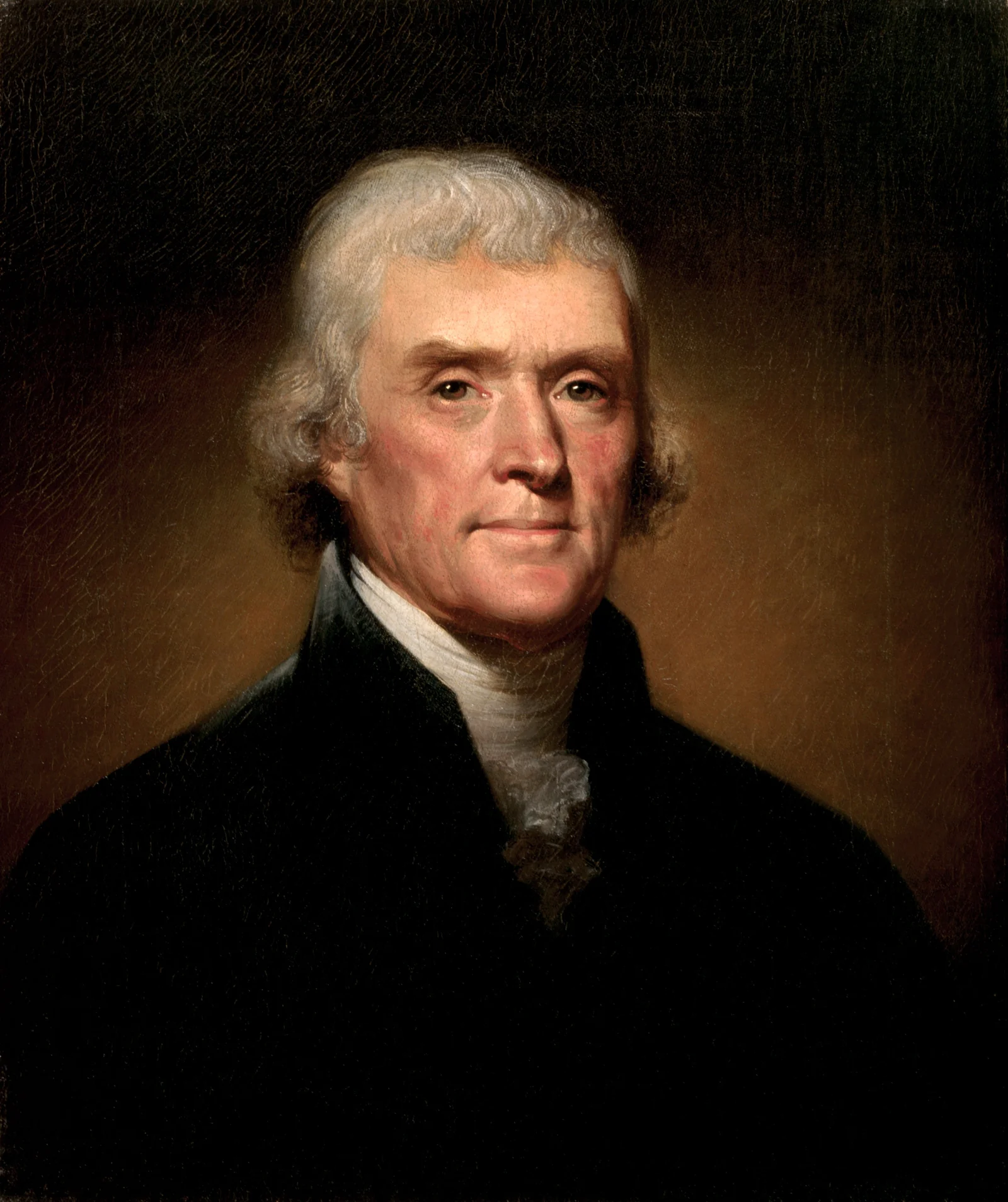
| 144 Quotes | |
| Occup. | President |
| From | USA |
| Born | April 13, 1743 |
| Died | July 4, 1826 |
| Aged | 83 years |
| Cite | |
Citation Formats
APA Style (7th ed.)
Thomas jefferson biography, facts and quotes. (2026, February 2). FixQuotes. https://fixquotes.com/authors/thomas-jefferson/
Chicago Style
"Thomas Jefferson biography, facts and quotes." FixQuotes. February 2, 2026. https://fixquotes.com/authors/thomas-jefferson/.
MLA Style (9th ed.)
"Thomas Jefferson biography, facts and quotes." FixQuotes, 2 Feb. 2026, https://fixquotes.com/authors/thomas-jefferson/. Accessed 27 Mar. 2026.
Early Life and Background
Thomas Jefferson was born on April 13, 1743, at Shadwell in Albemarle County, Virginia, the third child of Peter Jefferson, a surveyor and planter, and Jane Randolph, from one of the colony's most connected families. His childhood unfolded on a plantation frontier where mapmaking, land hunger, and slavery were everyday facts, and where status rested on acreage, lineage, and credit as much as on learning. When his father died in 1757, Jefferson inherited land and enslaved people, along with a sense that property brought both independence and obligation.The Virginia of Jefferson's youth was a world of county courts, Anglican parish authority, and a political elite trained to see itself as steward of public life. Yet the same landscape contained its contradiction: a rhetoric of liberty built upon coerced labor. Jefferson absorbed that paradox early, later enlarging it into a lifelong effort to reconcile Enlightenment principles with the plantation reality that sustained his household and, in part, his public career.
Education and Formative Influences
Jefferson studied first under tutors, then at the College of William and Mary in Williamsburg (1760-1762), where he encountered mathematics, moral philosophy, and the cosmopolitan currents of the Scottish Enlightenment. The decisive influence was George Wythe, the colony's leading legal mind, who trained him in law and classical republican history while introducing him to a circle that prized rational inquiry and public virtue. Jefferson read widely - Bacon, Locke, Newton - and cultivated the habits that would define him: systematic note-taking, architectural sketching, and an almost ascetic faith that good government could be designed like a well-proportioned building.Career, Major Works, and Turning Points
Admitted to the Virginia bar in 1767, Jefferson entered the House of Burgesses and then revolutionary leadership, drafting "A Summary View of the Rights of British America" (1774) and, in 1776, the Declaration of Independence, whose cadences turned colonial grievance into universal claim. As Virginia's governor (1779-1781) he faced British invasion and political criticism, then rebuilt his standing through legislative work: the Virginia Statute for Religious Freedom, written in 1777 and enacted in 1786, became his most cherished domestic achievement. Abroad in Paris as minister to France (1785-1789), he watched the Old World's glamour and inequality at close range, returning to serve as Washington's secretary of state (1790-1793) and as the intellectual leader of the emerging Democratic-Republican opposition to Federalist centralization. As president (1801-1809), he pursued limited government while acting boldly - most notably through the Louisiana Purchase (1803) - and faltered with the Embargo Act (1807), a coercive experiment that strained his own creed. In retirement at Monticello he founded the University of Virginia, battled debt, and maintained an immense correspondence until his death on July 4, 1826, the fiftieth anniversary of independence.Philosophy, Style, and Themes
Jefferson's inner life was a blend of analytical coolness and romantic longing: a man who trusted reason, yet wrote with lyric intensity about nature, friendship, and the republic's moral destiny. His public philosophy rested on the conviction that political legitimacy must be kept close to the citizen, not concentrated in offices, banks, or armies. “When the people fear the government, there is tyranny. When the government fears the people, there is liberty”. The line captures his suspicion of permanent power and his preference for rotation, transparency, and a vigilant electorate - ideals shaped by the revolutionary struggle and sharpened by his battles with Alexander Hamilton over finance and executive reach.At the same time, Jefferson believed character was cultivated by environment: dispersed landholding, local institutions, and a civic culture that resisted dependence. “When we get piled upon one another in large cities, as in Europe, we shall become as corrupt as Europe”. This agrarian republicanism was not mere nostalgia; it was an attempt to protect autonomy against what he saw as the social psychology of crowding, patronage, and imitation. Yet his most piercing theme was the moral contradiction of slavery. He could describe human equality in the abstract while living from enslaved labor and, at Monticello, almost certainly sustaining a long relationship with Sally Hemings. The unease surfaces in a sentence of prophetic dread: “I tremble for my country when I reflect that God is just; that his justice cannot sleep forever”. Jefferson's style - plain in structure, musical in rhythm - turned philosophical claims into political scripture, but it also revealed a mind capable of postponement, compartmentalization, and self-justifying hope.
Legacy and Influence
Jefferson endures as both architect and problem: the principal author of the nation's most famous statement of rights, a president who expanded the republic, and a founder of American public education through the University of Virginia. His influence runs through democratic reform movements that have repeatedly returned to the Declaration's promises to argue against inherited privilege, religious establishment, and racial caste. Yet his legacy is inseparable from the enslaved community at Monticello and the gulf between his universal language and his private practice, a tension that has made him a permanent reference point in American moral argument - invoked as inspiration, interrogated as evidence, and studied as a case where genius and blindness lived in the same mind.Our collection contains 144 quotes written by Thomas, under the main topics: Witty One-Liners - Motivational - Ethics & Morality - Truth - Wisdom.
Other people related to Thomas: James Madison (President), John Adams (President), George Mason (Statesman), Patrick Henry (Politician), John Randolph (Leader), James Monroe (President), Dolley Madison (First Lady), Meriwether Lewis (Explorer), William Floyd (Politician), David Rittenhouse (Scientist)
Thomas Jefferson Famous Works
- 1820 The Life and Morals of Jesus of Nazareth (Book)
- 1801 Manual of Parliamentary Practice for the Use of the Senate of the United States (Book)
- 1785 Notes on the State of Virginia (Book)
- 1776 Declaration of Independence (Historical Document)
- 1774 A Summary View of the Rights of British America (Book)