
Thomas Malthus Biography Quotes 19 Report mistakes
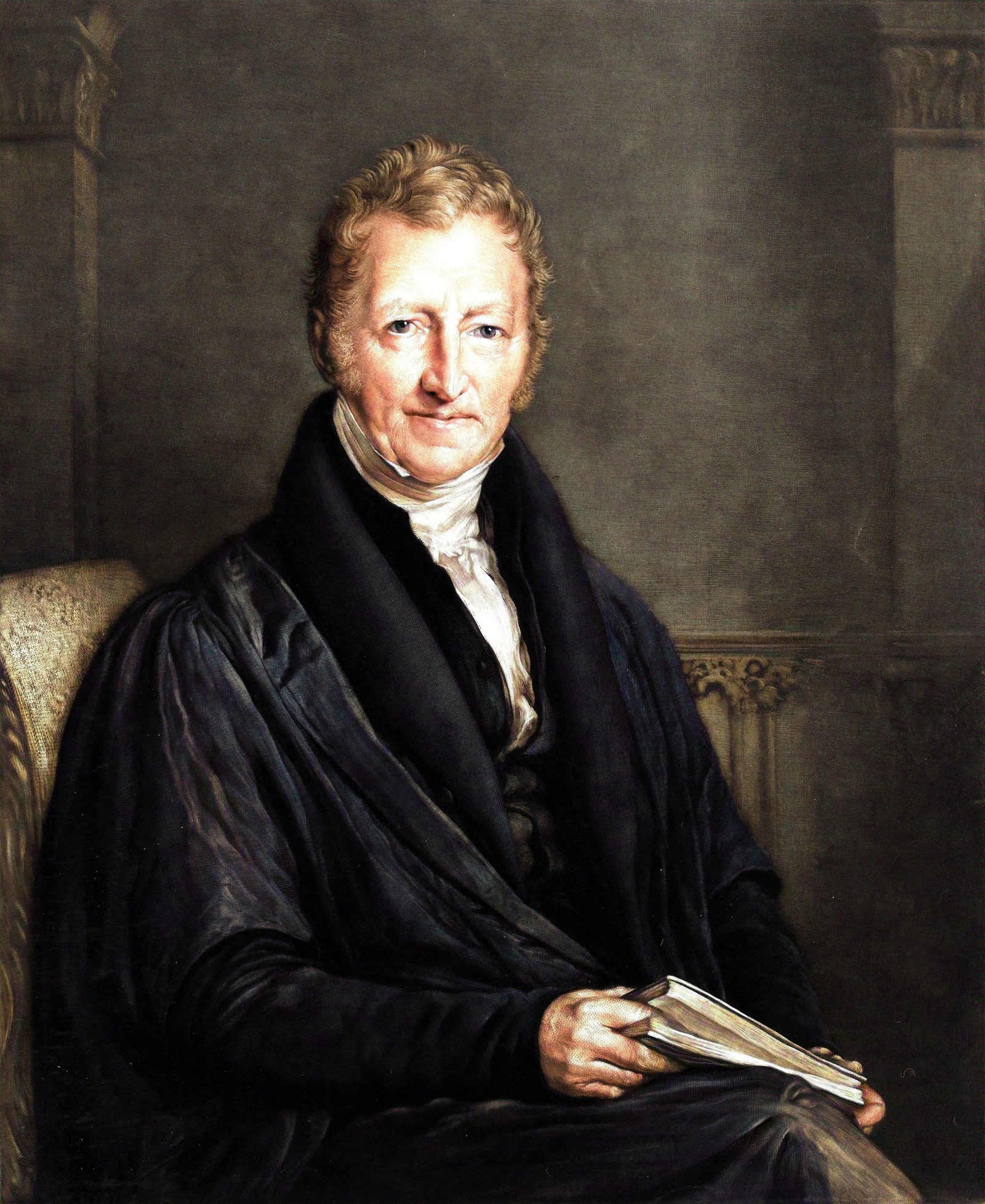
Attr: John Linnell
| 19 Quotes | |
| Born as | Thomas Robert Malthus |
| Occup. | Economist |
| From | England |
| Born | February 13, 1766 Dorking, Surrey, England |
| Died | December 23, 1834 Bath, Somerset, England |
| Aged | 68 years |
| Cite | |
Citation Formats
APA Style (7th ed.)
Thomas malthus biography, facts and quotes. (2026, February 11). FixQuotes. https://fixquotes.com/authors/thomas-malthus/
Chicago Style
"Thomas Malthus biography, facts and quotes." FixQuotes. February 11, 2026. https://fixquotes.com/authors/thomas-malthus/.
MLA Style (9th ed.)
"Thomas Malthus biography, facts and quotes." FixQuotes, 11 Feb. 2026, https://fixquotes.com/authors/thomas-malthus/. Accessed 25 Mar. 2026.
Early Life and Background
Thomas Robert Malthus was born on February 13, 1766, at The Rookery near Wotton in Surrey, into the comfortable but intellectually restless world of the English gentry. His father, Daniel Malthus, was an admirer of Enlightenment thinkers and a friend of David Hume and Jean-Jacques Rousseau, and he raised his son amid arguments about progress, reason, and the perfectibility of society. The household combined Anglican respectability with a taste for dissenting ideas, giving Malthus early familiarity with the clash between utopian speculation and lived social limits.
Eighteenth-century England was already being remade by enclosure, commercial agriculture, and early industrialization; the poor laws and periodic grain crises kept hunger within sight of prosperity. Malthus grew up observing how markets, harvests, and local relief shaped village life, and he carried forward a moral seriousness about poverty that never fit neatly into either complacent conservatism or radical optimism. He would become, above all, a theorist of constraint - and a clergyman-economist determined to describe the pressures beneath polite narratives of improvement.
Education and Formative Influences
Malthus entered Jesus College, Cambridge, in 1784, graduating in 1788 and taking his MA in 1791; he was elected a fellow and was ordained in the Church of England in 1797. Cambridge mathematics trained his taste for ratios and regularities, while the moral philosophy of the period pushed him to treat economics as an inquiry into human behavior under scarcity. The immediate provocation for his most famous argument was the late-1790s debate stirred by William Godwin and the Marquis de Condorcet, whose visions of indefinite human improvement struck Malthus as psychologically seductive but empirically reckless.
Career, Major Works, and Turning Points
In 1798 he published, anonymously, An Essay on the Principle of Population as it Affects the Future Improvement of Society, a polemical intervention aimed at utopian reformers; the greatly expanded second edition of 1803, now under his name, shifted from pamphlet to program, adding historical and travel-based evidence and developing the distinction between preventive checks (moral restraint, later marriage) and positive checks (disease, famine, war). He became professor of history and political economy at the East India Company College at Haileybury in 1805, one of the first such chairs in Britain, teaching administrators destined for imperial service. Later works extended his analysis beyond population: Observations on the Effects of the Corn Laws (1814) addressed grain policy and distributional conflict; Principles of Political Economy (1820) challenged the idea that general gluts were impossible and emphasized effective demand; and Definitions in Political Economy (1827) defended clarity against conceptual slippage. A marriage in 1804 to Harriet Eckersall steadied his domestic life, but intellectually he remained a public target - caricatured as an enemy of the poor even as he insisted on sober compassion.
Philosophy, Style, and Themes
Malthus wrote with the cadence of a parish moralist and the architecture of a mathematician: premise, ratio, consequence. His central claim was not that poverty was deserved, but that institutions and sentiments could not repeal biological and social impulses. “Population, when unchecked, increases in a geometrical ratio”. That sentence contains his psychology of human nature: desire, reproduction, and imitation press forward faster than any slow-moving improvement in land, yields, or wages, so policy must reckon with limits rather than promise painless abundance.
He was also acutely aware of how abstraction can become a refuge from responsibility. “A writer may tell me that he thinks man will ultimately become an ostrich. I cannot properly contradict him”. The dry humor masks a deeper anxiety about intellectual fashion: once speculation severs itself from evidence, it becomes immune to refutation and dangerously persuasive. Yet Malthus was no simple apologist for wealth or hierarchy; his attention to incentives and power led him to insist that distress is often prolonged by elites as well as by nature. “The rich, by unfair combinations, contribute frequently to prolong a season of distress among the poor”. In this tension - between natural constraint and man-made injustice - lies the enduring complexity of his thought.
Legacy and Influence
Malthus died on December 23, 1834, at St Catherine near Bath, leaving a legacy that outgrew both his intentions and his era. His principle of population became a cornerstone of classical political economy, shaping debates on the poor laws, wages, and food prices, while provoking lasting controversy over whether scarcity is primarily natural or political. Charles Darwin and Alfred Russel Wallace later acknowledged that Malthus helped them conceptualize struggle and selection in nature, translating social pressure into evolutionary mechanism. Across the 19th and 20th centuries, "Malthusian" became shorthand - sometimes unfairly - for pessimism and austerity, yet the best of his work remains a disciplined warning against utopian certainty: that policy must face reproduction, resources, distribution, and human motive together, or it will mistake hopes for laws.
Our collection contains 19 quotes written by Thomas, under the main topics: Witty One-Liners - Ethics & Morality - Wisdom - Nature - Deep.
Other people related to Thomas: Robert Heilbroner (Economist), Thomas Chalmers (Clergyman)
Frequently Asked Questions
- What did Thomas Malthus believe: That population growth tends to outstrip resources, leading to scarcity unless checked by moral restraint or natural limits.
- Thomas Robert Malthus books: An Essay on the Principle of Population; Principles of Political Economy; Definitions in Political Economy.
- Thomas Robert Malthus influenced: Charles Darwin, Alfred Russel Wallace, and classical economic/demographic thought.
- Thomas Malthus contribution to evolution: His population pressure idea inspired Darwin and Wallace’s theory of natural selection.
- Thomas Malthus book: An Essay on the Principle of Population (1798).
- Thomas Malthus' theory: Unchecked population growth outpaces resources, causing poverty and crisis unless limited by preventive or positive checks.
- Thomas Malthus population theory: Population grows geometrically while food supply grows arithmetically; checks like famine, disease, war, and moral restraint curb growth.
- How old was Thomas Malthus? He became 68 years old
Source / external links