
Thomas Mann Biography Quotes 44 Report mistakes
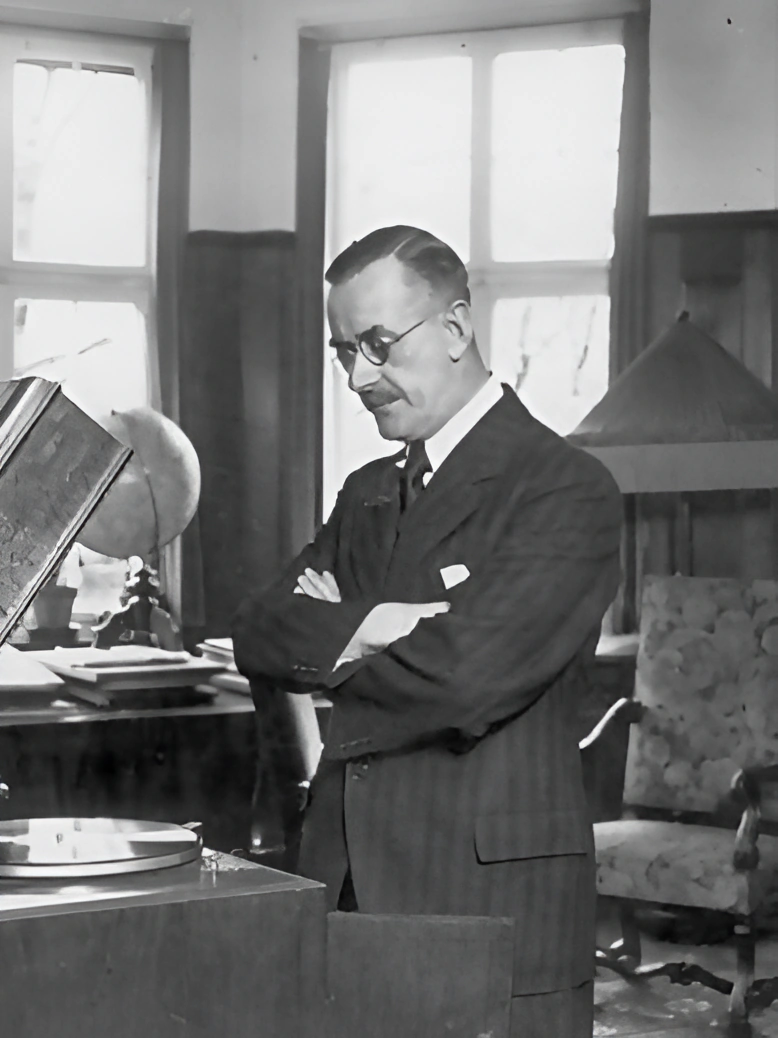
| 44 Quotes | |
| Born as | Paul Thomas Mann |
| Occup. | Writer |
| From | Germany |
| Born | June 6, 1875 Lubeck, German Empire |
| Died | August 12, 1955 Zurich, Switzerland |
| Aged | 80 years |
| Cite | |
Citation Formats
APA Style (7th ed.)
Thomas mann biography, facts and quotes. (2026, February 11). FixQuotes. https://fixquotes.com/authors/thomas-mann/
Chicago Style
"Thomas Mann biography, facts and quotes." FixQuotes. February 11, 2026. https://fixquotes.com/authors/thomas-mann/.
MLA Style (9th ed.)
"Thomas Mann biography, facts and quotes." FixQuotes, 11 Feb. 2026, https://fixquotes.com/authors/thomas-mann/. Accessed 18 Feb. 2026.
Early Life and Background
Paul Thomas Mann was born on June 6, 1875, in Lubeck, a Hanseatic port whose mercantile pride and tight social hierarchies left an imprint he never stopped anatomizing. His father, Thomas Johann Heinrich Mann, was a grain merchant and senator, a figure of civic solidity; his mother, Julia da Silva Bruhns, brought a more cosmopolitan, Brazilian-inflected sensibility and a taste for music and storytelling. The contrast between bourgeois duty and aesthetic temptation - already visible in his parents - became the basic tension of his fiction.When his father died in 1891, the family firm was liquidated and the old certainties cracked. The adolescent Mann watched status become contingency, and the experience sharpened his fascination with decline, inheritance, and the way a family myth can outlive the economic facts that once sustained it. In 1894 he moved with his mother and younger siblings to Munich, beginning a lifelong alternation between belonging and exile, security and self-invention.
Education and Formative Influences
Mann did not follow a conventional university route; he attended the Katharineum in Lubeck, then trained loosely for business and worked briefly in an insurance office while writing in earnest. Munich offered theaters, cafés, journals, and the modernist ferment that could turn private observation into public art. He read widely - Schopenhauer and Nietzsche for metaphysics and psychology, Goethe for classical measure, and Wagner for the seductions and dangers of total art - and he absorbed the fin-de-siecle preoccupation with sickness, erotic ambiguity, and the costs of civilization.Career, Major Works, and Turning Points
Mann broke through with Buddenbrooks (1901), a family chronicle modeled on Lubeck that turned the erosion of a merchant dynasty into a meditation on time and temperament, earning him the 1929 Nobel Prize in Literature. In the years that followed he refined his method: Tonio Kroger (1903) framed the artist as an insider-outsider; Death in Venice (1912) distilled desire, discipline, and decay into a tragic fable; The Magic Mountain (1924) staged pre-1914 Europe in a Swiss sanatorium where ideas themselves become symptoms. Politically, he moved from the nationalist defensiveness of Reflections of a Nonpolitical Man (1918) toward an explicit commitment to democracy during the Weimar years, then into exile after Hitler's rise in 1933, first in Switzerland, later in the United States. From abroad he fought Nazism with essays and the BBC radio addresses later gathered as Deutsche Horer!, while producing his major late cycles: the Joseph and His Brothers tetralogy (1933-1943), Lotte in Weimar (1939), and Doktor Faustus (1947), his bleakest reckoning with German culture and the catastrophe of fascism. He returned to Europe after the war, settling in Switzerland, and died in Zurich on August 12, 1955.Philosophy, Style, and Themes
Mann's inner life was a disciplined performance over a volatile core: a craftsman of stately sentences and ironic distance, yet haunted by longing, shame, and the fear that art feeds on what ordinary life forbids. He cultivated a public persona of bourgeois reliability - husband to Katia Pringsheim and father of six - while his diaries and fiction reveal a persistent homoerotic current transmuted into form, metaphor, and moral inquiry. His narratives often proceed like case studies in which a character's ethical posture is tested by time, eros, illness, and the pressure of history.His style is simultaneously classical and corrosive: long-breathed, essayistic, alert to the comic, and committed to the idea that language is the medium of civic life as much as private confession. In his mature view, the writer cannot retreat into purity because power will not allow it; “Everything is politics”. Yet he also distrusted consoling myths, insisting on the educative sting of honesty - “A harmful truth is better than a useful lie”. The result is a literature of doubles: health and sickness, duty and desire, culture and barbarism, Germany's humanist tradition and its capacity for self-destruction. Even his fascination with paradox - the possibility that incompatible claims can both be valid - echoes his method of holding competing truths in tense suspension: “A great truth is a truth whose opposite is also a truth”. Legacy and Influence
Mann became one of the central moral witnesses of 20th-century European letters: a novelist who turned the bourgeois home, the sickroom, and the lecture hall into stages where civilizations reveal their secret drives. His work shaped the modern intellectual novel, influencing writers from Hermann Hesse to W.G. Sebald, and his exile stance helped define the role of the public author confronting tyranny without surrendering complexity. Buddenbrooks remains a template for family realism; The Magic Mountain and Doktor Faustus endure as interpretive machines for modernity itself, reminding readers that culture is never merely refinement - it is also an arena where fate and responsibility contend sentence by sentence.
Our collection contains 44 quotes written by Thomas, under the main topics: Witty One-Liners - Wisdom - Truth - Art - Love.
Other people related to Thomas: Johann Wolfgang Von Goethe (Writer), Joseph Campbell (Author), Philippe Halsman (Photographer), Arnold Schoenberg (Composer), Herman Hesse (Author), Hermann Broch (Writer), George Steiner (Critic), Ann Patchett (Author), Lion Feuchtwanger (Novelist), Alfred A. Knopf (Publisher)
Thomas Mann Famous Works
- 1954 Confessions of Felix Krull (Novel)
- 1947 Doctor Faustus (Novel)
- 1939 Lotte in Weimar (Novel)
- 1933 Joseph and His Brothers (Novel)
- 1930 Mario and the Magician (Novella)
- 1924 The Magic Mountain (Novel)
- 1918 Reflections of a Non-Political Man (Essay)
- 1912 Death in Venice (Novella)
- 1909 Royal Highness (Novel)
- 1903 Tristan (Short Story)
- 1903 Tonio Kröger (Novella)
- 1901 Buddenbrooks (Novel)
Source / external links