
Thomas More Biography Quotes 30 Report mistakes
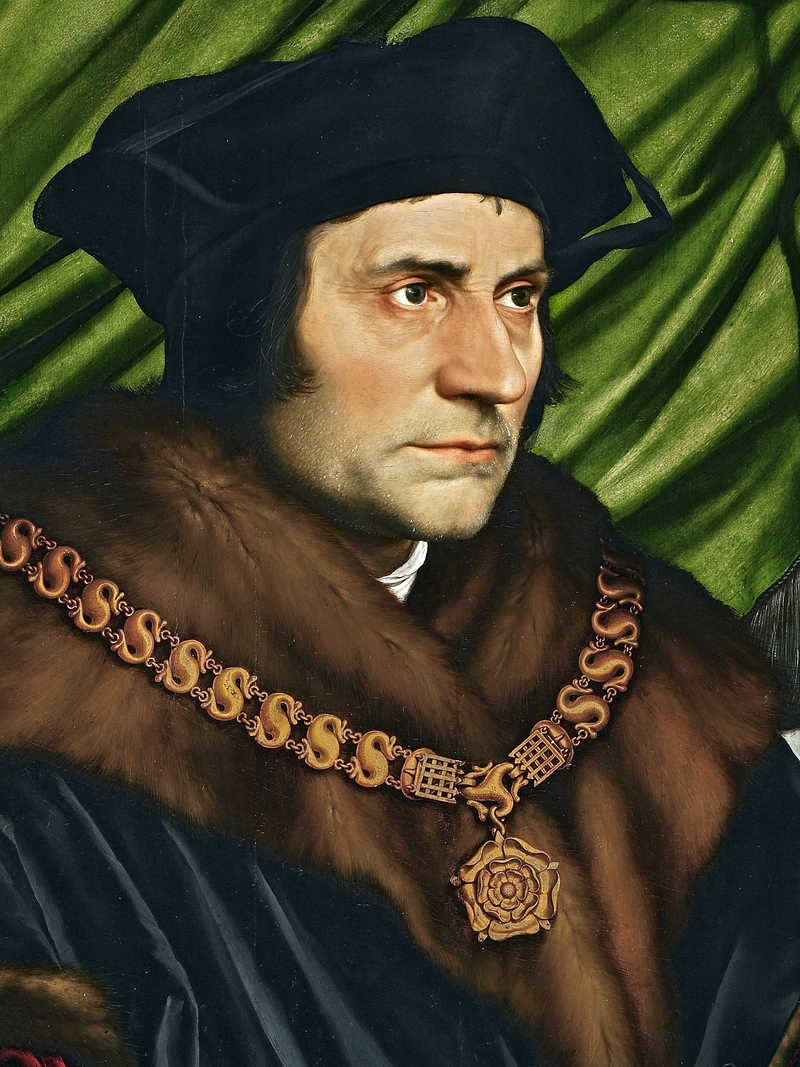
| 30 Quotes | |
| Known as | Saint Thomas More |
| Occup. | Author |
| From | England |
| Born | February 7, 1478 London, England |
| Died | July 6, 1535 London, England |
| Cause | beheading |
| Aged | 57 years |
| Cite | |
Citation Formats
APA Style (7th ed.)
Thomas more biography, facts and quotes. (2026, February 11). FixQuotes. https://fixquotes.com/authors/thomas-more/
Chicago Style
"Thomas More biography, facts and quotes." FixQuotes. February 11, 2026. https://fixquotes.com/authors/thomas-more/.
MLA Style (9th ed.)
"Thomas More biography, facts and quotes." FixQuotes, 11 Feb. 2026, https://fixquotes.com/authors/thomas-more/. Accessed 4 Mar. 2026.
Early Life and Background
Thomas More was born on 7 February 1478 in London, England, into the self-confident world of the late medieval city where law, commerce, and royal service interlocked. His father, Sir John More, rose as a successful lawyer and later a judge of the King's Bench, giving his son both a professional model and an early lesson in how public authority could be built from technical mastery rather than inherited rank. London at the turn of the sixteenth century was a place of parish discipline, bustling guild life, and anxious piety - a culture still Catholic in texture yet increasingly exposed to the new humanist learning flowing from the Continent.As a young man More moved close to power without being born to it. He served as a page in the household of John Morton, Archbishop of Canterbury and Lord Chancellor, a kingmaker under Henry VII who recognized More's quick intelligence and moral seriousness. This proximity to court trained him in the language of counsel and the art of restrained speech, while the city's legal culture trained him in procedure, precedent, and the slow coercion of institutions. The tension that would define his adulthood - between inner conscience and public office - began as an apprenticeship in two disciplines that rarely agree: law and salvation.
Education and Formative Influences
More studied at Oxford in the 1490s, absorbing Greek and Latin letters and the emerging program of Christian humanism, then returned to London for legal training at New Inn and Lincoln's Inn, being called to the bar in 1501. He lived for a time near the Carthusian Charterhouse, practicing intense devotional routines and seriously weighing a monastic vocation, yet he chose marriage and civic life - first to Jane Colt, and after her death to Alice Middleton - while keeping a near-monastic regimen within a household that became famous for learning, music, disciplined conversation, and the education of his daughters, especially Margaret Roper.Career, Major Works, and Turning Points
More entered Parliament in 1504 and gained a reputation for plain speaking, then advanced through London offices to become Under-Sheriff of London (1510), a post that honed his reputation for brisk justice and incorruptibility. Diplomatic missions for Henry VIII brought him into the circle of Erasmus, whose friendship and wit matched his own; their exchange helped define northern humanism's blend of classical clarity and Christian reform. In 1516 More published "Utopia" (Latin; expanded 1518), a fiction framed as travel report that anatomized European greed, war, and punitive law by imagining an alternative commonwealth; its ironies made it both a mirror and a provocation. Under Henry VIII he rose to knighthood (1521), the Privy Council, and in 1529 succeeded Cardinal Wolsey as Lord Chancellor, the highest legal office in England. The turning point came with the King's break from Rome: More resigned in 1532, refusing to endorse the royal supremacy, and in 1534 was imprisoned in the Tower for rejecting the Oath of Succession. Tried for treason on contested evidence, he was executed on 6 July 1535, dying as a statesman who chose fidelity to conscience over the mechanics of power.Philosophy, Style, and Themes
More's inner life was built from a strict Catholic devotional core wrapped in a humanist style that loved dialogue, paradox, and the testing of ideas by irony. "Utopia" is often misread as a blueprint; it is better approached as a moral instrument, forcing readers to see how custom masks cruelty and how policy can be judged by the kind of person it produces. He distrusted moral theater and assumed that virtue is most endangered precisely where it is most praised, a suspicion captured in his acid realism: “If honor were profitable, everybody would be honorable”. That sentence reads like autobiography - the lawyer's awareness that incentives shape public behavior, and the Christian's insistence that goodness must be chosen when it costs.His legal imagination likewise defended structure, not sentiment. More could prosecute heresy with severity in an age when religious unity was treated as civic peace, yet he also believed that law is the last defense against arbitrary force, especially when rulers claim necessity. His famous insistence, “I would uphold the law if for no other reason but to protect myself”. , reveals a psychology wary of purity unmoored from procedure: he feared that once law is cut down to chase devils, no one is safe when the wind changes. And against the grand gestures of reformers and courtiers alike, he kept returning to the household as the primary theater of sanctity: “The ordinary acts we practice every day at home are of more importance to the soul than their simplicity might suggest”. In More's world, the state could demand words, but only daily practice could form character; that is why his home became both a school of letters and a rehearsal space for conscience.
Legacy and Influence
More endures as one of the defining figures of Renaissance England - author of "Utopia", patron of learning, and martyr of conscience in the crisis of the Reformation. To Catholics he became a saint (canonized 1935), and to political thinkers he remains a case study in the limits of obedience and the dignity of principled refusal. Yet his legacy is intentionally uncomfortable: the same man who imagined religious variety in distant lands also fought heresy at home; the same counselor who served a charismatic king died resisting that king's claims. His influence survives because his life forces a hard question that modernity still struggles to answer: what is the cost of integrity when power demands not merely action, but assent?Our collection contains 30 quotes written by Thomas, under the main topics: Witty One-Liners - Ethics & Morality - Wisdom - Friendship - Love.
Other people related to Thomas: Desiderius Erasmus (Philosopher), John Donne (Poet), Edward Hall (Lawyer), William Tyndale (Clergyman), Anne Boleyn (Royalty), Jeremy Northam (Actor), Paul Scofield (Actor), Elizabeth Barton (Celebrity), Peter Ackroyd (Author)
Thomas More Famous Works
- 1534 A Dialogue of Comfort Against Tribulation (Essay)
- 1529 The Supplication of Souls (Essay)
- 1523 Responsio ad Lutherum (Answer to Martin Luther) (Essay)
- 1516 Utopia (Book)
- 1513 The History of King Richard III (Non-fiction)