
Thor Heyerdahl Biography Quotes 22 Report mistakes
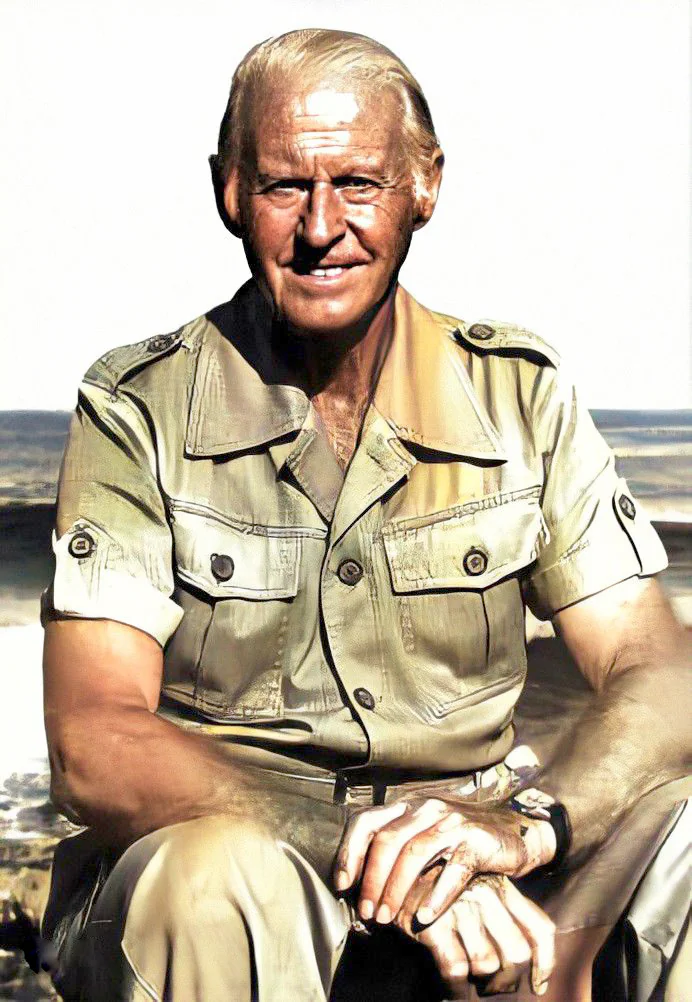
| 22 Quotes | |
| Occup. | Explorer |
| From | Norway |
| Spouse | Liv Coucheron-Torp |
| Born | October 6, 1914 Larvik, Norway |
| Died | April 18, 2002 Colla Micheri, Italy |
| Cause | Heart failure |
| Aged | 87 years |
| Cite | |
Citation Formats
APA Style (7th ed.)
Thor heyerdahl biography, facts and quotes. (2026, February 2). FixQuotes. https://fixquotes.com/authors/thor-heyerdahl/
Chicago Style
"Thor Heyerdahl biography, facts and quotes." FixQuotes. February 2, 2026. https://fixquotes.com/authors/thor-heyerdahl/.
MLA Style (9th ed.)
"Thor Heyerdahl biography, facts and quotes." FixQuotes, 2 Feb. 2026, https://fixquotes.com/authors/thor-heyerdahl/. Accessed 5 Mar. 2026.
Early Life and Background
Thor Heyerdahl was born on 6 October 1914 in Larvik, a small Norwegian port town facing the Skagerrak. His father ran a brewery; his mother, Alison Lyng, worked at the local museum and filled the household with specimens, maps, and stories of distant seas. Larvik in the early 20th century still carried Norway's deep maritime inheritance - seamanship, whaling routes, and the idea that the ocean was both workplace and pathway. In that setting Heyerdahl absorbed a practical confidence about boats and weather, and an imaginative hunger for what lay beyond the horizon.He grew up during a Europe destabilized by World War I's aftermath and, later, by the hardening ideologies of the 1930s. For a young Norwegian, the world seemed simultaneously larger (through radio, books, and travel accounts) and more barricaded (through borders, militarization, and suspicion). Heyerdahl's early temperament fused two impulses that often conflict: a collector's attention to natural detail and a provocateur's impatience with official consensus. By his late teens he was already drawn to the question that would structure his life - not only where peoples came from, but how ideas about origins become cultural gatekeeping.
Education and Formative Influences
Heyerdahl studied zoology and geography at the University of Oslo, training that gave him the language of biology and distribution but also exposed him to academic boundaries he would later test. In 1937 he married Liv Coucheron-Torp and traveled to French Polynesia, living on Fatu Hiva in the Marquesas. The experience moved him away from armchair theories and toward material culture: currents, winds, rafts, and the everyday technologies of island life. The Pacific became his lifelong laboratory, and the interwar period's spirit of field exploration - mixed with a growing skepticism toward purely textual scholarship - formed his method: argue with artifacts, not only with books.Career, Major Works, and Turning Points
World War II interrupted his plans; he served in the Norwegian armed forces and emerged more distrustful of state narratives and the romance of military heroism. After the war he developed his most famous hypothesis: that ancient peoples could have crossed the Pacific from South America, and that such voyages were within the reach of pre-modern technology. In 1947 he led the Kon-Tiki expedition, sailing a balsa-wood raft from Peru to the Tuamotu archipelago, a 101-day passage that turned an unorthodox ethnographic argument into a public event. The Kon-Tiki book (and Oscar-winning documentary) made him a global figure, and he followed it with the Ra expeditions (1969-70) attempting an Atlantic crossing in papyrus boats, and with Tigris (1977-78), launched in the Persian Gulf and sailed toward the Red Sea before he burned it in protest against regional conflict. He also undertook archaeological work on Rapa Nui (Easter Island) and in the Maldives, writing prolifically and courting controversy as he tried to keep diffusion - the movement and mixing of peoples - at the center of popular historical imagination.Philosophy, Style, and Themes
Heyerdahl's inner life reads as a sustained argument against confinement: intellectual, national, and psychological. He was not content to say that something might have happened; he wanted to build the vessel, feel the swell, and let the sea deliver a verdict. His experiments were theater in the best sense - staged under real risk so that an abstract debate could be experienced. That approach revealed both his strength and his blind spot. He could expose the complacency of "impossible" assumptions, yet his voyages demonstrated feasibility more than they proved specific historical migrations, and professional archaeologists often challenged his interpretations. Still, his work was driven by an ethical intuition as much as a technical one: the conviction that human history is broader than any one nation's story, and that curiosity is a kind of peace-making.His writing returns again and again to permeability - between continents, disciplines, and ways of knowing. “Borders? I have never seen one. But I have heard they exist in the minds of some people”. For Heyerdahl, the statement is not a slogan but a diagnosis: fear turns geography into destiny, while imagination turns geography into a route. He also distrusted the self-satisfied complexity of modern institutions, warning that “Progress is man's ability to complicate simplicity”. That impatience animated his craft choices - rafts, reeds, and ropes - as if stripping technology back could strip thought back, too, revealing what human bodies and natural forces can actually do together. And he framed knowledge as humility before the non-academic world: “One learns more from listening than speaking. And both the wind and the people who continue to live close to nature still have much to tell us which we cannot hear within university walls”. It is a self-portrait of the explorer as listener, even when his public persona looked like defiance.
Legacy and Influence
Heyerdahl died on 18 April 2002, leaving a legacy that sits between scholarship and mythmaking, and that is precisely why he endures. He helped popularize experimental archaeology and reintroduced ocean currents and traditional craft into conversations about prehistory, influencing later hands-on approaches even among critics. His central claim - that long-distance contact was more achievable than modern people assume - has been partly vindicated in a general sense by increasing evidence of ancient voyaging networks, even as many of his specific conclusions remain disputed. More broadly, his life offered a model of intellectual courage: to test an idea with one's own hands, to cross seas to argue about the past, and to insist that human history is a story of movement rather than isolation.Our collection contains 22 quotes written by Thor, under the main topics: Wisdom - Truth - Mortality - Freedom - Learning.
Other people related to Thor: Jeff Rich (Explorer)
Thor Heyerdahl Famous Works
- 1986 The Maldive Mystery (Book)
- 1978 Early Man and the Ocean (Book)
- 1971 The Ra Expeditions (Book)
- 1958 Aku-Aku: The Secret of Easter Island (Book)
- 1952 American Indians in the Pacific (Book)
- 1948 Kon-Tiki (Book)
Source / external links