
Thornton Wilder Biography Quotes 34 Report mistakes
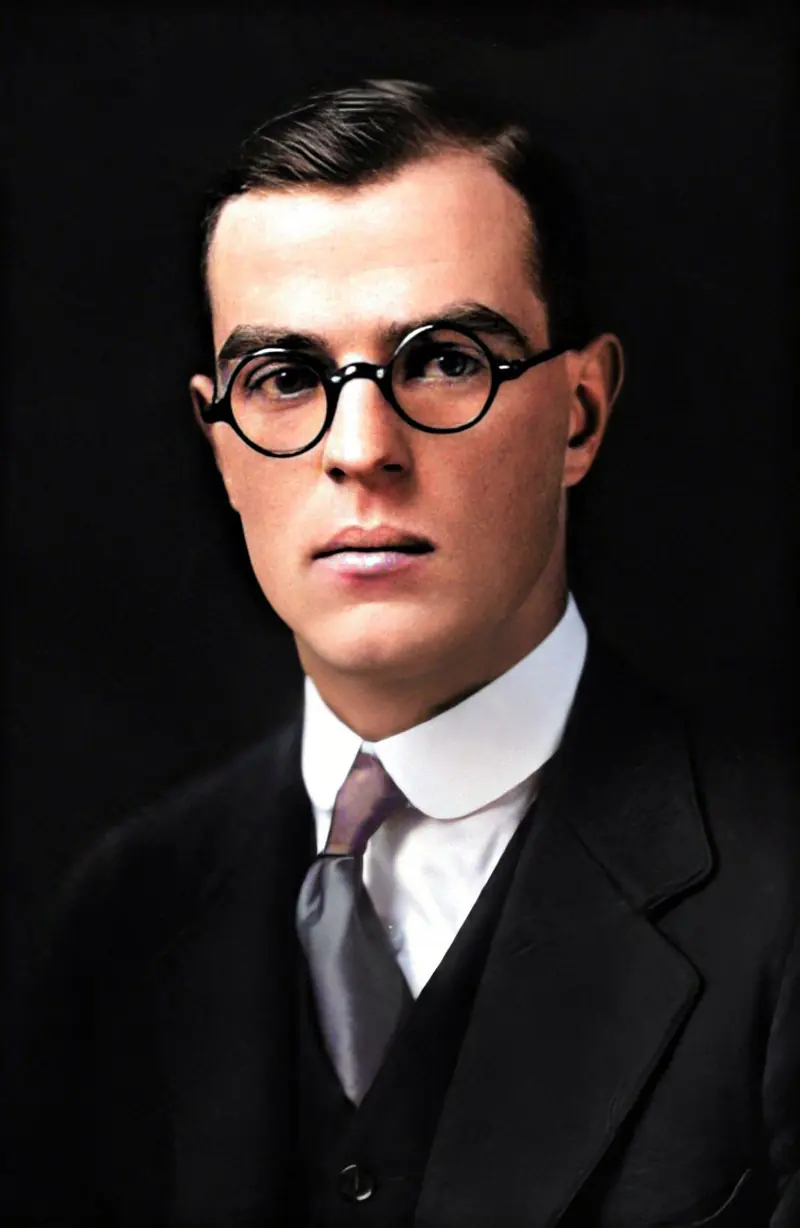
| 34 Quotes | |
| Born as | Thornton Niven Wilder |
| Occup. | Writer |
| From | USA |
| Spouse | Isabel Wilder |
| Born | April 17, 1897 Madison, Wisconsin, USA |
| Died | December 7, 1975 Hamden, Connecticut, USA |
| Cause | Heart attack |
| Aged | 78 years |
Thornton Niven Wilder was born on April 17, 1897, in Madison, Wisconsin, into a household shaped by public service, Protestant seriousness, and constant motion. His father, Amos Parker Wilder, was a newspaper editor and later a U.S. diplomat; his mother, Isabella Niven Wilder, brought cultivated tastes and a steady domestic discipline that tried to make each new posting feel like a home. Wilder grew up alongside siblings who would also become notable - including the poet and critic Amos Niven Wilder and the novelist Isabel Wilder - in a family where reading was not a pastime but a way of making sense of the world.
That diplomatic life carried him from the American Midwest to China, where the young Wilder absorbed a double education: the day-to-day strangeness of living abroad and the inward habit of turning experience into story. The repeated departures and arrivals trained him to see communities as temporary arrangements and to notice, in ordinary routines, the permanence people hunger for. This tension - between attachment and impermanence - became the emotional engine of his later fiction and theater, in which the smallest social rituals bear the weight of metaphysical questions.
Education and Formative Influences
Wilder studied at Oberlin College and then Yale University, graduating in 1920, and later pursued further study in archaeology in Rome, where classical remains sharpened his sense of time as layered and ironic. At Yale he wrote for campus publications and absorbed the discipline of structure and argument, while his reading in Greek and Latin drama, European moderns, and American realism helped him form a hybrid voice: classical in scaffolding, modern in skepticism, and distinctly American in its plainspoken surfaces. The post-World War I era - disillusioned, restless, newly cosmopolitan - gave him both a subject and a warning: sentimentality would not do, but cynicism was also too easy.
Career, Major Works, and Turning Points
Wilder began as a novelist and won immediate standing with The Bridge of San Luis Rey (1927), a book that turned an 18th-century Peruvian disaster into a laboratory for examining chance, love, and providence; it earned him a Pulitzer Prize and made his name. He taught at the University of Chicago in the 1930s, living a life split between academia and the stage, and in 1938 he reinvented American theater with Our Town, whose bare stage, Stage Manager, and insistence on the holiness of the everyday won a second Pulitzer. The Skin of Our Teeth (1942) - a third Pulitzer - confronted world war and civilizational collapse with a daring mix of allegory, vaudeville, and apocalypse. Later years brought The Matchmaker (1954, basis for Hello, Dolly!) and collaborations and revisions, including work connected to The Ides of March (1948), while he also served in U.S. military intelligence during World War II, an experience that deepened his sense of how thin the veneer of order can be.
Philosophy, Style, and Themes
Wilder wrote as if the plainest sentence could carry a metaphysical charge, and he distrusted literary fussiness in favor of architecture - a fable-like clarity that smuggled big questions into modest rooms. His work returns to the same pressure point: people do not notice their lives until they are losing them, and communities are most moving when seen as fragile agreements against oblivion. That is why Our Town can feel both comforting and accusatory, and why The Bridge of San Luis Rey turns grief into a demand for meaning without pretending that meaning arrives neatly packaged.
His aphoristic cast of mind was not decorative; it was a tool for self-interrogation. He could sound almost hedonistically simple - "My advice to you is not to inquire why or whither, but just enjoy your ice cream while it's on your plate". Yet the cheerfulness is edged with urgency: enjoyment is a discipline because time leaks away. Likewise, his compassion never fully abandons his satire: "Ninety-nine per cent of the people in the world are fools and the rest of us are in great danger of contagion". The line exposes a fear of moral infection - the ease with which crowds flatten judgment - that runs through his wartime work. And his deepest creed is a theology of attention: "We can only be said to be alive in those moments when our hearts are conscious of our treasures". It is the spiritual thesis of Emily Webb and George Gibbs, of survivors picking through wreckage, of ordinary speech made luminous by the knowledge that it will end.
Legacy and Influence
Wilder endures as one of the few American writers to make philosophical theater popular without diluting its rigor. Our Town remains a civic ritual in schools and regional theaters because its minimalism is not a gimmick but an ethic: it asks actors and audiences to supply the missing world with their own memory and gratitude. His experiments opened doors for later playwrights who trusted direct address, metatheatrical frames, and the collision of comedy with dread, while his fiction models how a short, spare narrative can hold arguments about fate and love. Wilder died on December 7, 1975, in Hamden, Connecticut, but his work keeps returning to the same charged instruction - to look hard at a kitchen table, a neighbor, a sunrise, and recognize, before it is too late, what has been there all along.
Our collection contains 34 quotes who is written by Thornton, under the main topics: Witty One-Liners - Motivational - Ethics & Morality - Wisdom - Love.
Other people realated to Thornton: Tallulah Bankhead (Actress), Hermann Broch (Writer), Ruth Gordon (Actress), Shirley Booth (Actress), Timothy Findley (Novelist), Montgomery Clift (Actor), Martha Scott (Actress)
Thornton Wilder Famous Works
- 1973 Theophilus North (Novel)
- 1948 The Ides of March (Novel)
- 1942 The Skin of Our Teeth (Play)
- 1938 Our Town (Play)
- 1927 The Bridge of San Luis Rey (Novel)
Source / external links