
Tim Berners-Lee Biography Quotes 33 Report mistakes
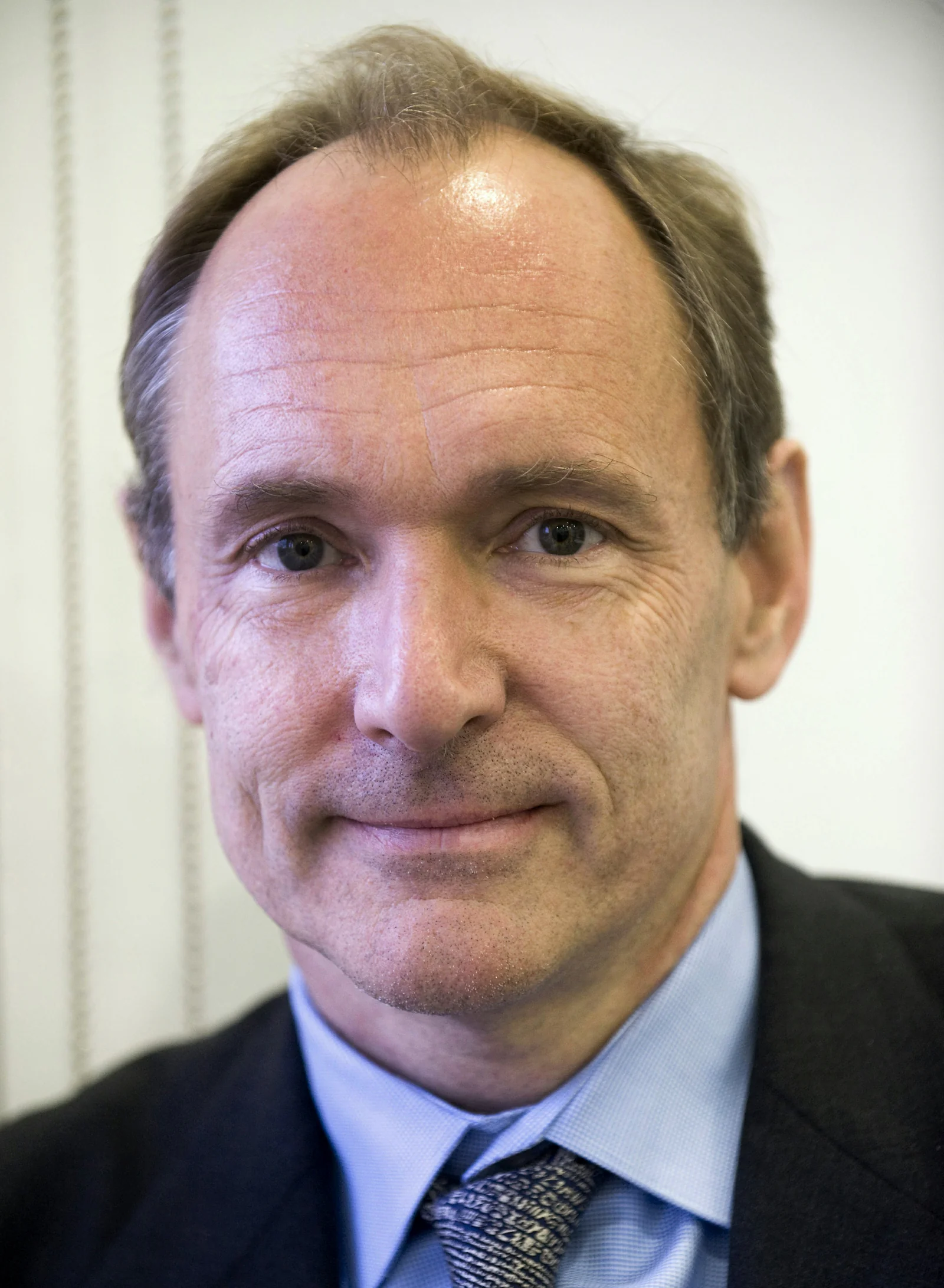
| 33 Quotes | |
| Born as | Timothy John Berners-Lee |
| Occup. | Inventor |
| From | United Kingdom |
| Spouse | Marilyn Lee |
| Born | June 8, 1955 London, England |
| Age | 70 years |
| Cite | |
Citation Formats
APA Style (7th ed.)
Tim berners-lee biography, facts and quotes. (2026, February 2). FixQuotes. https://fixquotes.com/authors/tim-berners-lee/
Chicago Style
"Tim Berners-Lee biography, facts and quotes." FixQuotes. February 2, 2026. https://fixquotes.com/authors/tim-berners-lee/.
MLA Style (9th ed.)
"Tim Berners-Lee biography, facts and quotes." FixQuotes, 2 Feb. 2026, https://fixquotes.com/authors/tim-berners-lee/. Accessed 5 Mar. 2026.
Early Life and Background
Timothy John Berners-Lee was born on 8 June 1955 in London, England, into a household where computing was not an abstraction but dinner-table reality. His parents, Mary Lee Woods and Conway Berners-Lee, worked on early commercial computing and helped program the Ferranti Mark 1, giving their son an upbringing steeped in the postwar British belief that information processing could reshape society.He grew up in a United Kingdom recalibrating from imperial power to scientific modernity, with universities, laboratories, and public institutions investing in networks, standards, and research collaboration. That atmosphere - pragmatic, technocratic, and often underfunded but intellectually ambitious - shaped his early sense that progress depends less on single machines than on interoperability: systems that can talk to each other without asking permission.
Education and Formative Influences
Berners-Lee attended schools in London and studied physics at The Queen's College, Oxford, graduating in 1976, an era when computing was shifting from isolated mainframes to distributed systems. At Oxford he combined an experimentalist's instinct with a builder's impatience, famously assembling a homemade computer with a soldering iron and scavenged parts, and learning firsthand how constraints force elegant design. Early jobs at Plessey Telecommunications and later D.G. Nash reinforced a practical competence with networks and software tools, while the broader research culture - packet switching, TCP/IP, and the ethic of open protocols - offered him a model for how technical standards can scale cooperation.Career, Major Works, and Turning Points
In 1980 Berners-Lee arrived at CERN near Geneva as a contractor and wrote ENQUIRE, a personal hypertext system that captured a recurring frustration: brilliant people produce knowledge that becomes inaccessible once separated by departments, machines, and file formats. Returning to CERN as a fellow in 1984, he watched the laboratory become a crossroads of incompatible computers and transient projects; in March 1989 he proposed an information system using hypertext over the Internet, and in 1990 built the core components: URL, HTTP, and HTML, plus the first web server (httpd) and browser-editor (WorldWideWeb) on a NeXT computer. The turning point was not merely invention but governance: in 1993 CERN released the Web technology royalty-free, enabling global adoption. Berners-Lee later founded the World Wide Web Consortium (W3C) at MIT in 1994 to steward standards, and he continued pushing the Web's next layers - linked data, the Semantic Web, and Web science - while advocating for openness, privacy, and decentralization through initiatives such as the Web Foundation and, later, Solid.Philosophy, Style, and Themes
Berners-Lee's style is austere engineering paired with moral imagination: build the smallest set of rules that lets others build everything else. He repeatedly framed the Web as a social contract encoded in protocols, a tool whose power comes from neutrality and universality rather than control. “We could say we want the Web to reflect a vision of the world where everything is done democratically. To do that, we get computers to talk with each other in such a way as to promote that ideal”. The line reveals a psychology that distrusts gatekeepers: his default is to widen the circle of participation, even when that makes outcomes messier.At the same time, he is not naive about fragility. “Data is a precious thing and will last longer than the systems themselves”. This is both technical counsel and a warning about memory and power: once information outlives platforms, control shifts to whoever can aggregate, analyze, and monetize it. His lifelong preoccupation with identifiers, standards, and decentralization is, at root, an anxiety about the mismatch between ephemeral software and durable human consequences. Even his optimism carries an edge of impatience: “The Web as I envisaged it, we have not seen it yet. The future is still so much bigger than the past”. He measures the present against an internal blueprint - a Web that is more interlinked, more user-controlled, and less distorted by surveillance incentives.
Legacy and Influence
Berners-Lee is the central architect of the World Wide Web, and his most consequential act was making it a commons: a general-purpose medium for publishing, linking, and building applications without licensing barriers. The standards culture he fostered shaped modern life - from browsers and web apps to online research, commerce, and civic organizing - while his later advocacy sharpened public debate about data rights, platform dominance, and the political economy of attention. His influence persists in the Web's basic grammar (URL/HTTP/HTML), in the ongoing work of W3C, and in the unfinished struggle his career embodies: keeping a world-scale communication system open enough to empower individuals, yet governed well enough to resist capture.Our collection contains 33 quotes written by Tim, under the main topics: Privacy & Cybersecurity - Technology - Coding & Programming - Internet.
Other people related to Tim: Ted Nelson (Author), Tim Bray (Inventor)
Source / external links