
Timothy McVeigh Biography Quotes 6 Report mistakes
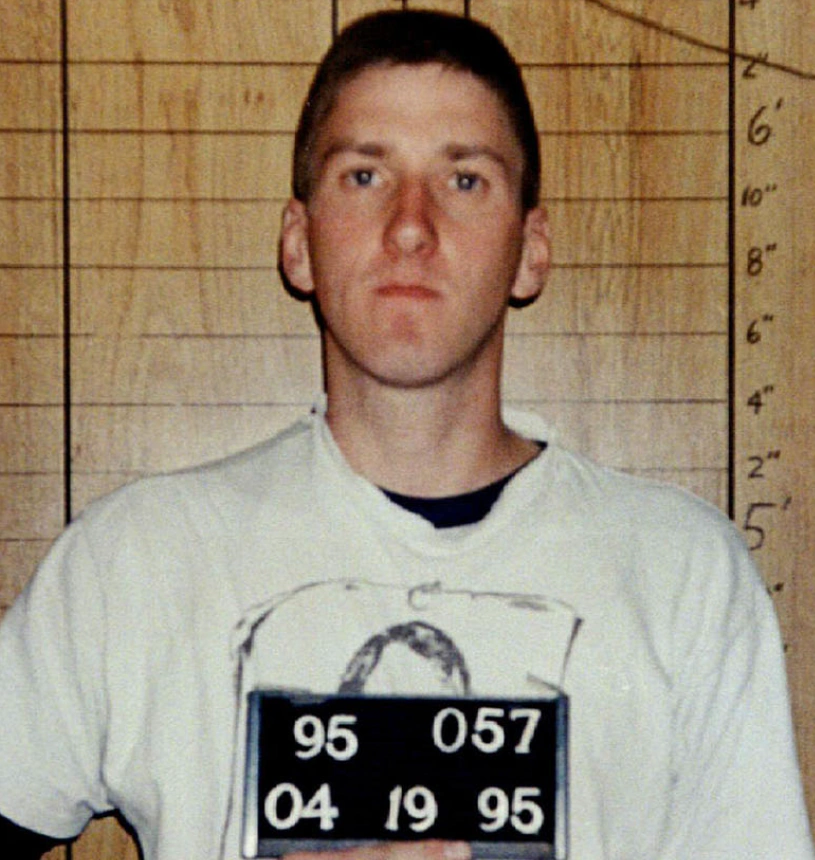
| 6 Quotes | |
| Born as | Timothy James McVeigh |
| Occup. | Criminal |
| From | USA |
| Born | April 23, 1968 Lockport, New York, USA |
| Died | June 11, 2001 Terre Haute, Indiana, USA |
| Cause | Execution by lethal injection |
| Aged | 33 years |
| Cite | |
Citation Formats
APA Style (7th ed.)
Timothy mcveigh biography, facts and quotes. (2026, March 17). FixQuotes. https://fixquotes.com/authors/timothy-mcveigh/
Chicago Style
"Timothy McVeigh biography, facts and quotes." FixQuotes. March 17, 2026. https://fixquotes.com/authors/timothy-mcveigh/.
MLA Style (9th ed.)
"Timothy McVeigh biography, facts and quotes." FixQuotes, 17 Mar. 2026, https://fixquotes.com/authors/timothy-mcveigh/. Accessed 26 Mar. 2026.
Early Life and Background
Timothy James McVeigh was born on April 23, 1968, in Lockport, New York, and grew up largely in the nearby town of Pendleton after his parents' marriage broke apart. His father, William McVeigh, worked long hours, and the household that shaped Timothy and his siblings was ordinary in income but emotionally unsettled. Friends later remembered him as shy, polite, and watchful - a boy more comfortable with machines, science fiction, and firearms than with intimacy. The distance between his inward life and outward presentation mattered. He was not raised in an overtly extremist household; rather, he assembled himself from grievances, private fantasies of order and force, and a deepening suspicion that modern America rewarded the corrupt and humiliated the disciplined.
In adolescence he developed habits that would later harden into ideology: retreat into solitary thought, fascination with weapons as instruments of mastery, and a tendency to interpret events through betrayal and siege. He worked small jobs, including at a Burger King, and was remembered as intelligent but socially awkward, nursing resentments and a sense of being unrecognized. The late Cold War and post-Vietnam culture of paramilitary fiction, survivalism, and anti-federal suspicion gave him a vocabulary for feelings he already possessed. By the time he entered adulthood, he had begun to imagine citizenship not as participation but as armed vigilance against the state.
Education and Formative Influences
McVeigh attended Starpoint High School but did not pursue higher education, a fact that intensified his self-education through gun culture, militia literature, and constitutional absolutism. The decisive institutional experience of his life was the U.S. Army, which he entered in 1988. There he found structure, competence, and status. He served in the Gulf War, earned a Bronze Star, and was regarded as a skilled soldier, particularly with weapons. Yet the Army also fed his binary worldview: chain of command, enemy designation, tactical problem-solving. His failure to complete Special Forces selection was a personal blow, and after leaving the Army in 1991 he drifted but remained psychologically militarized. In that unsettled period he forged close ties with Terry Nichols and Michael Fortier, sold gun-show merchandise, consumed The Turner Diaries - a racist apocalyptic novel depicting a truck bombing of a federal building - and interpreted the Ruby Ridge siege of 1992 and the Waco disaster of 1993 as proof that the federal government had become tyrannical.
Career, Major Works, and Turning Points
McVeigh had no conventional career; his life after the Army became a narrowing campaign of radicalization. He moved through the gun-show circuit, spoke the language of rights and resistance, and treated politics as a battlefield already underway. The crucial turning point was his decision to translate grievance into mass murder. On April 19, 1995 - the second anniversary of the end of the Waco siege - he parked a Ryder truck loaded with an ammonium nitrate bomb outside the Alfred P. Murrah Federal Building in Oklahoma City. The blast killed 168 people, including 19 children, and injured hundreds, making it the deadliest act of domestic terrorism in U.S. history until September 11, 2001. Arrested soon afterward during a traffic stop for a missing license plate and an illegally carried handgun, he was eventually identified through evidence linking him to the truck rental and bomb components. Convicted in federal court in 1997, he was sentenced to death. Executed by lethal injection on June 11, 2001, he left behind not a body of work but a catastrophe, letters, interviews, and a documentary trail of self-justification.
Philosophy, Style, and Themes
McVeigh's inner world was defined by ideological compression: he collapsed war, politics, revenge, and personal injury into one frame. He wanted to see himself not as a murderer of civilians but as a soldier acting under reciprocal rules. That need for moral equivalence is plain in his own language: “Based on observations of the policies of my own government, I viewed this action as an acceptable option”. The sentence is chilling not because it is incoherent, but because it is coldly procedural. He borrowed legitimacy from state violence, treating American military conduct abroad as a license for private terror at home. The psychological maneuver allowed him to replace conscience with analogy. He was less a political thinker than a prosecutor of the nation, selecting evidence that ratified an identity he desperately wanted - disciplined avenger, reluctant combatant, man forced by history to act.
His style of explanation was similarly revealing. "I explain this not for publicity, nor seeking to win an argument of right or wrong, I explain so that the record is clear as to my thinking and motivations in bombing a government installation" [Quote
Our collection contains 6 quotes written by Timothy, under the main topics: Ethics & Morality - Justice - War.
Source / external links