
Ursula K. Le Guin Biography Quotes 31 Report mistakes
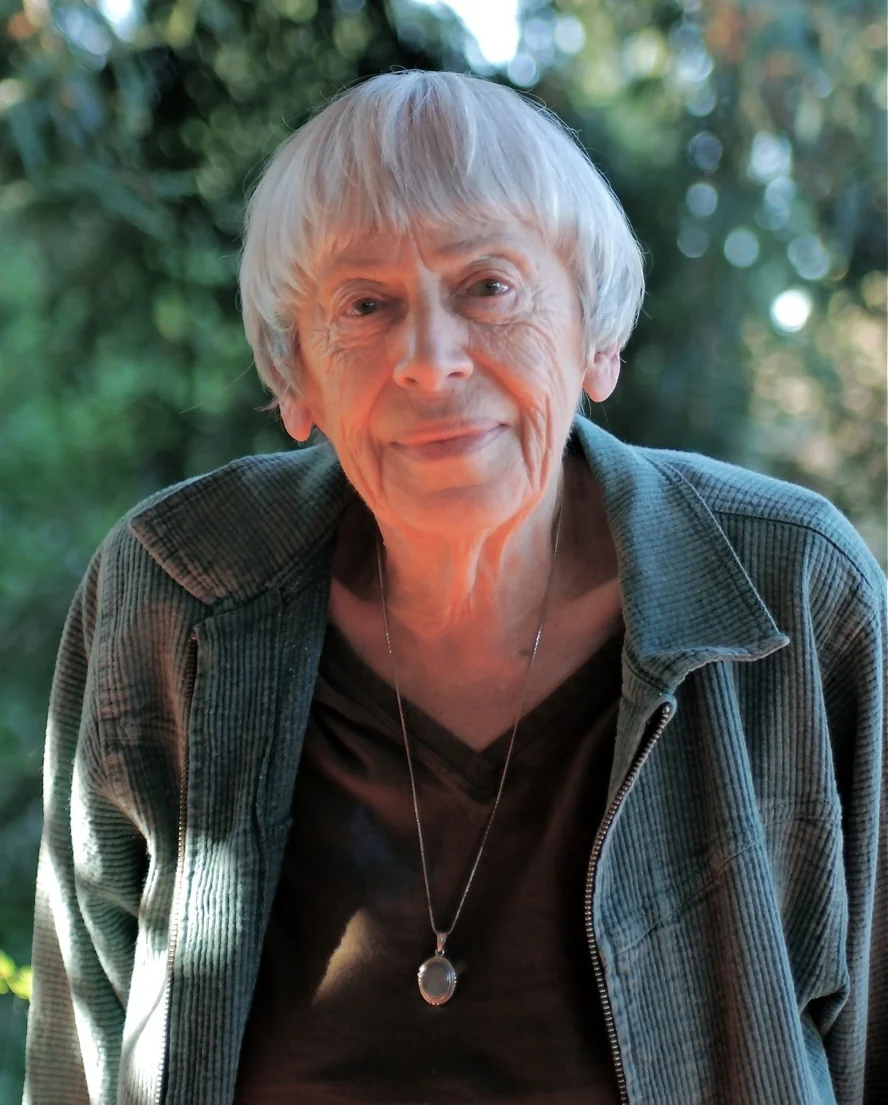
| 31 Quotes | |
| Born as | Ursula Kroeber Le Guin |
| Occup. | Writer |
| From | USA |
| Born | October 21, 1929 Berkeley, California, United States |
| Age | 96 years |
| Cite | |
Citation Formats
APA Style (7th ed.)
Ursula k. le guin biography, facts and quotes. (2026, February 2). FixQuotes. https://fixquotes.com/authors/ursula-k-le-guin/
Chicago Style
"Ursula K. Le Guin biography, facts and quotes." FixQuotes. February 2, 2026. https://fixquotes.com/authors/ursula-k-le-guin/.
MLA Style (9th ed.)
"Ursula K. Le Guin biography, facts and quotes." FixQuotes, 2 Feb. 2026, https://fixquotes.com/authors/ursula-k-le-guin/. Accessed 12 Feb. 2026.
Early Life and Background
Ursula Kroeber Le Guin was born on October 21, 1929, in Berkeley, California, into a household where ideas were daily weather. Her father, Alfred L. Kroeber, was a foundational figure in American anthropology at the University of California, Berkeley; her mother, Theodora Kroeber, would later write Ishi in Two Worlds (1961), shaping public understanding of Ishi, the last known Yahi survivor. From childhood, Ursula absorbed the ethical tensions of cultural encounter - curiosity entwined with loss, translation with betrayal - that would later animate her invented worlds.The Great Depression and the Second World War formed the era behind her early life, but in her family the deeper pressure was intellectual: how to listen across difference without turning the other into an exhibit. Summers at the family place in Napa Valley and the Bay Area milieu of scholars and artists gave her both rootedness and distance - a sense that "home" could be an archive, a landscape, a language, or a story. She began writing young, sending a science fiction story to a magazine as a teenager and collecting rejections that quietly trained her persistence.
Education and Formative Influences
Le Guin studied at Radcliffe College (BA, 1951) and earned an MA in French at Columbia University (1952), focusing on medieval and Renaissance literature, then won a Fulbright to study in France. On the voyage to Europe in 1953 she met historian Charles Le Guin; they married later that year and settled in the Pacific Northwest, eventually in Portland, Oregon, raising three children. Her formal immersion in European narrative tradition - coupled with lifelong proximity to anthropology and to thinkers such as Carl Jung, and later the Tao Te Ching and anarchist theory - gave her an unusually broad toolkit: mythic structure without dogma, philology without pedantry, and a steady suspicion of imperial certainties.Career, Major Works, and Turning Points
After years balancing domestic life with writing, she broke through in the 1960s with stories and novels that refused the era's genre boundaries: Rocannon's World (1966), Planet of Exile (1966), and City of Illusions (1967) established the Hainish setting, while A Wizard of Earthsea (1968) opened a radically inward fantasy, followed by The Tombs of Atuan (1971), The Farthest Shore (1972), and later Tehanu (1990), Tales from Earthsea (2001), and The Other Wind (2001). The Left Hand of Darkness (1969) and The Dispossessed (1974) became turning points not only in her career but in Anglophone speculative literature, offering gender and politics as lived systems rather than allegorical props. Over decades she moved freely among novels, short fiction, essays, translation, and poetry, earning major honors (including multiple Hugos, Nebulas, and the National Book Foundation's Medal for Distinguished Contribution to American Letters) while remaining a sharp critic of market power over art, notably in her 2014 National Book Awards speech.Philosophy, Style, and Themes
Le Guin's imagination was ethical before it was technological: she treated worldbuilding as a way to test how people make meaning under pressure - scarcity, exile, ritual, shame, desire. She distrusted tidy solutions and dramatized the cost of simplistic frames: "There are no right answers to wrong questions". That sentence could sit over The Dispossessed, where the dispute is not "capitalism vs. anarchism" as a debate prompt but as an agonizing ecology of institutions, habits, and compromises; it also describes Earthsea, where the hero's task is not conquest but recognition. Her work returns again and again to the idea that power without self-knowledge curdles into violence, and that naming - in language, in law, in story - is both a gift and a trap.Stylistically she wrote with a rare combination of clarity and resonance: spare sentences that still carry mythic aftersound, an anthropologist's eye for custom, and a poet's feel for silence. She used speculative premises to insist on ambiguity as the human condition: "The only thing that makes life possible is permanent, intolerable uncertainty; not knowing what comes next". Yet uncertainty was not despair in her hands; it was the doorway to relationship and change. Against the fantasy of love as static possession, she emphasized practice, attention, and renewal - a moral stance as much as a romantic one: "Love does not just sit there, like a stone; it had to be made, like bread, remade all the time, made new". That sensibility links her gentlest domestic scenes to her boldest political imaginings, where solidarity is an ongoing labor rather than a banner.
Legacy and Influence
Le Guin died in Portland on January 22, 2018, but her influence continues to widen: she reshaped science fiction and fantasy by making them vehicles for anthropology, feminism, ecology, and political philosophy without sacrificing narrative enchantment. Writers across genres cite her as proof that speculative literature can be intellectually rigorous and emotionally exact, and that moral seriousness need not harden into sermon. Her enduring gift is a body of work that teaches readers to think in systems and to feel in particulars - to see the shadow cast by every candle, and still to choose the light.Our collection contains 31 quotes written by Ursula, under the main topics: Witty One-Liners - Wisdom - Truth - Art - Love.
Other people related to Ursula: Harlan Ellison (Writer)
Ursula K. Le Guin Famous Works
- 2008 Lavinia (Novel)
- 2001 The Other Wind (Novel)
- 1990 Tehanu (Novel)
- 1985 Always Coming Home (Novel)
- 1974 The Dispossessed (Novel)
- 1972 The Farthest Shore (Novel)
- 1971 The Tombs of Atuan (Novel)
- 1971 The Lathe of Heaven (Novel)
- 1969 The Left Hand of Darkness (Novel)
- 1968 A Wizard of Earthsea (Novel)
Source / external links