
Valentino Rossi Biography Quotes 21 Report mistakes
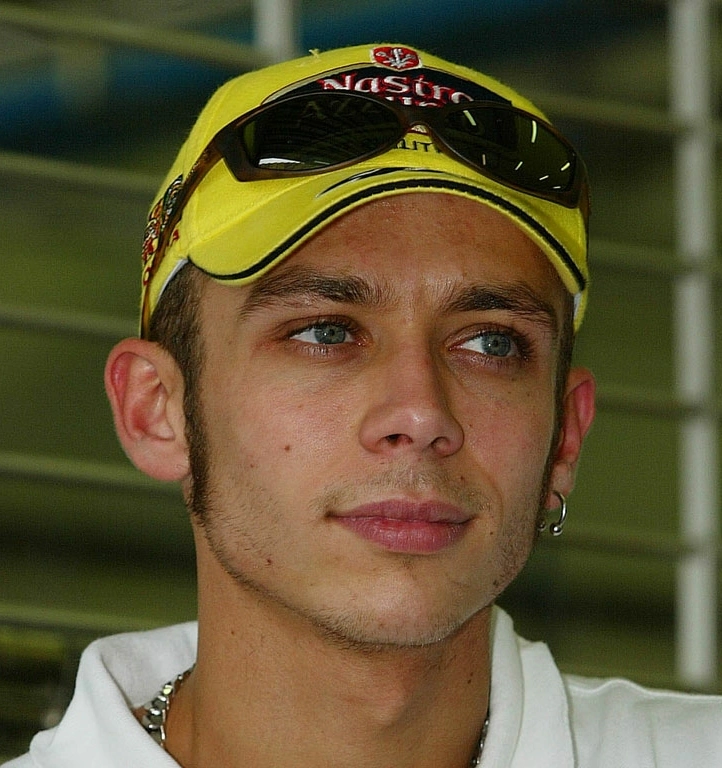
| 21 Quotes | |
| Occup. | Athlete |
| From | Italy |
| Born | February 16, 1979 Urbino, Italy |
| Age | 47 years |
| Cite | |
Citation Formats
APA Style (7th ed.)
Valentino rossi biography, facts and quotes. (2026, February 19). FixQuotes. https://fixquotes.com/authors/valentino-rossi/
Chicago Style
"Valentino Rossi biography, facts and quotes." FixQuotes. February 19, 2026. https://fixquotes.com/authors/valentino-rossi/.
MLA Style (9th ed.)
"Valentino Rossi biography, facts and quotes." FixQuotes, 19 Feb. 2026, https://fixquotes.com/authors/valentino-rossi/. Accessed 25 Mar. 2026.
Early Life and Background
Valentino Rossi was born on February 16, 1979, in Urbino, in Italys Marche region, and grew up in nearby Tavullia, a small hill town that would later become inseparable from his public mythology - the "46" on village signs, the nightly scooter parades after victories, the sense of a local kid turning global without ever leaving his dialect behind. His era was the late analog age of motorsport: paddocks still intimate, television expanding, and Italian racing culture still shaped by the afterglow of Giacomo Agostini and the hard-edged professionalism of the 500cc two-stroke years.Racing was not a distant dream but a household language. His father, Graziano Rossi, was a Grand Prix rider, and the family workshop atmosphere normalized speed as craft rather than fantasy. Rossi started on karts, then minibikes, learning early that bravery alone does not win - repetition does. Later he would frame his origin almost as contingency and inheritance: “Maybe if Graziano make another work or another sport, I wouldn't have had this passion to be a rider”. That admission points to a psychology built from proximity: he did not discover racing so much as he grew into it, absorbing its rituals until they felt like identity.
Education and Formative Influences
Rossi came of age as European motorcycle racing professionalized around youth pipelines and sponsor economics, and his real education was the paddock - mechanics, tire behavior, data, and the social intelligence required to lead a garage. In the mid-1990s he entered the Grand Prix ladder and quickly became a student of pressure: how to read rivals, conserve tires, and convert chaos into points. Italian fandom - devotional and demanding - formed another influence, rewarding charisma but punishing complacency, pushing him to craft a public persona that could carry expectation without letting it harden him.Career, Major Works, and Turning Points
He debuted in the 125cc World Championship in 1996, won the 125 title in 1997, then rose through 250cc to take that championship in 1999, arriving in the premier class as the sport shifted from 500cc to MotoGP. Championships followed in 2001 (500cc), 2002 and 2003 (MotoGP) with Honda, but the defining turning point was his 2004 move to Yamaha - a wager against the easy path, and a bet on his ability to build a machine around his feel. He won the title immediately in 2004, again in 2005, then fought through injury, rule changes, Bridgestone vs Michelin tire politics, and generational rivalry to win two more MotoGP championships in 2008 and 2009. His later career included near-misses and a sharp 2015 campaign that ended in bitter controversy, plus a final phase as elder-statesman and team leader, before retiring from MotoGP after the 2021 season and continuing in car racing and team ownership through the VR46 project.Philosophy, Style, and Themes
Rossi raced with a blend of improvisation and calculation that made his passes feel like narrative - late-braking feints, mid-corner line changes, and a talent for making rivals look hurried. Yet his own description of motivation is simple and relentless: “I race to win. If I am on the bike or in a car it will always be the same”. The line captures a core trait: competition as constant, not category-specific, which helps explain his credible forays into rallying and endurance racing and his long flirtation with Formula 1 testing. Winning was not vanity for him so much as proof that his inner map of traction, risk, and timing still matched reality.Beneath the showmanship sat an ambivalence toward the cage of celebrity, and this tension shaped his career choices as much as lap times. “I don't like being famous - it is like a prison. And driving for Ferrari would make it far worse”. That unease clarifies why he clung to Tavullia and to a tight, almost family-like crew, using humor and alter-egos as pressure valves. His craft ethic also ran deep - he treated sensation as data and data as a way to protect sensation: “Riding a race bike is an art - a thing that you do because you feel something inside”. In Rossi, instinct was never opposed to work; it was the raw material that testing, feedback, and psychological gamesmanship refined into repeatable advantage.
Legacy and Influence
Rossi is widely regarded as one of motorcycle racings defining figures - a nine-time Grand Prix world champion across multiple classes, the face of MotoGPs global boom in the 2000s, and a rare athlete whose personality expanded the sports audience without diluting its technical seriousness. His greatest influence may be cultural infrastructure: he helped normalize riders as complete entertainers and tactical thinkers, and through the VR46 Academy and his teams he institutionalized mentorship, turning his own hard-won lessons into a pipeline that reshaped Italys presence on the grid. Even after retirement, the number 46, the Tavullia rituals, and the template of fearless-yet-methodical racing remain shorthand for an era when artistry, rivalry, and engineering met at 200 mph.Our collection contains 21 quotes written by Valentino, under the main topics: Sarcastic - Freedom - Victory - Sports - Training & Practice.
Other people related to Valentino: Sete Gibernau (Athlete)
Source / external links