
Vannevar Bush Biography Quotes 6 Report mistakes
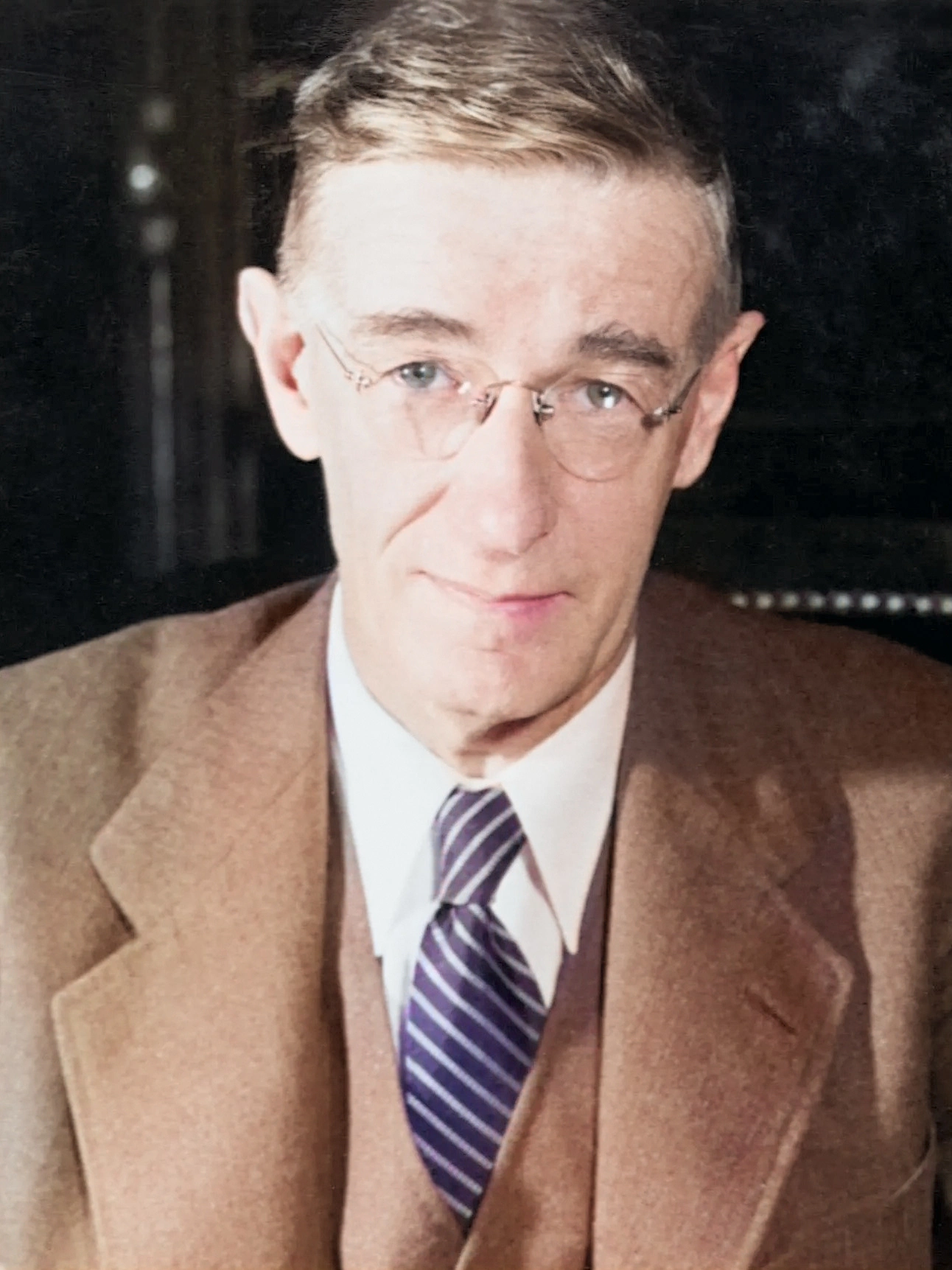
| 6 Quotes | |
| Occup. | Scientist |
| From | USA |
| Born | March 11, 1890 Everett, Massachusetts, USA |
| Died | June 30, 1974 Belmont, Massachusetts, USA |
| Cause | Pneumonia |
| Aged | 84 years |
| Cite | |
Citation Formats
APA Style (7th ed.)
Vannevar bush biography, facts and quotes. (2026, February 11). FixQuotes. https://fixquotes.com/authors/vannevar-bush/
Chicago Style
"Vannevar Bush biography, facts and quotes." FixQuotes. February 11, 2026. https://fixquotes.com/authors/vannevar-bush/.
MLA Style (9th ed.)
"Vannevar Bush biography, facts and quotes." FixQuotes, 11 Feb. 2026, https://fixquotes.com/authors/vannevar-bush/. Accessed 6 Mar. 2026.
Early Life and Education
Vannevar Bush was born in 1890 in Massachusetts and became one of the most consequential American engineers and science administrators of the twentieth century. He was educated at Tufts College, where he trained as an electrical engineer and showed an early facility for practical invention and for building instruments that bridged theory and application. After an initial stint in industry, including work with General Electric, he returned to academia for advanced study and earned a doctorate in engineering by the mid-1910s. The mixture of hands-on engineering and analytical rigor that he absorbed in these years would shape his lifelong approach: solve concrete problems, build usable systems, and create institutions that let science and engineering flourish together.Engineer and Inventor
Bush first made his mark not by policy but by machines. At Massachusetts Institute of Technology he became known for pioneering analog computing. With colleagues such as Harold Hazen, he built the differential analyzer, a room-filling assemblage of gears, shafts, and disks that could solve complex differential equations mechanically. This machine provided researchers and students with a powerful tool for problems in physics and engineering well before digital computers became practical. The analyzer also created an intellectual environment that influenced younger talents; Claude Shannon worked with it as a graduate student and later credited that experience with shaping his insights into switching theory, which helped launch digital circuit design and information theory. In the same milieu, Bush interacted with Norbert Wiener, whose mathematical perspective on feedback and control would culminate in cybernetics, another foundational thread of modern computing and systems science.Academic Leadership at MIT
As his reputation grew, Bush moved into academic leadership, serving as a senior administrator at MIT in the 1930s, including as vice president and dean of engineering. He operated with a brisk, pragmatic style that emphasized interdisciplinary collaboration and close ties to industry. Working with MIT's president Karl T. Compton, he helped position the Institute as a partner to government and industry on large technical challenges. This would prove decisive when the nation mobilized for war and needed institutions capable of managing science at unprecedented scale.Raytheon and Industrial Collaboration
Bush was also a founder of American Appliance Company, soon renamed Raytheon, alongside Laurence K. Marshall and Charles G. Smith. The firm began with novel rectifiers and quickly diversified into electronics. Bush's role bridged technical and managerial domains: he understood both the laboratory and the factory, and he saw how organizational structure could accelerate technological progress. Although he eventually stepped back from day-to-day corporate work as national demands increased, the Raytheon experience deepened his belief that robust partnerships between universities, government, and private industry were essential to national strength.Wartime Science Administrator
When World War II loomed, Bush brought together scientific leaders to propose a coordinated national effort for research and development. With President Franklin D. Roosevelt's support, he first chaired the National Defense Research Committee and then directed the Office of Scientific Research and Development (OSRD), created in 1941. From that perch, he managed a vast portfolio of projects, insisting on clear goals, rapid contracting, and accountability. He worked closely with James B. Conant of Harvard, with Karl T. Compton, and with the financier-scientist Alfred Loomis, whose organizational acumen and private resources had already catalyzed radar research.Under Bush's direction, the OSRD sponsored the MIT Radiation Laboratory, led by Lee DuBridge, which worked with British colleagues arriving via the Tizard Mission and transformed the cavity magnetron into effective airborne radar. The OSRD also shepherded the proximity fuze program, drawing on Merle Tuve's expertise at Johns Hopkins, and supported breakthroughs in mass-producing penicillin and in synthetic materials crucial to the war effort. On nuclear matters, Bush oversaw early research, coordinated with the Army as the Manhattan Project took shape, and interfaced with General Leslie Groves and scientific leaders such as J. Robert Oppenheimer as the program moved under military management. He excelled at balancing civilian scientific creativity with military urgency, keeping disparate groups focused on deliverable systems.
Postwar Vision and National Science Policy
Even before the war ended, Roosevelt asked Bush to consider how the peace should harness scientific talent. The result was Science, the Endless Frontier, delivered in 1945 to President Harry S. Truman after Roosevelt's death. The report argued that the nation's health, security, and prosperity required sustained federal investment in basic research and education, administered through merit-based, peer-reviewed processes and largely carried out at universities. It sketched a postwar compact among government, academia, and industry that emphasized discovery, trained new generations of scientists and engineers, and spread benefits through the economy and society. Though debated and revised, these ideas underpinned the creation of the National Science Foundation and influenced the architecture of American research funding for decades. Bush's advocacy for civilian oversight of science policy, and for openness tempered by sensible security, helped set norms that balanced national defense with the free exchange of ideas.Ideas, Writing, and the Memex
Bush was not only an organizer but also a thinker who articulated frameworks for the information age. In 1945 he published "As We May Think" in the Atlantic Monthly, describing the Memex, a hypothetical desk-sized system using microfilm, associative indexing, and personal "trails" of linked information. The Memex anticipated core concepts of hypertext and personal knowledge management. Decades later, pioneers such as Douglas Engelbart, J. C. R. Licklider, and Ted Nelson cited Bush's essay as a stimulus for their work on interactive computing, human-computer symbiosis, and hypertext systems. Bush argued that the human mind worked by association rather than strict hierarchy, and he urged engineers to build tools that amplified that natural mode of thought. His exhortation that scientists look beyond wartime imperatives to the broader augmentation of human knowledge became a touchstone for the emerging field of information science.Carnegie Institution and Stewardship of Big Science
From 1939 to the mid-1950s, Bush served as president of the Carnegie Institution of Washington, where he oversaw major research programs in fields ranging from biology to astronomy. The role required the same abilities he displayed in government: setting priorities, recruiting and supporting first-rate scientists, and defending long-term, curiosity-driven research. He navigated the transition from wartime mobilization to peacetime inquiry, arguing that the nation's strength would depend on maintaining scientific capacity even without the immediate pressure of conflict.Relationships, Mentorship, and Networks
Bush's greatest achievements depended on relationships. He trusted colleagues who combined scientific depth with managerial nerve, and he cultivated a network across universities, industry, and the military. He worked in concert with Conant, Compton, and Loomis to structure wartime laboratories; he engaged closely with DuBridge at the Rad Lab; he coordinated with Groves and Oppenheimer at critical junctures of the atomic project; and he kept lines open to British counterparts such as Henry Tizard. In the academy, his milieu included Wiener and a rising Claude Shannon, whose trajectories illustrate how Bush's laboratories incubated new disciplines. He also drew insight from philanthropic and industrial figures like Warren Weaver at the Rockefeller Foundation, who helped shape the broader landscape of postwar science. Bush's talent lay as much in assembling and aligning such people as in designing machines himself.Later Years and Legacy
After the war, Bush remained an influential voice on national policy, technology, and education. He continued at Carnegie before returning to writing and advisory work, publishing essays and books that reflected on the responsibilities of scientists in a free society. His memoir, Pieces of the Action, offered a candid account of wartime decisions and the complexities of organizing large endeavors under pressure. He received many honors in recognition of his service and his intellectual leadership. He died in 1974.Vannevar Bush's legacy spans artifacts, institutions, and ideas. The differential analyzer embodied a practical, transitional step toward modern computation; the OSRD demonstrated how government could catalyze high-impact research by empowering the right people and removing administrative friction; Science, the Endless Frontier articulated a durable framework for public support of discovery; and the Memex gave language to the vision of interactive, associative information systems. Through his influence on figures ranging from Shannon and Wiener to Engelbart and Licklider, and through his partnerships with leaders such as Roosevelt, Truman, Conant, Compton, Loomis, Groves, and Oppenheimer, he helped define how science could serve both national needs and human curiosity. His life's work left a template for organizing knowledge creation that remains central to modern research and innovation.
Our collection contains 6 quotes written by Vannevar, under the main topics: Truth - Hope - Reason & Logic - Science - Fear.
Other people related to Vannevar: James Bryant Conant (Scientist)
Frequently Asked Questions
- Vannevar Bush differential analyzer: The differential analyzer was an early analog computer invented by Vannevar Bush to solve differential equations.
- Vannevar Bush Manhattan Project: While Vannevar Bush was not directly involved in the Manhattan Project, he played a crucial role in wartime science policy and research, which supported the project.
- Vannevar Bush son: Vannevar Bush had two sons, Richard Davis Bush and John Hathaway Bush.
- What did Vannevar Bush invent: Vannevar Bush is known for inventing the differential analyzer, an analog computer.
- Vannevar Bush pronunciation: Vannevar Bush is pronounced as 'Vuh-NEE-var Bush'.
- Vannevar Bush Oppenheimer: Vannevar Bush and J. Robert Oppenheimer worked on scientific endeavors during World War II, particularly related to the development of the atomic bomb.
- Dr Vannevar Bush family tree: Vannevar Bush was born to Richard Perry Bush and Emma Linwood Paine Bush. He was married to Phoebe Clara Davis and had two sons.
- Vannevar Bush related to George Bush: No, Vannevar Bush was not related to George Bush.
- How old was Vannevar Bush? He became 84 years old
Vannevar Bush Famous Works
- 1949 Modern Arms and Free Men: A Discussion of the Role of Science in Preserving Democracy (Book)
- 1945 Science, The Endless Frontier (Book)
Source / external links