
Victor Wembanyama Biography Quotes 7 Report mistakes
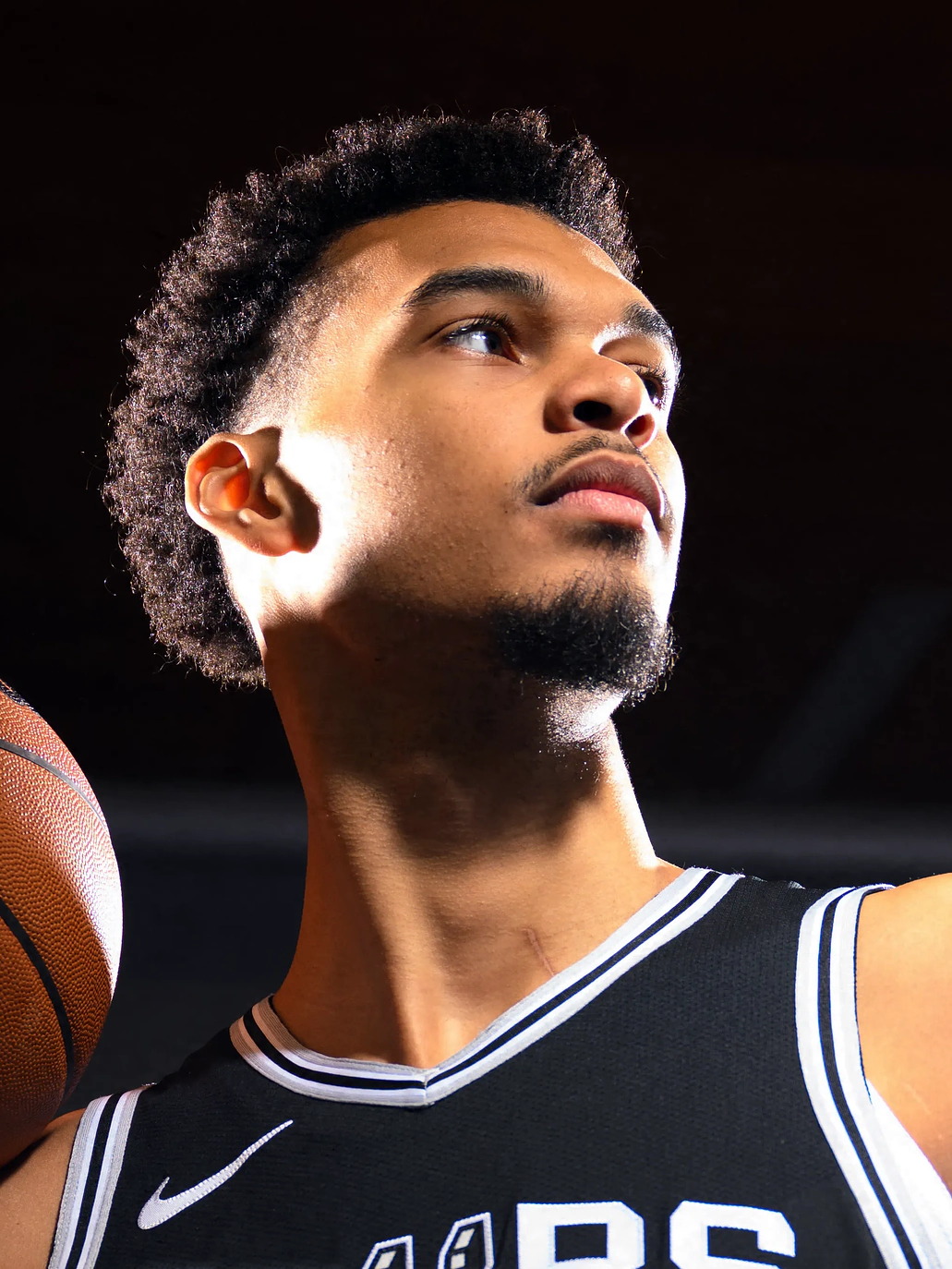
Attr: talkSPORT
| 7 Quotes | |
| Born as | Victor Wembanyama |
| Occup. | Athlete |
| From | France |
| Born | January 4, 2004 Le Chesnay, Yvelines, Île-de-France, France |
| Age | 22 years |
| Cite | |
Citation Formats
APA Style (7th ed.)
Victor wembanyama biography, facts and quotes. (2026, February 14). FixQuotes. https://fixquotes.com/authors/victor-wembanyama/
Chicago Style
"Victor Wembanyama biography, facts and quotes." FixQuotes. February 14, 2026. https://fixquotes.com/authors/victor-wembanyama/.
MLA Style (9th ed.)
"Victor Wembanyama biography, facts and quotes." FixQuotes, 14 Feb. 2026, https://fixquotes.com/authors/victor-wembanyama/. Accessed 8 Mar. 2026.
Early Life and Background
Victor Wembanyama was born on January 4, 2004, in Le Chesnay, in the western suburbs of Paris, France, into a household where sport was a language as common as French. His father, Felix Wembanyama, had an athletic background, and his mother, Elodie de Fautereau, was a coach who had competed in track and field. Long before the world called him a generational basketball prospect, he grew up as a tall, coordinated child in a country where football dominates street culture and where elite basketball still tends to be cultivated through federations, academies, and patient instruction.That environment shaped his early psychology: unusually visible, constantly evaluated, yet protected by structure. His height made him a public phenomenon while he was still private in temperament, and his family-and-club ecosystem offered ballast against hype. Even as viral clips began circulating, the rhythms around him were distinctly French: federation pathways, national youth teams, and a developmental emphasis on fundamentals over theatrics. The future NBA spotlight arrived early, but he learned first to be a disciplined teammate inside small gyms and organized systems.
Education and Formative Influences
Wembanyama developed through the French basketball pipeline, notably with Nanterre 92 as a youth before joining ASVEL Basket (LDLC ASVEL), the Lyon-Villeurbanne club associated with Tony Parker, whose career provided a French template for NBA ambition without surrendering European development values. He also emerged as a standout for France in youth international competition, where the pressure of representing a basketball nation still chasing its first senior men’s Olympic gold sharpened his sense of responsibility. The formative influences were less about a single coach or ideology than about an ecosystem that rewarded timing, spacing, and defensive schemes - a training that later made his unusual body seem less like an exception and more like an instrument.Career, Major Works, and Turning Points
He turned professional as a teenager in France, gaining early experience in top domestic competition and European play, then made a decisive career move by joining Metropolitans 92 for the 2022-2023 season, positioning himself as the centerpiece rather than a developing role player. That year became a turning point: his production, two-way impact, and week-to-week durability reframed him from prodigy to inevitability. In June 2023 he was selected first overall in the NBA Draft by the San Antonio Spurs, a franchise defined by developmental patience and international success, and he entered the league with the rare burden of being treated as both a present defender and a future offensive system. His rookie season confirmed the outline - rim protection, outlier shot contesting, and a rapidly expanding offensive palette - while also revealing the practical tasks of stardom: managing physical load, learning NBA scouting cycles, and turning highlight plays into winning habits.Philosophy, Style, and Themes
Wembanyama’s inner life reads as a tension between the spectacle others project onto him and the craft he insists on pursuing. His body invites myth-making - the “unicorn” label, the comparisons to earlier giants - yet he repeatedly pulls the story back to work and utility, saying, “My goal is not to be a unicorn; it’s to be a great basketball player and help my team win”. That sentence functions like a self-defense mechanism: it narrows the world’s expectations into a controllable daily mission, and it reveals an athlete who fears stagnation more than scrutiny. In public he is measured, almost clinical; in performance he is experimental, willing to take perimeter shots, handle in space, and accept mistakes as tuition.His style is built on contradictions that he has learned to coordinate: a rim protector who can switch, a towering finisher who dribbles into pull-ups, a player whose highlights suggest ease but whose interviews emphasize dissatisfaction. The motor is improvement, not applause - “I think I can always do better. That’s what motivates me every day”. Even confidence, for him, is not a mood but an output of preparation: “I love the work. That’s where the confidence comes from”. Psychologically, that orientation protects him from the volatility of modern sports celebrity, where a bad week becomes a narrative and a good week becomes a trap; his stated goal is to keep the focus on repeatable inputs, and the theme running through his early career is the attempt to turn unprecedented gifts into ordinary professionalism.
Legacy and Influence
Wembanyama’s legacy is still being written, but his influence is already visible in how basketball talks about possibility: the league’s long arc toward length, versatility, and rim pressure now has a prototype who also bends spacing and defensive geometry. In France, he extends the lineage from Parker and Rudy Gobert into a new era where French development is no longer an exception but a pipeline; for young players, he represents permission to be both European-schooled and globally central. If he fulfills even a conservative version of his trajectory, his enduring mark will be the normalization of the “impossible” skill set - not as novelty, but as a standard built through obsessive improvement, tactical learning, and the insistence that winning, not wonder, is the point.Our collection contains 7 quotes written by Victor, under the main topics: Motivational - Learning - Sports - Confidence - Self-Improvement.
Source / external links