
Vin Scully Biography Quotes 9 Report mistakes
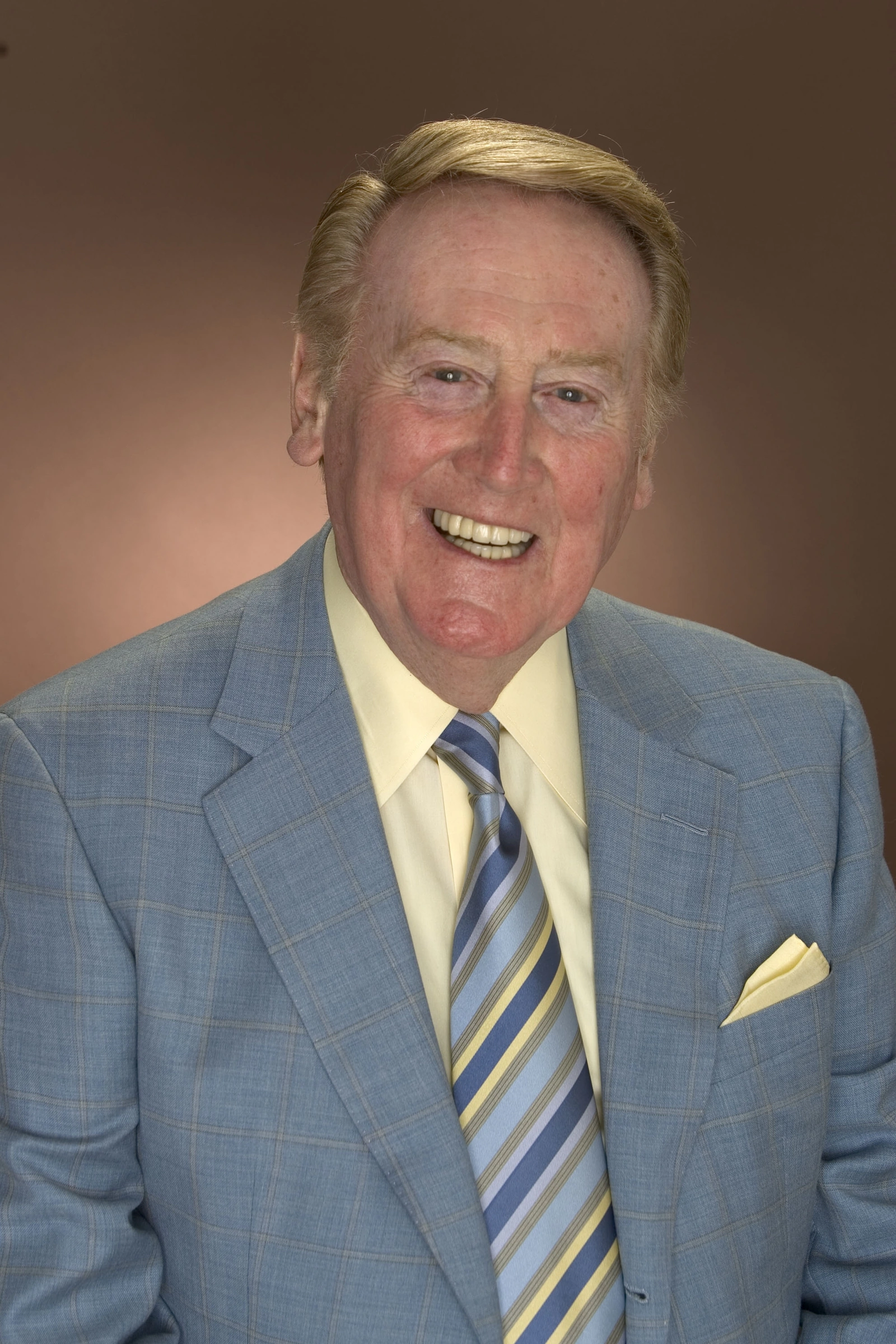
| 9 Quotes | |
| Born as | Vincent Edward Scully |
| Known as | The Voice of the Dodgers |
| Occup. | Celebrity |
| From | USA |
| Born | November 29, 1927 The Bronx, New York, U.S. |
| Age | 98 years |
| Cite | |
Citation Formats
APA Style (7th ed.)
Vin scully biography, facts and quotes. (2026, February 11). FixQuotes. https://fixquotes.com/authors/vin-scully/
Chicago Style
"Vin Scully biography, facts and quotes." FixQuotes. February 11, 2026. https://fixquotes.com/authors/vin-scully/.
MLA Style (9th ed.)
"Vin Scully biography, facts and quotes." FixQuotes, 11 Feb. 2026, https://fixquotes.com/authors/vin-scully/. Accessed 6 Mar. 2026.
Early Life and Background
Vincent Edward Scully was born on November 29, 1927, in the Bronx, New York City, into an Irish Catholic, working-class world shaped by the Great Depression and the borough rhythms of street games, parish life, and radio voices that turned distant ballparks into neighborhood theater. His father, Vincent Aloysius Scully, died when Vin was young, leaving the family with a quiet absence that later seemed to train him for the solitary discipline of narration - speaking steadily into silence, carrying the emotional weather of a game without showing strain.Raised primarily by his mother, Catherine, and later his stepfather, he grew up during World War II-era austerity, when baseball on the radio offered continuity and civic ritual. The Bronx in those years was a proving ground for attention and memory: the ability to track detail, cadence, and character in a crowded soundscape. Those instincts - compassion for ordinary struggle, delight in language, and a sense that public events had private meanings - would become the core of his broadcasting persona.
Education and Formative Influences
Scully attended Fordham Preparatory School and Fordham University, where he studied English and discovered how technique could serve warmth. At Fordham he honed his voice at WFUV, learning to paint pictures with timing rather than volume, and he developed a respect for preparation that bordered on moral duty. He admired radio craftsmen and storytellers, but also the Jesuit emphasis on clarity and conscience - an education that pushed him to treat sport not as noise but as narrative, with the listener as a partner.Career, Major Works, and Turning Points
After early work as a messenger and then an announcer, Scully joined CBS Radio and in 1950 was assigned to call Brooklyn Dodgers games, apprenticing under Red Barber. In 1953, at just 25, he became the Dodgers' lead announcer, and when the club moved west in 1958 he became a constant in Los Angeles as the city invented itself. Over 67 seasons with the Dodgers (1950-2016) and decades of national work for CBS and NBC, he narrated baseball's modern canon: Don Larsen's perfect game in the 1956 World Series, Sandy Koufax's perfect game in 1965, Hank Aaron's 715th home run in 1974, and Kirk Gibson's 1988 World Series walk-off. His career turned on a rare balance - he could be the intimate voice of a single franchise while also sounding like the country's storyteller, and he did it with an almost stubborn independence, long resisting the drift toward louder booths and manufactured controversy.Philosophy, Style, and Themes
Scully's style was quiet architecture: long stretches of patient description, the courage to let crowd sound do the talking, and a novelist's sense of entrance and exit. He treated baseball as a moral laboratory where small choices accumulate into fate, and he trusted listeners to feel the stakes without being told. His discipline could be exacting, even self-punishing, because he believed craft was a kind of respect. “Good is not good when better is expected”. That line captures his inner engine - not perfectionism for vanity, but an ethic that demanded he earn the privilege of attention every night.He also understood the psychology of competition in a way that kept his empathy sharp. “Losing feels worse than winning feels good”. In his hands, that truth made space for the defeated and prevented triumph from curdling into mockery; he could celebrate a champion while protecting the dignity of the man who struck out. Yet he never let numbers replace human meaning, puncturing statistical absolutism with a skeptic's humor: “Statistics are used much like a drunk uses a lamppost: for support, not illumination”. The remark is revealing - Scully loved research, but he mistrusted any certainty that did not pass through story, context, and the unrepeatable strangeness of a given night.
Legacy and Influence
Scully retired after the 2016 season having redefined what a play-by-play announcer could be: not a salesman of adrenaline, but a custodian of memory. His influence runs through generations of broadcasters who borrowed his pacing, his restraint, and his insistence that the listener's imagination is the main camera. In an era that moved from radio intimacy to high-definition spectacle, he remained the steady human scale, proving that a single voice - well prepared, morally grounded, and artistically free - can become a city's companion and a nation's archive.Our collection contains 9 quotes written by Vin, under the main topics: Witty One-Liners - Wisdom - Sarcastic - Sports - Smile.
Other people related to Vin: Al Michaels (Entertainer), Ron Fairly (Athlete)
Source / external links