
Volodymyr Zelensky Biography Quotes 28 Report mistakes
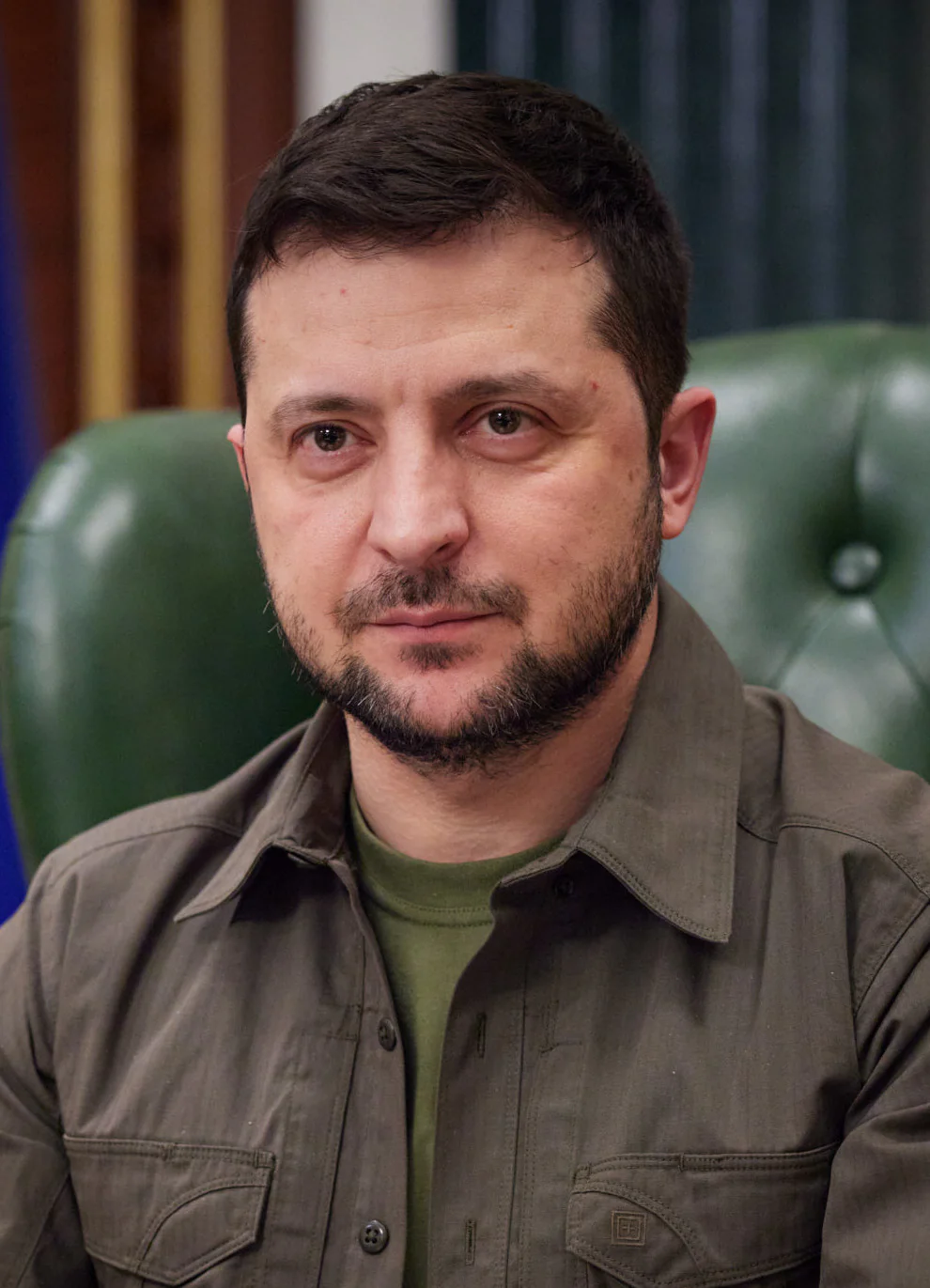
Attr: President Of Ukraine, PDM-owner
| 28 Quotes | |
| Born as | Volodymyr Oleksandrovych Zelensky |
| Occup. | President |
| From | Ukraine |
| Spouse | Olena Kiyashko (2003-) |
| Born | January 25, 1978 Kryvyi Rih, Ukrainian SSR, Soviet Union |
| Age | 48 years |
| Cite | |
Citation Formats
APA Style (7th ed.)
Volodymyr zelensky biography, facts and quotes. (2026, February 3). FixQuotes. https://fixquotes.com/authors/volodymyr-zelensky/
Chicago Style
"Volodymyr Zelensky biography, facts and quotes." FixQuotes. February 3, 2026. https://fixquotes.com/authors/volodymyr-zelensky/.
MLA Style (9th ed.)
"Volodymyr Zelensky biography, facts and quotes." FixQuotes, 3 Feb. 2026, https://fixquotes.com/authors/volodymyr-zelensky/. Accessed 26 Mar. 2026.
Early Life and Background
Volodymyr Oleksandrovych Zelensky was born on January 25, 1978, in Kryvyi Rih, an industrial city in Ukraine's Dnipropetrovsk region, then part of the Ukrainian SSR. He grew up in the late-Soviet and early post-Soviet transition, when everyday life was shaped by heavy industry, scientific ambition, and then the sudden uncertainties of independence. The Ukrainian language revival, the persistence of Russian as an urban lingua franca, and a pervasive cynicism toward officialdom formed the ambient culture of his youth - a culture that later made satire feel less like entertainment than a survival skill.His family background was academically oriented: his father, Oleksandr Zelensky, worked as a professor and researcher, and the household valued education, performance, and discipline. Zelensky spent part of his childhood in Mongolia, where his father worked for a period, a detail that widened his sense of Ukraine as both local and internationally embedded. Returning to Kryvyi Rih, he gravitated toward school performance and comedic improvisation, learning early how to read a room and how laughter could temporarily level social hierarchies in a society accustomed to deference.
Education and Formative Influences
Zelensky studied law at the Kryvyi Rih Institute of Economics (affiliated with Kyiv National Economic University), graduating in the late 1990s, though he did not build a legal career. Instead, the decisive education was extracurricular: the post-Soviet boom of television, advertising, and variety entertainment, and the long tradition of KVN (Club of the Funny and Inventive), where Zelensky honed timing, ensemble leadership, and the art of compressing political critique into jokes that could pass censors and sponsors alike.Career, Major Works, and Turning Points
He rose to national fame through comedy and production. As a key figure in KVN teams before founding the production company Kvartal 95, Zelensky moved from performer to architect of a media brand, creating sketches and shows that treated corruption and bureaucratic absurdity as daily reality rather than abstract scandal. The turning point came with the television series "Servant of the People" (2015), where he played a history teacher who unexpectedly becomes president after an anti-corruption rant goes viral - a storyline that fused wish-fulfillment with political indictment. When Zelensky entered the 2019 presidential race, the boundary between role and reality became a mass psychological experiment: the public used the familiar face of a satirist to signal exhaustion with oligarchic politics, and he won decisively, then faced the hard conversion of symbolic mandate into state capacity. Russia's full-scale invasion in February 2022 transformed his presidency into wartime leadership, testing his communicative strengths against existential stakes.Philosophy, Style, and Themes
Zelensky's public philosophy is built on anti-idolatry, moral proximity, and a deliberately non-sacral style of power. He tries to collapse distance between the state and ordinary life, insisting that the presidency is a tool rather than a throne: “I really do not want my pictures in your offices, for the President is not an icon, an idol or a portrait. Hang your kids' photos instead, and look at them each time you are making a decision”. Psychologically, the line signals an aversion to the ornamental rituals of post-Soviet authority and a fear of the moral anesthesia that comes with hierarchy. It also reframes governance as a parental obligation - future-facing, intimate, and accountable to the vulnerable.His style, shaped by television, is direct, emotionally legible, and repetitive in the way modern mass persuasion requires: short sentences, memorable contrasts, and appeals to unity that double as strategic messaging. “I'm not a politician. I am just a simple person who came to break the system”. That self-description is less a literal biography than a narrative identity: the outsider who enters a compromised institution without becoming it. Under invasion, his rhetoric hardens into civic mobilization, where unity becomes both morale and deterrence: “If we are united, we are invincible”. Across peace and war, the recurring themes are dignity, sovereignty, and the effort to turn national trauma into a coherent story that can sustain sacrifice without erasing pluralism.
Legacy and Influence
Zelensky's legacy is still being written, but his influence is already clear in how he redefined the modern presidency as a communications front line and a moral performance under pressure. He demonstrated how a cultural figure can translate narrative skill into political legitimacy, then how legitimacy must be re-earned daily when institutions are stressed by invasion, displacement, and loss. Internationally, he became a symbol of small-state resistance and a case study in wartime public diplomacy; domestically, his tenure will be judged by whether unity can be converted into durable reforms, accountability, and a postwar state resilient enough to outlive any single leader - precisely the future he implicitly demands when he asks citizens to look not at portraits, but at their children before making decisions.Our collection contains 28 quotes written by Volodymyr, under the main topics: Justice - Freedom - Honesty & Integrity - Equality - War.
Other people related to Volodymyr: Mikhail Saakashvili (Statesman)
Volodymyr Zelensky Famous Works
- 2015 Servant of the People (Screenplay)
- 2005 Evening Quarter (Screenplay)
Source / external links