
Voltaire Biography Quotes 132 Report mistakes
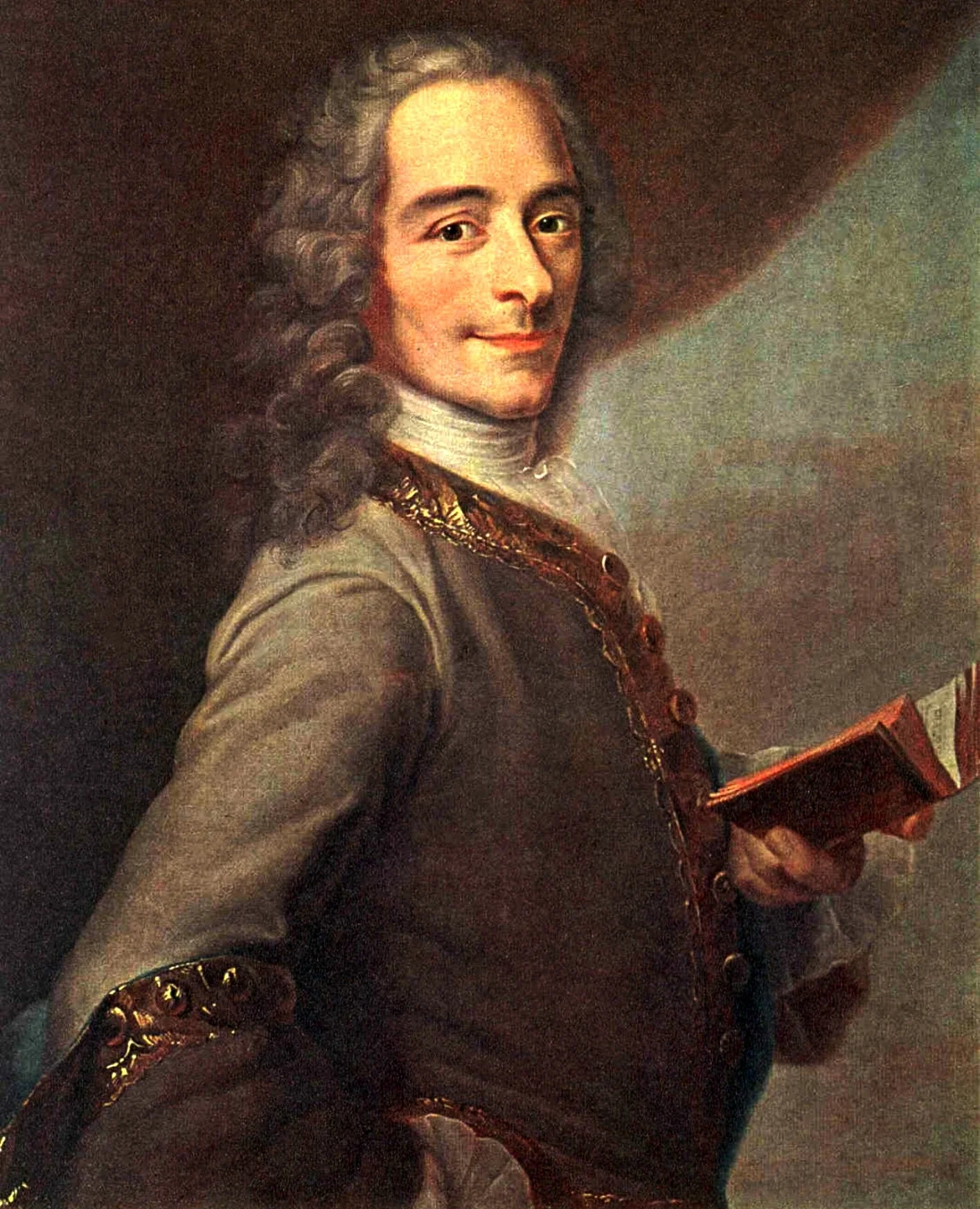
| 132 Quotes | |
| Born as | François-Marie Arouet |
| Occup. | Writer |
| From | France |
| Born | November 21, 1694 Paris, Kingdom of France |
| Died | May 30, 1778 Paris, Kingdom of France |
| Aged | 83 years |
| Cite | |
Citation Formats
APA Style (7th ed.)
Voltaire biography, facts and quotes. (2026, February 2). FixQuotes. https://fixquotes.com/authors/voltaire/
Chicago Style
"Voltaire biography, facts and quotes." FixQuotes. February 2, 2026. https://fixquotes.com/authors/voltaire/.
MLA Style (9th ed.)
"Voltaire biography, facts and quotes." FixQuotes, 2 Feb. 2026, https://fixquotes.com/authors/voltaire/. Accessed 26 Mar. 2026.
Early Life and Background
Francois-Marie Arouet, later Voltaire, was born in Paris on 1694-11-21, in the reign of Louis XIV, when court splendor masked mounting fiscal strain and religious rigidity. His father, Francois Arouet, was a notary and treasury official who wanted a respectable legal career for his son; his mother, Marie Marguerite Daumard, died when he was young, leaving a temperamental, quick-witted boy to be shaped by Parisian salons and the citys appetite for satire.From the start, Voltaire learned how words could be both currency and weapon. He absorbed the arts of conversation, mockery, and flattering insult that animated aristocratic circles, and he discovered the central tension of his life: craving recognition from the powerful while resenting their pretensions. That tension, sharpened by a gift for epigram and a near-reflex for defiance, repeatedly pushed him into conflict with authority and then into the practical problem of surviving it.
Education and Formative Influences
Educated at the Jesuit College Louis-le-Grand, he gained a classical grounding in Latin rhetoric and theatre while also observing how disciplined persuasion could serve institutional power. In the Regency after Louis XIVs death, Paris loosened briefly, and the young writer moved between legal studies, salon life, and the theatre, learning that publics could be swayed by wit as effectively as by sermons. Early satirical verses brought notoriety and, after a sharp lampoon of the Regent, imprisonment in the Bastille in 1717-1718 - an ordeal that hardened his distrust of arbitrary power and confirmed that the pen could purchase both fame and punishment.Career, Major Works, and Turning Points
He emerged with the tragedy Oedipe (1718) and the epic poem La Henriade, adopting "Voltaire" as a self-made identity suited to a public career. A beating by the Chevalier de Rohan and the states protection of the offender led to another Bastille confinement and then exile to England (1726-1729), where constitutional monarchy, religious pluralism, and Newtonian science widened his intellectual horizon; Lettres philosophiques (1734) distilled these lessons and was condemned in France, pushing him into semi-exile at Cirey with Emilie du Chatelet, whose mathematical and philosophical rigor deepened his engagement with science and metaphysics. Later he courted and escaped courts - notably Frederick the Great in Prussia - and from the 1750s based himself near Geneva and then at Ferney, using wealth, publishing networks, and relentless correspondence to wage public campaigns: against censorship, against superstition, and against judicial cruelty, as in the Calas affair (Treatise on Tolerance, 1763) and other causes that made him Europes most famous advocate of enlightened justice. His most enduring fiction, Candide (1759), sharpened his critique of philosophical optimism after the Lisbon earthquake and the brutalities of war and empire.Philosophy, Style, and Themes
Voltaire was not a system-builder but a strategist of clarity. A deist suspicious of priestly power, he trusted reason, empirical inquiry, and humane skepticism more than metaphysical certainties; the point was to reduce cruelty, not to perfect doctrine. His prose moved like a rapier - quick, lucid, and designed for circulation - turning anecdotes, trial records, and travel impressions into moral argument. He prized the social uses of intelligence: law reformed, torture abolished, minorities protected, commerce dignified, and fanaticism mocked into embarrassment.His psychology shows in the way he framed evil as both ordinary and organized. “To the wicked, everything serves as pretext”. The line is less a sigh than a warning: he watched how self-interest learns the language of piety, patriotism, and order, and he trained readers to hear that disguise. Likewise, his most corrosive political aphorism - “All murderers are punished unless they kill in large numbers and to the sound of trumpets”. - captures his obsession with state violence laundered into honor, a theme running from his histories to Candide, where massacre and propaganda travel together. Yet his Enlightenment was also therapeutic and pragmatic; even in medicine he saw theater and consolation - “The art of medicine consists in amusing the patient while nature cures the disease”. - a metaphor for his own art, which used wit to keep readers alert while slowly shifting what they would tolerate.
Legacy and Influence
Voltaire died in Paris on 1778-05-30, having returned as a celebrated old man whose name had become shorthand for fearless critique. His influence is less a single doctrine than a template: the public intellectual who uses style, networks, and moral urgency to confront power, and who treats intolerance as a civic emergency. He helped make religious freedom, procedural justice, and freedom of expression central topics of modern politics, even as later generations argued over his limits - his elitism, his occasional prejudice, his willingness to flatter rulers for access. Still, in the long arc from ancien regime censorship to modern rights talk, Voltaire remains a defining voice of the Enlightenment: a writer who made satire serve compassion, and reason serve the vulnerable.Our collection contains 132 quotes written by Voltaire, under the main topics: Witty One-Liners - Motivational - Ethics & Morality - Truth - Wisdom.
Other people related to Voltaire: Catherine the Great (Royalty), Andre Maurois (Writer), John Morley (Statesman), Georg Brandes (Critic), Francois Rabelais (Clergyman), Gottfried Leibniz (Philosopher), Jean Racine (Dramatist), John Ralston Saul (Author), Luc de Clapiers (Writer), Evelyn Beatrice Hall (Author)
Frequently Asked Questions
- Voltaire beliefs: He supported Enlightenment reason, civil liberties, and religious tolerance, and was generally a deist and critic of church intolerance.
- Voltaire education: He was educated at the Jesuit Collège Louis-le-Grand in Paris.
- Voltaire meaning: “Voltaire” is a pen name; its exact origin is uncertain, often linked to a wordplay/anagram based on “Arouet le jeune.”
- Voltaire known for: He is known for satirical works like “Candide,” advocating freedom of speech, religious tolerance, and criticizing abuses of power.
- Voltaire pronunciation: English: vol-TAIR; French: vol-TEHR (Voltaire).
- Voltaire vessel: “Voltaire” is not known as a specific vessel name; it’s mainly the pen name of the French writer and philosopher.
- Who were Voltaire's friends? Notable friends and correspondents included Denis Diderot, Jean le Rond d’Alembert, Émilie du Châtelet, and King Frederick II of Prussia.
- How old was Voltaire? He became 83 years old
Voltaire Famous Works
- 1764 Philosophical Dictionary (Book)
- 1763 Treatise on Tolerance (Book)
- 1759 Candide (Novella)
- 1752 Micromegas (Science Fiction Novella)
- 1747 Zadig (Novella)
- 1733 Letters on England (Book)
Source / external links