
W. H. Auden Biography Quotes 60 Report mistakes
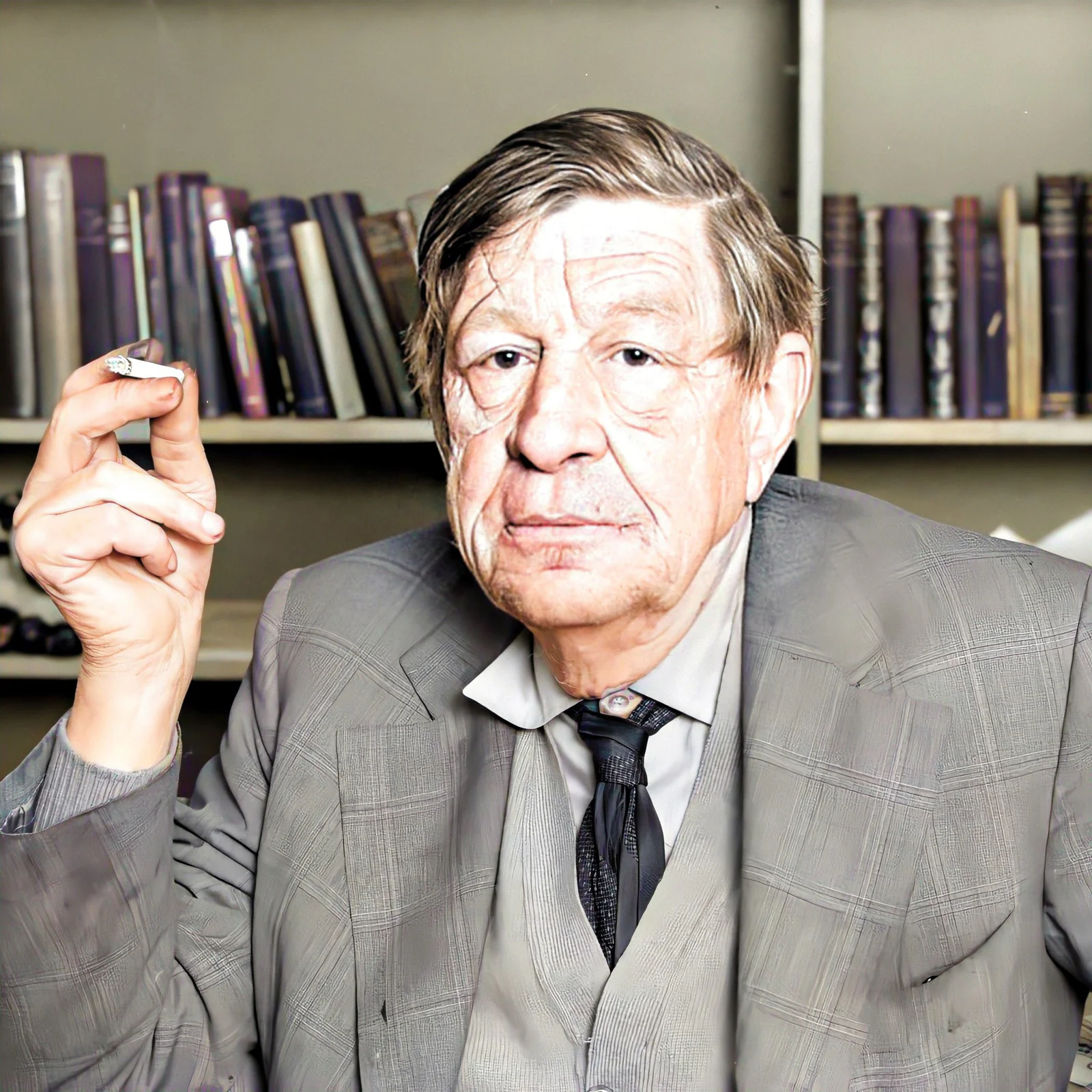
| 60 Quotes | |
| Known as | Wystan Hugh Auden |
| Occup. | Poet |
| From | England |
| Born | February 21, 1907 York, England |
| Died | September 29, 1973 |
| Aged | 66 years |
| Cite | |
Citation Formats
APA Style (7th ed.)
W. h. auden biography, facts and quotes. (2026, February 8). FixQuotes. https://fixquotes.com/authors/w-h-auden/
Chicago Style
"W. H. Auden biography, facts and quotes." FixQuotes. February 8, 2026. https://fixquotes.com/authors/w-h-auden/.
MLA Style (9th ed.)
"W. H. Auden biography, facts and quotes." FixQuotes, 8 Feb. 2026, https://fixquotes.com/authors/w-h-auden/. Accessed 21 Mar. 2026.
Early Life and Background
Wystan Hugh Auden was born on February 21, 1907, in York, England, into a professional, bookish household shaped by Edwardian confidence and the approaching fracture of modern war. His father, George Augustus Auden, was a physician with scientific and folkloric interests; his mother, Constance Rosalie Auden, had trained as a nurse and carried an Anglican piety that would later echo, by inversion and return, in her son's spiritual imagination. Auden grew up largely in Birmingham after the family moved there, in a landscape of industry and nonconformist seriousness that fed his early sense that private life and public structures are never separable.The First World War arrived as background thunder to his childhood, leaving in its wake a generation both disillusioned and hungry for new systems of meaning. For the young Auden, the period's mix of technological modernity and moral anxiety created a lifelong attentiveness to how ordinary people cooperate with large historical forces. Even before fame, he was drawn to maps, mining landscapes, and the idea of "zones" - physical and psychological - in which human choices harden into habit.
Education and Formative Influences
Auden was educated at Gresham's School, Holt, and then at Christ Church, Oxford, where he entered intending to study biology and engineering before turning decisively to English and to poetry. Oxford in the late 1920s was a crucible of aesthetic experiment and political argument; there Auden formed friendships with Christopher Isherwood, Stephen Spender, and Cecil Day-Lewis, a cohort later labeled (often reductively) as the "Auden generation". He absorbed the modernist break with Victorian rhetoric, but also the pressures of economics, fascism, and class conflict; Freud and Marx were in the air, as were Hardy's moral plainness and Eliot's urban intelligence. These influences taught him that technique could be a form of diagnosis - and that a poem could act like a report on the state of a soul.Career, Major Works, and Turning Points
Auden's first major public arrival came with "Poems" (1930), followed by the more openly social and tense "The Orators" (1932), works that made him the era's sharpest poet of anxiety, systems, and impending crisis. In the 1930s he taught in schools, wrote plays with Isherwood ("The Dog Beneath the Skin", "The Ascent of F6", "On the Frontier"), and traveled restlessly, including a turbulent visit to Spain during the Civil War, later distilled into the poem "Spain" (1937), which he would revise and partly repudiate as his moral thinking hardened against political euphemism. A decisive turning point came in 1939 when he and Isherwood left for the United States; the move, widely criticized as escapist, became instead the hinge of his mature voice. In America he wrote some of his most enduring work - "September 1, 1939", "Funeral Blues" (in its best-known version), "The Sea and the Mirror", and the long poem "The Age of Anxiety" (1947) - while undergoing a return to Christian belief and an intensified scrutiny of desire, conscience, and vocation. He became a U.S. citizen in 1946, spent later years partly in Italy and Austria, and died on September 29, 1973, in Vienna, leaving behind a body of work that moved from prophetic public address to a late, wry, humane clarity.Philosophy, Style, and Themes
Auden's inner life was marked by a tension between the wish to instruct and the fear of self-deception. Early on he wrote as if societies were patients and poems were case histories, full of coded landscapes, clipped imperatives, and the coolness of someone watching disaster with a clinician's eye. Over time, especially after 1939 and his renewed Christianity, his moral focus shifted from collective slogans to the intimate theater of temptation, self-justification, and grace. His gift was not purity but honesty about mixed motives: the way virtue can become theater, and the way cruelty can appear banal and domestic. “Evil is unspectacular and always human, and shares our bed and eats at our own table”. That sentence could serve as a key to his mature work, where the true enemy is not merely the tyrant but the ordinary heart's capacity to normalize harm.Formally, Auden was an omnivore - ballad meters, sonnets, hymns, dramatic monologues, syllabics - and this range was not decorative but ethical. He treated style as a means of telling the truth without flattering either despair or righteousness. His poems repeatedly weigh eros against duty, and loneliness against the need for community, insisting that desire is real but not sovereign. “Thousands have lived without love, not one without water”. In Auden's psychology, the line reads as both chastening and compassionate: love is not guaranteed, and the self must still learn to live, to drink what is necessary, and to refrain from turning longing into entitlement. Behind his historic consciousness lay a belief in art as conversation across mortality, a refusal to let the dead become abstractions. “Art is our chief means of breaking bread with the dead”. It is a credo for his criticism as well as his poetry, and it explains his devotion to earlier voices - from Anglo-Saxon verse to Kierkegaard - as companions rather than monuments.
Legacy and Influence
Auden remains one of the 20th century's defining English-language poets because he made intelligence feel urgent without sacrificing music, and because he revised himself in public when conscience required it. He helped set the template for the modern poet as both citizen and private moralist, influencing writers as different as Philip Larkin, Seamus Heaney, Joseph Brodsky, and many American poets who learned from his technical daring and tonal range. His work endures not as a single ideology but as a record of a mind struggling toward responsibility: skeptical of utopias, alert to complicity, and committed to the hard, sustaining idea that language - when disciplined and honest - can still be a form of care.Our collection contains 60 quotes written by H. Auden, under the main topics: Witty One-Liners - Motivational - Ethics & Morality - Truth - Wisdom.
Other people related to H. Auden: Rainer Maria Rilke (Poet), Ned Rorem (Composer), James Schuyler (Poet), Grace Paley (Writer), Geoffrey Faber (Publisher), Benjamin Britten (Composer), Carson McCullers (Novelist), John Berryman (Poet), Louis MacNeice (Poet)
W. H. Auden Famous Works
- 1960 Homage to Clio (Book)
- 1955 The Shield of Achilles (Book)
- 1951 Nones (Book)
- 1947 The Age of Anxiety (Book)
- 1940 Another Time (Book)
- 1936 Look, Stranger! (Book)
- 1932 The Orators (Book)
- 1930 Poems (Book)