
Walt Disney Biography Quotes 51 Report mistakes
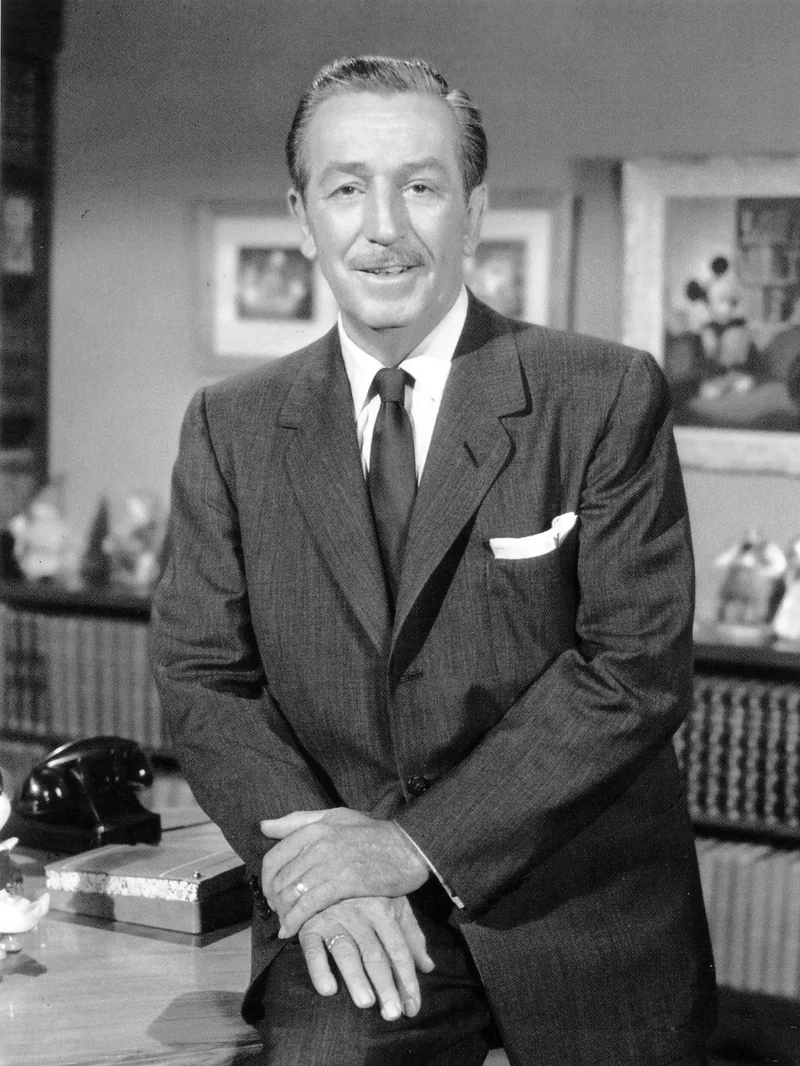
Attr: Anonymous studio
| 51 Quotes | |
| Born as | Walter Elias Disney |
| Occup. | Cartoonist |
| From | USA |
| Born | December 5, 1901 Chicago, Illinois, USA |
| Died | December 15, 1966 Burbank, California, USA |
| Cause | lung cancer |
| Aged | 65 years |
| Cite | |
Citation Formats
APA Style (7th ed.)
Walt disney biography, facts and quotes. (2026, February 2). FixQuotes. https://fixquotes.com/authors/walt-disney/
Chicago Style
"Walt Disney biography, facts and quotes." FixQuotes. February 2, 2026. https://fixquotes.com/authors/walt-disney/.
MLA Style (9th ed.)
"Walt Disney biography, facts and quotes." FixQuotes, 2 Feb. 2026, https://fixquotes.com/authors/walt-disney/. Accessed 26 Mar. 2026.
Early Life and Background
Walter Elias Disney was born on December 5, 1901, in Chicago, Illinois, the fourth son of Elias Disney and Flora Call. His father, a stern, restless builder and sometime farmer, moved the family often in search of stability, while his mother supplied warmth and practical endurance. In Disney's later self-mythology, these two poles - discipline and reassurance - became the emotional engine of his work: the ache of scarcity answered by the promise that effort could summon wonder.In 1906 the Disneys relocated to a farm near Marceline, Missouri, a landscape that left a lifelong imprint - small-town rituals, trains, parades, and the moral clarity of Main Street. When the family moved again to Kansas City in 1911, Walt and his brother Roy delivered newspapers before school, an early apprenticeship in deadlines and fatigue. As a teenager he sketched constantly, absorbed vaudeville humor, and watched new technologies (film projection, mass advertising) turn entertainment into an industry. Even before he had an audience, he was building a private refuge: drawing as a way to impose order, charm, and motion on an unpredictable world.
Education and Formative Influences
Disney attended McKinley High School in Chicago and took night classes at the Chicago Academy of Fine Arts, balancing formal instruction with relentless self-teaching through cartoons, newspapers, and silent comedies. In 1918 he tried to enlist for World War I, and after being turned away for age, joined the Red Cross Ambulance Corps; in France he decorated vehicles and paper with caricatures, learning how quickly images could lift morale. The war's aftermath and the boom of commercial art convinced him that drawing could be both vocation and business, but it also trained his eye toward sentiment as a public need - a lesson he never forgot.Career, Major Works, and Turning Points
Back in Kansas City, Disney worked in commercial art and founded Laugh-O-Gram Studio, producing modernized fairy tales; the company collapsed in 1923, sending him to Hollywood with little more than a reel and stubborn faith. With Roy as financier and partner, he built the Disney Brothers Studio, scored success with the Alice Comedies, and then, after losing rights to his first major character (Oswald the Lucky Rabbit) in 1928, remade himself through Mickey Mouse - a creative rebirth that fused slapstick with personality animation. Steamboat Willie (1928) proved synchronized sound could be narrative, not novelty; Snow White and the Seven Dwarfs (1937) validated the feature-length animated film and paid for a studio that could pursue Fantasia (1940), Pinocchio (1940), and Bambi (1942) even when war and debt strained it. The 1941 animators' strike exposed the cost of his paternalistic management style, yet he pivoted through wartime training films, postwar packages, and then into live action (Treasure Island, 1950), television (Disneyland, 1954; The Mickey Mouse Club, 1955), and the park that became his most radical narrative form: Disneyland (1955). In his final decade he pushed toward audio-animatronics, the 1964-65 New York World's Fair, and the early planning of Florida's EPCOT concept, dying on December 15, 1966, in Burbank, California, before he could test his last, most civic-minded ambitions.Philosophy, Style, and Themes
Disney's inner life was a study in control and escape. He needed play, but he needed it engineered - timed, storyboarded, rehearsed, and reworked until spontaneity looked effortless. The early Missouri memories he treasured became a template for safety, cleanliness, and belonging, while his Kansas City exhaustion and the Oswald betrayal hardened him into a man who guarded intellectual property and demanded loyalty. His best work arises from that tension: sweetness with an undertow of fear, comedy that keeps death at bay through speed, music, and invention. Characters want home, but the world is dangerous; they survive by courage, community, and a kind of moral craftsmanship.His public aphorisms reveal the psychology beneath the brand: action as antidote to anxiety, risk as proof of worth, and nostalgia as a compass rather than a cage. “The way to get started is to quit talking and begin doing”. That impatience with talk fueled his constant technological leaps - color, multiplane cameras, feature animation, television, and the themed environment - and also his intolerance for dissent when it slowed production. Yet he framed his grandest projects as intergenerational repair: “We believed in our idea - a family park where parents and children could have fun- together”. Disneyland externalized his recurring theme - a curated world where the child self is protected and the adult self is allowed back in. Even his origin story stays deliberately small, a reminder that empire began as character and gesture: “I only hope that we don't lose sight of one thing - that it was all started by a mouse”.
Legacy and Influence
Disney reshaped 20th-century popular culture by proving animation could carry feature-length emotion and by turning storytelling into a vertically integrated system spanning studio, music, television, consumer products, and physical space. His methods - storyboarding as language, character-driven motion, and the fusion of engineering with showmanship - became industry standards, while his moral universe helped define "family entertainment" as a global category. The Walt Disney Company long outlived him, expanding his reach far beyond his own films, but his lasting influence is less corporate than conceptual: he taught modern audiences to expect wonder to be designed, to feel nostalgia as an experience, and to believe that imagination, when disciplined, could become infrastructure.Our collection contains 51 quotes written by Walt, under the main topics: Witty One-Liners - Motivational - Art - Nature - Freedom.
Other people related to Walt: Ray Kroc (Businessman), Marc Davis (Artist), Roy E. Disney (Businessman), Keith Haring (Artist), Hayley Mills (Actress), Ed Wynn (Entertainer), James MacArthur (Actor), Richard Schickel (Author), Jane Darwell (Actress), Louis Prima (Entertainer)