
Wilhelm Dilthey Biography Quotes 20 Report mistakes
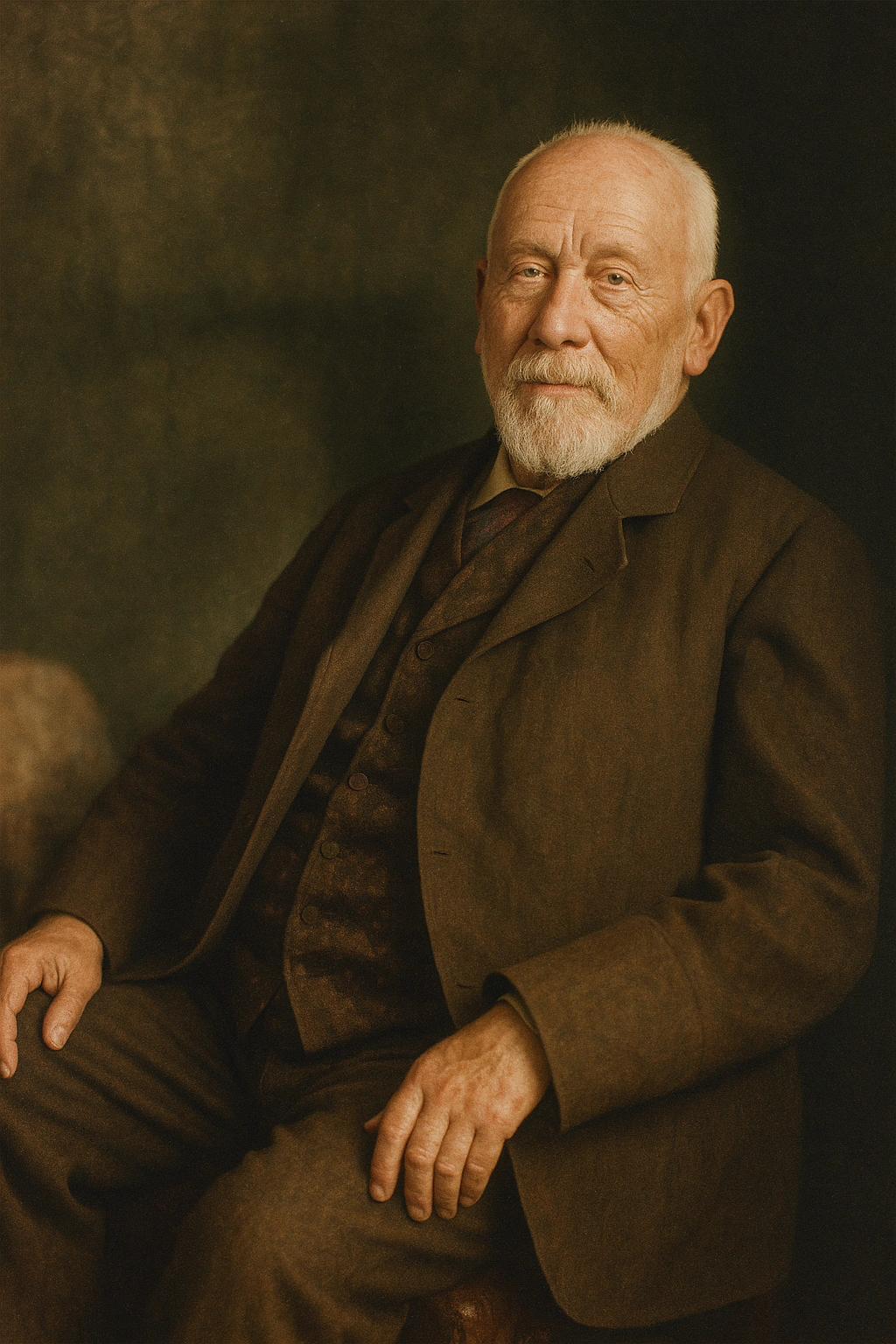
| 20 Quotes | |
| Born as | Wilhelm Christian Ludwig Dilthey |
| Occup. | Historian |
| From | Germany |
| Born | November 19, 1833 Biebrich, Duchy of Nassau |
| Died | October 1, 1911 Seis am Schlern, Tyrol, Austria-Hungary |
| Aged | 77 years |
| Cite | |
Citation Formats
APA Style (7th ed.)
Wilhelm dilthey biography, facts and quotes. (2026, February 21). FixQuotes. https://fixquotes.com/authors/wilhelm-dilthey/
Chicago Style
"Wilhelm Dilthey biography, facts and quotes." FixQuotes. February 21, 2026. https://fixquotes.com/authors/wilhelm-dilthey/.
MLA Style (9th ed.)
"Wilhelm Dilthey biography, facts and quotes." FixQuotes, 21 Feb. 2026, https://fixquotes.com/authors/wilhelm-dilthey/. Accessed 26 Mar. 2026.
Early Life and Background
Wilhelm Christian Ludwig Dilthey was born on November 19, 1833, in Biebrich on the Rhine (then in the Duchy of Nassau), a landscape of small courts and Protestant parishes poised between tradition and the accelerating pressures of industrial modernity. His father was a Reformed pastor, and the household rhythm of sermons, catechism, and parish duties gave Dilthey an early sense that human life is lived inside inherited forms of meaning - language, ritual, memory - before it is ever theorized.
The Germany of his youth was not yet unified; it was an archipelago of states, universities, and confessions, with the legacy of Romantic historicism still vivid and the authority of the natural sciences rising quickly. Dilthey absorbed both currents: a reverence for the individuality of historical worlds and a restless awareness that the new scientific prestige threatened to reduce persons to mechanisms. That tension, already felt in the mid-century battles over theology and criticism, became the permanent background to his later attempt to secure a distinct foundation for the human sciences.
Education and Formative Influences
Dilthey studied theology and philosophy at Heidelberg and then Berlin, where he encountered the aftershocks of Hegel, the philological discipline of classical scholarship, and the new rigor of historical method. He was drawn to Schleiermacher's hermeneutics and to the historical school of law and economics, which treated institutions as evolving expressions of life rather than timeless abstractions. At the same time, he watched the prestige of physiology and physics reshape intellectual expectations, sharpening his desire to articulate an epistemology adequate to lived experience without retreating into speculative metaphysics.
Career, Major Works, and Turning Points
After early work as a teacher and editor, Dilthey held professorships at Basel and Kiel before settling into a long tenure in Berlin, where he became a central voice in debates about method across history, philology, psychology, and sociology. A major turning point was his archival labor on Friedrich Schleiermacher, culminating in the influential Life of Schleiermacher and the editing of Schleiermacher's correspondence, which trained his biographical eye on the relation between inner development and public work. His own programmatic statements appeared in the Introduction to the Human Sciences (1883) and in essays later gathered as The Formation of the Historical World in the Human Sciences, where he advanced the distinction between explaining (Erklaren) in the natural sciences and understanding (Verstehen) in the human sciences. In his final decades he worked toward a descriptive and analytic psychology rooted in lived experience, leaving much in fragments at his death on October 1, 1911, in Seis am Schlern in South Tyrol, then part of Austria-Hungary.
Philosophy, Style, and Themes
Dilthey's central wager was that human reality is intelligible from within because it is constituted by meaning, not merely caused by forces. Against reductive naturalism, he argued that the human sciences require their own grounding in experience as it is lived - in expression, action, and historical situation. His prose often moves like a careful dossier: definitions, distinctions, and patient reconstructions of how a concept emerges from a life-world. Yet the motive is existential as much as methodological - to defend the legitimacy of culture, history, and personality in an age tempted to treat them as epiphenomena.
Psychologically, Dilthey returns again and again to the unity of the person beneath analytic partitions. “In the real life-process, willing, feeling, and thinking are only different aspects”. This is not a casual aphorism but a clue to his method: interpretation must follow the structural nexus of life, where motives, moods, and judgments co-constitute one another over time. He also insists that the human sciences belong to their own domain of validity, refusing the idea that they are merely incomplete natural sciences: “Thus, in accordance with the spirit of the Historical School, knowledge of the principles of the human world falls within that world itself, and the human sciences form an independent system”. That independence is paired with a disciplined humility about standpoint - the knower cannot leap outside the conditions of consciousness: “To attempt this would be like seeing without eyes or directing the gaze of knowledge behind one's own eye. Modern science can acknowledge no other than this epistemological stand-point”. The quiet urgency of these claims reflects a man trying to secure intellectual freedom for historical life without dissolving it into subjectivism.
Legacy and Influence
Dilthey became a foundational figure for twentieth-century hermeneutics and interpretive social thought: Heidegger drew on his analytic of historicity, Gadamer refined his account of understanding as historically effected, and thinkers in sociology and anthropology found in him a charter for meaning-centered inquiry. His influence also runs through intellectual history and biography, where his sensitivity to the interplay of structure and individuality helped legitimate life-writing as a serious mode of knowledge. Although his system remained unfinished and sometimes opaque, the enduring power of his work lies in a precise insistence: that to know human beings is to interpret their expressions within the temporal contexts that make them what they are.
Our collection contains 20 quotes written by Wilhelm, under the main topics: Truth - Justice - Deep - Knowledge - Reason & Logic.
Frequently Asked Questions
- Dilthey hermeneutics summary: Meaning is understood through the hermeneutic circle (parts–whole), rooted in lived experience (Erlebnis) and historical context, aiming at intersubjective validity rather than natural-science explanation.
- Wilhelm Dilthey influenced: Max Weber, Martin Heidegger, Hans-Georg Gadamer, Edmund Husserl, Paul Ricoeur, R. G. Collingwood, José Ortega y Gasset, Georg Simmel.
- Wilhelm Dilthey theory: Methodology for the human sciences (Geisteswissenschaften): understand expressions of life within historical context via hermeneutics; emphasize Verstehen over causal laws.
- Wilhelm Dilthey Verstehen: Interpretive understanding of lived experience to grasp meaning in the human sciences, contrasted with causal explanation (Erklären).
- Wilhelm Dilthey pronunciation: German: [ˈvɪlhɛlm ˈdɪltaɪ]; English: VIL-helm DILL-tie.
- Wilhelm Dilthey books: Introduction to the Human Sciences; Ideas for a Descriptive and Analytic Psychology; The Formation of the Historical World in the Human Sciences (Pattern and Meaning in History); Hermeneutics and the Study of History.
- How old was Wilhelm Dilthey? He became 77 years old
Source / external links