
William Butler Yeats Biography Quotes 58 Report mistakes
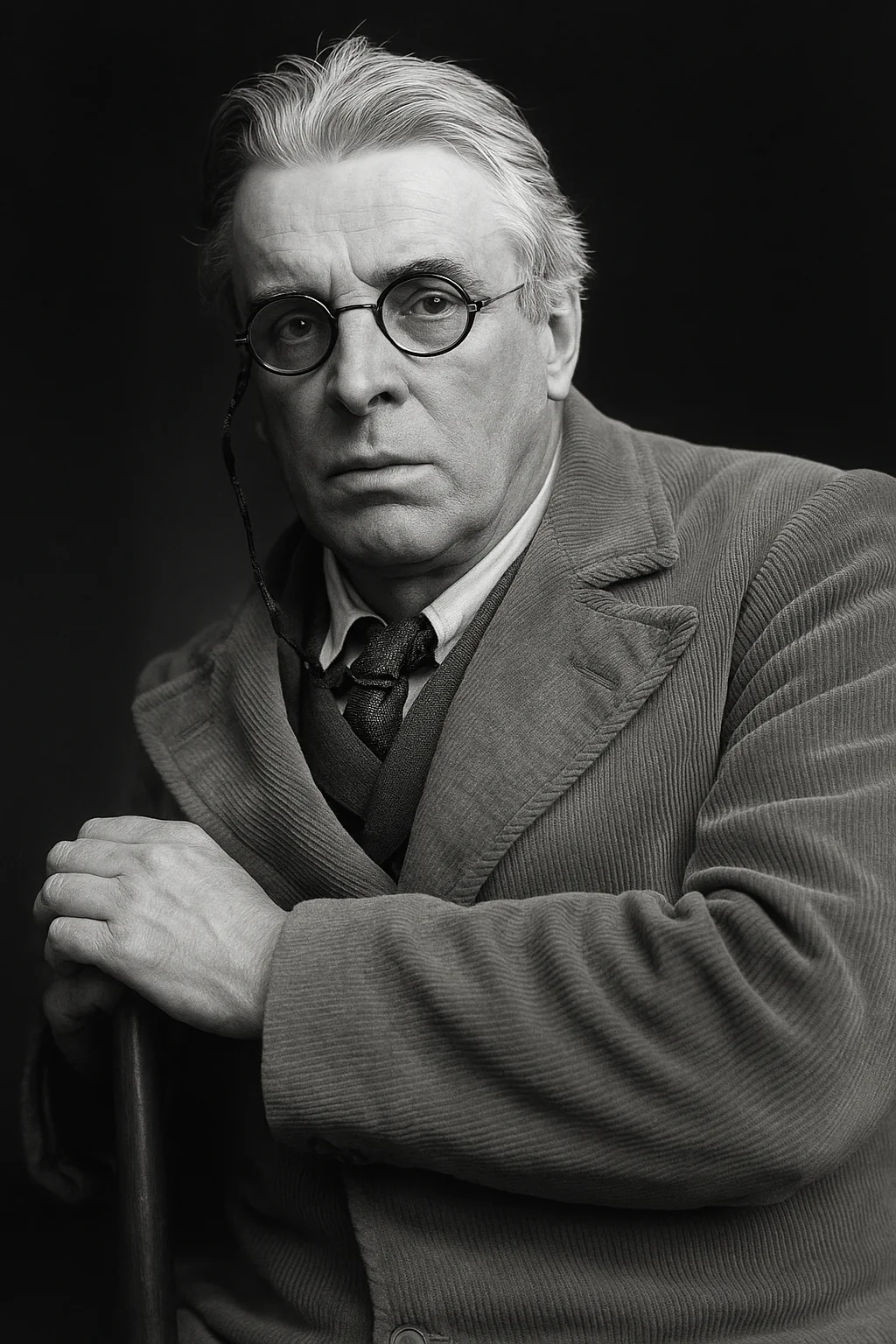
| 58 Quotes | |
| Known as | W. B. Yeats |
| Occup. | Poet |
| From | Ireland |
| Born | June 13, 1865 Sandymount, Dublin, Ireland |
| Died | January 28, 1939 Roquebrune-Cap-Martin, France |
| Aged | 73 years |
| Cite | |
Citation Formats
APA Style (7th ed.)
William butler yeats biography, facts and quotes. (2026, February 2). FixQuotes. https://fixquotes.com/authors/william-butler-yeats/
Chicago Style
"William Butler Yeats biography, facts and quotes." FixQuotes. February 2, 2026. https://fixquotes.com/authors/william-butler-yeats/.
MLA Style (9th ed.)
"William Butler Yeats biography, facts and quotes." FixQuotes, 2 Feb. 2026, https://fixquotes.com/authors/william-butler-yeats/. Accessed 27 Mar. 2026.
Early Life and Background
William Butler Yeats was born on June 13, 1865, in Sandymount, Dublin, into an Anglo-Irish Protestant family whose fortunes and identity were never simple in a country sharpening its arguments about land, language, and sovereignty. His father, John Butler Yeats, was a portrait painter of restless intellect; his mother, Susan Pollexfen, came from a Sligo merchant family whose coastline, folklore, and graveyards would become Yeats's most enduring inner landscape. From early on he lived between worlds - the bourgeois Dublin of studios and talk, and the west of Ireland that felt older than politics, where story and superstition carried the authority of weather.The Yeats household moved frequently, including long periods in London, and the boy grew up with a sense of exile even when at home: Irish in England, and a kind of English-influenced Protestant in an increasingly nationalist Dublin. This doubleness sharpened his hunger for a coherent self and a coherent Ireland, and it gave his imagination a lifelong habit of turning biography into symbol. The private pressures of money, family expectation, and precarious health were real, but they were transmuted early into a vocation - not simply to write poems, but to make a worldview that could bear love, politics, and mortality without collapsing into mere opinion.
Education and Formative Influences
Yeats was educated irregularly, shaped less by formal schooling than by reading, aesthetic debate, and occult study, with early exposure to Shelley, Blake, and the Pre-Raphaelites, and later to Irish folk tradition through Sligo and Dublin circles. In the late 1880s he entered the intellectual ferment of the Irish Literary Revival, meeting figures such as John O'Leary, Douglas Hyde, and later Lady Augusta Gregory, who offered both an anchoring discipline and a public mission. Parallel to this ran his esoteric formation: Theosophy, the Hermetic Order of the Golden Dawn, and a fascination with spiritual experience as a kind of evidence - influences that taught him to treat the imagination not as decoration but as a faculty for knowing.Career, Major Works, and Turning Points
Yeats published early verse in the 1880s and quickly became the most recognizable poetic voice of the Revival, with works like The Wanderings of Oisin and other poems (1889) and The Wind Among the Reeds (1899) establishing a dream-haunted, mythic Ireland. His unrequited love for Maud Gonne, beginning in 1889, intensified his lifelong pattern of turning personal desire into national and metaphysical drama. With Lady Gregory and others he co-founded the Abbey Theatre in Dublin, and his plays - notably Cathleen ni Houlihan (1902) - helped script the emotional theater of nationalism. After marrying Georgie Hyde-Lees in 1917, the automatic writing that followed became the seedbed of A Vision (1925, revised 1937), while the violence of revolutionary Ireland - the Easter Rising, civil war, and bitter faction - pushed him toward a harder, more public modernism in poems like "Easter 1916", "The Second Coming", and the late sequence in The Tower (1928) and The Winding Stair (1933). He served as a senator of the Irish Free State (1922-1928) and received the Nobel Prize in Literature in 1923, yet he remained, in temperament, a maker of inner systems rather than a party man.Philosophy, Style, and Themes
Yeats's central drama is the quarrel between the self he wished to be and the self time allowed - a struggle he elevated into an art of masks, cycles, and oppositions: youth and age, action and contemplation, Ireland as dream and Ireland as bloody fact. His famous claim that “We make out of the quarrel with others, rhetoric, but of the quarrel with ourselves, poetry”. is more than a maxim; it is an X-ray of his method. Public conflict gave him slogans and theater, but the poem begins where he is divided against himself - where love becomes humiliation, conviction becomes doubt, and the artist must confess that he is not pure. This is why his political poems rarely settle into propaganda: the psyche keeps interrupting the program.Formally, he moved from lush, musical early lyric to a later style of compressed statement and argumentative music, as if he had decided that ornament must earn its survival. His work ethic was famously severe: “A line will take us hours maybe; Yet if it does not seem a moment's thought, our stitching and unstitching has been naught”. The late poems insist that craft is a moral discipline against self-deception and against the seductions of mere intensity. Even the most quoted aesthetic question - “How can we know the dancer from the dance?” - reveals his psychology: he feared the splitting of life into performance and essence, yet he also believed identity is made, not found, through the practiced unity of gesture and belief.
Legacy and Influence
Yeats died on January 28, 1939, in Roquebrune-Cap-Martin, France, and was later reinterred at Drumcliff in County Sligo, beneath Ben Bulben, the mountain that became his final emblem of chosen fate. His legacy is twofold: he helped give modern Ireland a literature equal to its political upheavals, and he demonstrated how a poet could evolve without renouncing earlier selves, converting romantic myth into modern severity. In English-language poetry he stands as a bridge between the 19th century and modernism, influencing poets as different as W.H. Auden, Seamus Heaney, and countless inheritors of his blend of song, argument, and symbolic architecture; he remains proof that the private life, honestly organized, can become a public instrument.Our collection contains 58 quotes written by William, under the main topics: Witty One-Liners - Motivational - Ethics & Morality - Wisdom - Art.
Other people related to William: Herbert Trench (Poet), Ernest Dowson (Poet), James G. Frazer (Scientist), John Berryman (Poet)
Frequently Asked Questions
- William Butler Yeats' most famous poem: The Second Coming.
- William Butler Yeats books: The Collected Poems; The Tower; The Winding Stair and Other Poems; The Wild Swans at Coole; Responsibilities; A Vision.
- William Butler Yeats works: Poems and plays; notable: The Wild Swans at Coole; Responsibilities; Michael Robartes and the Dancer; A Vision; The Countess Cathleen.
- William Butler Yeats famous works: The Second Coming; The Lake Isle of Innisfree; Easter, 1916; The Tower; The Winding Stair; Cathleen ni Houlihan.
- Poems of William Butler Yeats: The Second Coming; Sailing to Byzantium; The Lake Isle of Innisfree; Easter, 1916; Leda and the Swan.
- How old was William Butler Yeats? He became 73 years old
William Butler Yeats Famous Works
- 1938 Purgatory (Play)
- 1933 The Winding Stair and Other Poems (Collection)
- 1928 The Tower (Collection)
- 1927 Sailing to Byzantium (Poetry)
- 1925 A Vision (Non-fiction)
- 1923 Leda and the Swan (Poetry)
- 1919 The Second Coming (Poetry)
- 1919 An Irish Airman Foresees His Death (Poetry)
- 1917 At the Hawk's Well (Play)
- 1917 The Wild Swans at Coole (Collection)
- 1916 Easter 1916 (Poetry)
- 1914 Responsibilities (Collection)
- 1904 On Baile's Strand (Play)
- 1902 Cathleen Ní Houlihan (Play)
- 1899 The Wind Among the Reeds (Poetry)
- 1897 The Secret Rose (Collection)
- 1893 The Celtic Twilight (Non-fiction)
- 1892 The Countess Cathleen (Play)
- 1889 The Stolen Child (Poetry)
- 1888 The Lake Isle of Innisfree (Poetry)
Source / external links