
William J. Casey Biography Quotes 2 Report mistakes
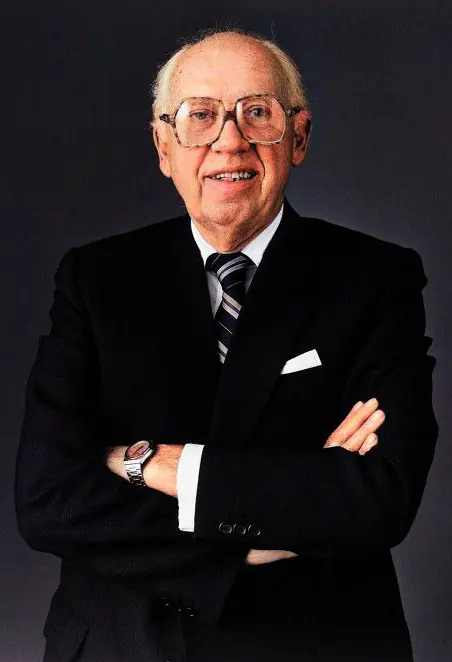
| 2 Quotes | |
| Born as | William Joseph Casey |
| Occup. | Director |
| From | USA |
| Born | March 13, 1913 New York City, U.S. |
| Died | May 6, 1987 Roslyn Harbor, New York, U.S. |
| Aged | 74 years |
William Joseph Casey was born on March 13, 1913, in the Bronx, New York, into an Irish Catholic family whose ambitions were shaped by urban machine politics, parish networks, and the hard arithmetic of Depression-era upward mobility. He grew up in a city where newspapers, courts, and ward clubs sat close together, and where public life could be both a ladder and a battlefield. That early proximity to power - and to its rougher methods - mattered: Casey learned to read institutions not as abstractions but as living organisms, sustained by loyalties, money, and information.
Friends and later colleagues often described him as tireless, private, and driven by a mixture of piety and appetite for combat. He cultivated an air of blunt practicality, yet he was also a man of intense interior discipline: he compartmentalized, kept his own counsel, and seemed most at ease in roles where success was difficult to measure publicly. Those traits would later fit the world he entered, where reputations were fragile, paperwork was destiny, and the real contest was over what decision-makers believed at the crucial moment.
Education and Formative Influences
Casey attended Fordham University, then earned his law degree from St. John's University School of Law, training that sharpened his instinct for adversarial argument and for the strategic use of facts. His Catholic milieu and the era's ideological crosswinds - the rise of fascism and communism, the New Deal's battles over the state, and the approach of world war - formed a temperament wary of utopian promises and attracted to order and efficacy. He admired bureaucratic competence, but he also absorbed a street-level realism: in politics and law, persuasion and timing often mattered more than formal principle.
Career, Major Works, and Turning Points
During World War II, Casey served in the Office of Strategic Services, the OSS, working in intelligence and clandestine operations and forming a lifelong belief that wars were won as much by deception, logistics, and alliances as by battlefield heroics. After the war he built a successful career in law and business, moving between private practice and public appointments; his reputation for management and political reliability eventually brought him into Republican circles that valued hard-nosed anti-communism. He directed Ronald Reagan's 1980 presidential campaign and, in 1981, Reagan appointed him Director of Central Intelligence, a post he held until illness forced his departure shortly before his death on May 6, 1987. His tenure coincided with the late Cold War's aggressive turn: expanded covert action, bitter bureaucratic fights over oversight, and the Iran-Contra scandal, in which secret arms-for-hostages contacts and support for the Nicaraguan Contras collided with legal restrictions and congressional scrutiny.
Philosophy, Style, and Themes
Casey's inner life is best approached through his recurring faith in belief as an instrument. He treated information not merely as evidence but as a lever - something that could be shaped, staged, and timed to compel action. His managerial style at the CIA pushed for operational tempo, plausible deniability, and a willingness to accept moral and political risk in exchange for strategic advantage. That urgency reflected his generation's lesson from the 1930s and 1940s: hesitation, in a contest of systems, could be fatal. Yet it also bred a habit of bypassing deliberation, and it blurred the line between persuasion and manipulation in ways that alarmed critics and complicated later reckonings.
In public, Casey could frame his political evolution as common sense rather than ideology: "I pass the test that says a man who isn't a socialist at 20 has no heart, and a man who is a socialist at 40 has no head". The line suggests a self-image of hardened maturity - sentiment disciplined into strategy - and it aligns with his preference for action over debate. More controversially, he was linked to a maxim that captured the darkest caricature of covert power: "We'll know our disinformation program is complete when everything the American public believes is false". Whether treated as boast or as warning, it fits a psyche attuned to the fragility of public narratives and to the temptation, in secret war, to treat citizens as another audience to be managed. In Casey's world, secrecy was not a regrettable exception; it was a governing tool.
Legacy and Influence
Casey left an enduring imprint on the CIA and on the modern American national security state: he championed an expansive view of covert action, pressed intelligence closer to presidential will, and helped set the tone for late Cold War activism that supporters credit with pressuring the Soviet system. His name, however, is also inseparable from the era's institutional ruptures - the struggle between secrecy and democratic oversight, the culture of end-runs around legal limits, and the long shadow of Iran-Contra, which hardened skepticism about clandestine governance. In the biography of American power, Casey remains a defining figure of the belief that history can be steered from the shadows - and of the costs when that belief becomes habit.
Our collection contains 2 quotes who is written by William, under the main topics: Wisdom - Truth.
Other people realated to William: Jeane Kirkpatrick (Diplomat), Frank Carlucci (Politician), Caspar Weinberger (Public Servant), Bobby R. Inman (American), Richard V. Allen (Public Servant), Bobby Ray Inman (Soldier)
Source / external links