
William James Biography Quotes 86 Report mistakes
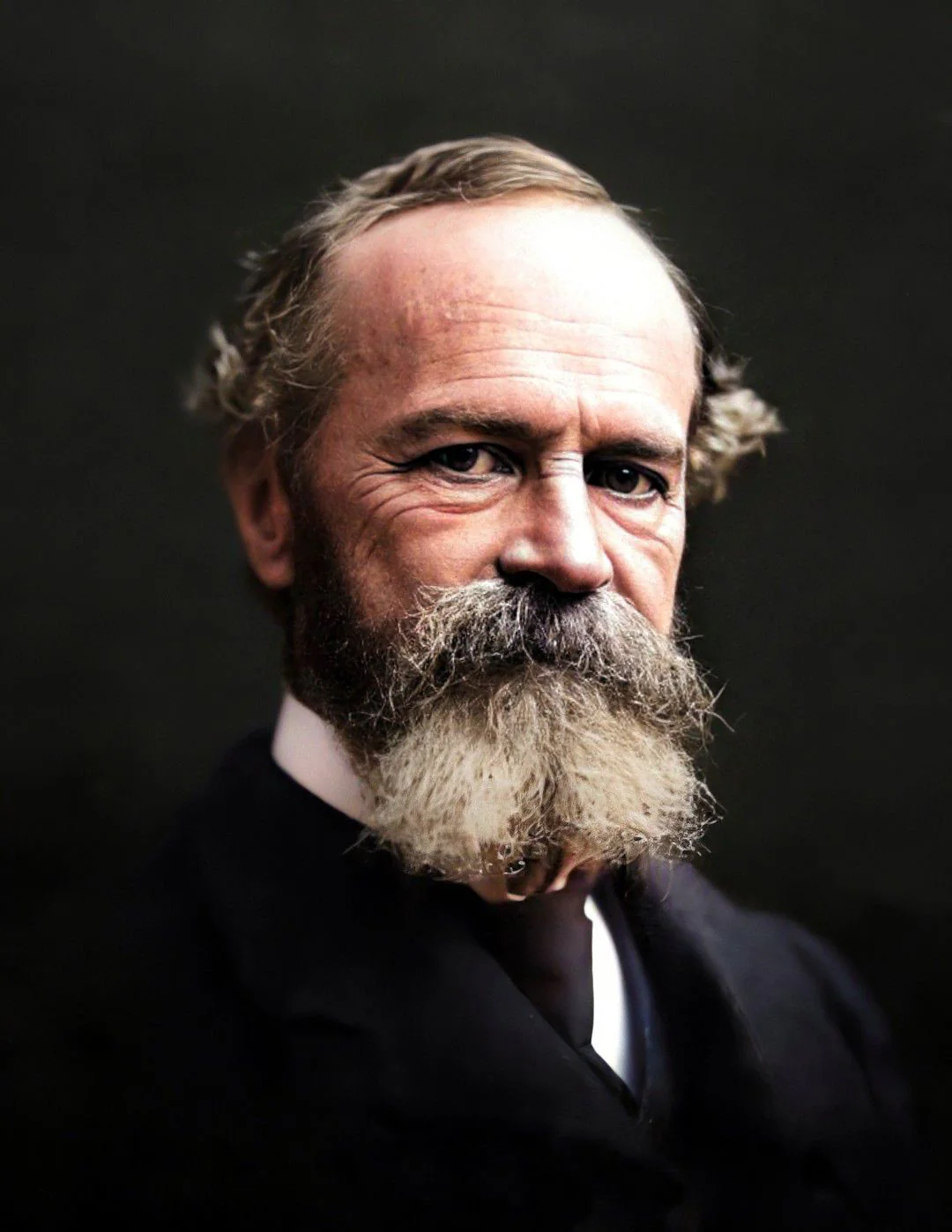
| 86 Quotes | |
| Occup. | Philosopher |
| From | USA |
| Born | January 11, 1842 New York City, USA |
| Died | August 26, 1910 Chocorua, New Hampshire, USA |
| Cause | Heart failure |
| Aged | 68 years |
| Cite | |
Citation Formats
APA Style (7th ed.)
William james biography, facts and quotes. (2026, February 2). FixQuotes. https://fixquotes.com/authors/william-james/
Chicago Style
"William James biography, facts and quotes." FixQuotes. February 2, 2026. https://fixquotes.com/authors/william-james/.
MLA Style (9th ed.)
"William James biography, facts and quotes." FixQuotes, 2 Feb. 2026, https://fixquotes.com/authors/william-james/. Accessed 6 Mar. 2026.
Early Life and Background
William James was born on January 11, 1842, in New York City, into a restless, cosmopolitan household that treated ideas as daily bread. His father, Henry James Sr., was a Swedenborgian-tinged religious thinker whose salons drew transatlantic intellectual traffic; his siblings included the novelist Henry James and diarist Alice James. The family moved repeatedly between the United States and Europe, and the children absorbed languages, art, and argument in equal measure. That mobility bred in William a lifelong sense that identity is not a fixed essence but a lived construction - a suspicion of rigid systems that later became a philosophical method.Behind the privilege ran strain. James suffered bouts of illness, eye trouble, and periods of severe despondency that today read like depression and panic, intensified by the era's confident materialism and the post-Darwinian fear that mind might be only mechanism. In the 1860s he felt himself caught between inherited spiritual longings and the hard authority of science. That inner conflict - the question of whether freedom is real or merely a feeling - became the furnace for his later pragmatism: philosophy not as metaphysical architecture, but as a discipline for choosing how to live.
Education and Formative Influences
James tried painting before turning to science, studying with William Morris Hunt in Newport, then entering Harvard's Lawrence Scientific School and, in 1864, Harvard Medical School. He joined Louis Agassiz's 1865 expedition to Brazil, where the rigors of field science met his fragile health and sharpened his skepticism about doctrinaire natural history. He completed the M.D. in 1869 but did not practice, drifting instead toward psychology and philosophy while reading widely - including British empiricists, Darwin, and the French thinkers of mind and pathology. A decisive moment came through his encounter with Charles Renouvier's defense of free will: James later described it as permission to treat belief as an act, not merely a conclusion.Career, Major Works, and Turning Points
At Harvard he helped found modern American psychology, teaching physiology, then psychology, and eventually philosophy; his laboratory work and lectures culminated in The Principles of Psychology (1890), a sprawling synthesis that introduced enduring ideas such as the "stream of consciousness" and a functional approach to mind. He followed with The Will to Believe (1897), arguing that in certain forced, momentous cases we must choose before evidence is complete; Talks to Teachers (1899) and The Varieties of Religious Experience (1902), based on the Gifford Lectures, treating conversion, mysticism, and saintliness as data for a naturalistic yet sympathetic study of religion; and Pragmatism (1907) and A Pluralistic Universe (1909), which defended truth as what proves itself in experience and reality as unfinished. He spent his final years wrestling with illness, completing essays that later appeared as Essays in Radical Empiricism (1912), and died on August 26, 1910, in Chocorua, New Hampshire.Philosophy, Style, and Themes
James wrote like a man thinking in real time: urgent, anecdotal, experimental, and allergic to philosophical intimidation. He treated consciousness as process, not thing, and he treated beliefs as instruments with consequences, not ornaments of a system. The famous doctrine of the "cash-value" of an idea was never a worship of money but a demand that concepts be tested against lived bearings - how they alter perception, conduct, and suffering. His "radical empiricism" insisted that relations are as much given in experience as discrete sensations, allowing him to resist both reductive materialism and disembodied idealism. In a nation industrializing at speed and arguing over science, faith, and democracy, James offered a temperament for modernity: pluralism, fallibilism, and moral seriousness without metaphysical certainty.The psychology underneath was candidly practical. He knew, from breakdown and recovery, that attention is destiny and that an inner life can be trained like a faculty. “The greatest weapon against stress is our ability to choose one thought over another”. That is not mere self-help in James's hands; it is a metaphysical wager that agency is real enough to cultivate. Likewise, his ethics is kinetic: “Action may not bring happiness but there is no happiness without action”. Belief, for James, is often the seed of the very evidence it seeks - courage generating its own confirmations. And his intellectual style prized selection over accumulation: “The art of being wise is knowing what to overlook”. In that sentence sits his method - a disciplined refusal of paralyzing totality, choosing the salient thread that makes life workable.
Legacy and Influence
James became the indispensable ancestor of American pragmatism and a bridge between philosophy, psychology, and the study of religion. John Dewey extended his instrumentalism into education and politics; later analytic and continental thinkers alike drew on his fallibilism, pluralism, and attention to lived experience. In psychology, his functionalism and account of attention and habit helped shape early American research, while Varieties remains a foundational text for religious studies and the psychology of spirituality. His deepest legacy is a model of intellectual honesty under uncertainty: a way to hold scientific seriousness together with the human need for meaning, and to treat ideas not as trophies but as tools for living.Our collection contains 86 quotes written by William, under the main topics: Witty One-Liners - Motivational - Ethics & Morality - Wisdom - Truth.
Other people related to William: Ralph Waldo Emerson (Philosopher), Henry James (Writer), Gertrude Stein (Author), Walter Lippmann (Journalist), David Seabury (Psychologist), Henri Bergson (Philosopher), Chauncey Wright (Philosopher), William Kingdon Clifford (Mathematician), George Jessel (Judge), Dorothea Brande (Writer)
William James Famous Works
- 1912 Essays in Radical Empiricism (Book)
- 1909 A Pluralistic Universe (Book)
- 1907 Pragmatism: A New Name for Some Old Ways of Thinking (Book)
- 1902 The Varieties of Religious Experience (Book)
- 1899 Talks to Teachers on Psychology (Book)
- 1897 The Will to Believe and Other Essays in Popular Philosophy (Book)
- 1890 The Principles of Psychology (Book)