
William Tecumseh Sherman Biography Quotes 35 Report mistakes
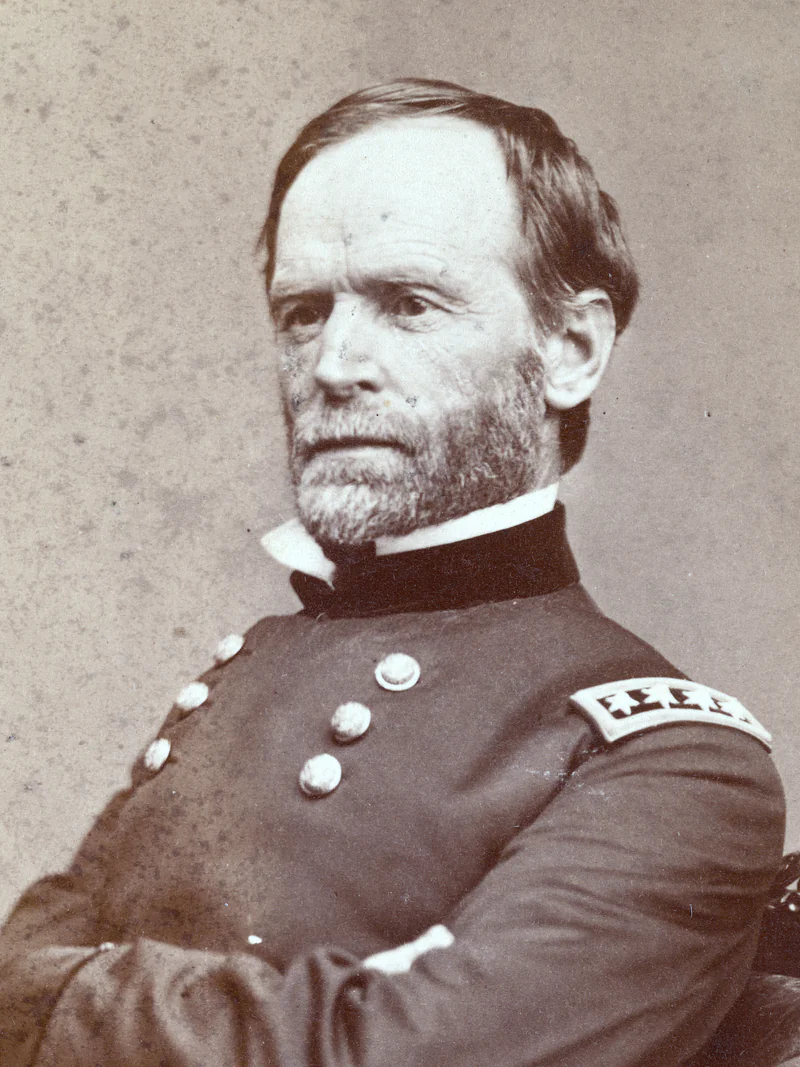
| 35 Quotes | |
| Occup. | Soldier |
| From | USA |
| Born | February 8, 1820 Lancaster, Ohio, USA |
| Died | February 14, 1891 New York City, New York, USA |
| Cause | pneumonia |
| Aged | 71 years |
| Cite | |
Citation Formats
APA Style (7th ed.)
William tecumseh sherman biography, facts and quotes. (2026, February 2). FixQuotes. https://fixquotes.com/authors/william-tecumseh-sherman/
Chicago Style
"William Tecumseh Sherman biography, facts and quotes." FixQuotes. February 2, 2026. https://fixquotes.com/authors/william-tecumseh-sherman/.
MLA Style (9th ed.)
"William Tecumseh Sherman biography, facts and quotes." FixQuotes, 2 Feb. 2026, https://fixquotes.com/authors/william-tecumseh-sherman/. Accessed 2 Apr. 2026.
Early Life and Background
William Tecumseh Sherman was born on February 8, 1820, in Lancaster, Ohio, the son of Charles Robert Sherman, a lawyer and jurist, and Mary Hoyt Sherman. His father died when Sherman was nine, leaving the large family financially exposed and emotionally unmoored - a private rupture that shaped his lifelong sensitivity to disorder, debt, and the sudden collapse of respectable structures.He was taken into the household of family friend Thomas Ewing, a powerful Ohio Whig who later served as US senator and cabinet officer. In the Ewings' world of law, patronage, and politics, Sherman absorbed the habits of public life and the costs of ambition. He also formed the intimate bond that would become his marriage to Ewing's daughter, Ellen, a relationship marked by affection and strain, especially over faith and family expectations in an era when Catholic-Protestant boundaries could still harden domestic life into a quiet contest.
Education and Formative Influences
Ewing secured Sherman an appointment to the US Military Academy at West Point, where Sherman graduated in 1840 (sixth in his class) without the romantic sheen of a battlefield prodigy but with a technician's command of order and routine. His early army years took him to posts in Georgia and South Carolina and then to the Mexican-American War period, where he served largely in administrative roles rather than combat - a pattern that initially denied him glory but trained him in logistics, movement, and the mundane infrastructure that actually makes armies function.Career, Major Works, and Turning Points
After leaving the army in 1853 for banking in San Francisco, Sherman was battered by the Panic of 1857 and then struggled in civilian roles, including a fraught superintendency at the Louisiana State Seminary of Learning and Military Academy in Pineville (now LSU), where he resigned rather than serve secession. Recommissioned in 1861, he suffered a well-publicized crisis while commanding in Kentucky - branded unstable by newspapers, he recoiled from public misreading even as he saw more clearly than many the war's scale. Under Ulysses S. Grant he returned to effectiveness at Shiloh (1862), Vicksburg (1863), and Chattanooga (1863), then commanded the armies that took Atlanta (1864) and executed the March to the Sea and the Carolinas Campaign (1864-65), using systematic destruction of infrastructure to break Confederate capacity and morale. After the war he became commanding general of the US Army (1869-83), managed Reconstruction-era deployments while avoiding partisan entanglement, and later wrote Memoirs (1875), a hard-edged narrative that defended his choices and fixed his reputation as both strategist and controversialist.Philosophy, Style, and Themes
Sherman's inner life mixed disciplined competence with a volatile need to be understood on his own terms. He prized clear chains of command, distrusted rhetorical posturing, and reacted with near-physical disgust to what he saw as the press's appetite for distortion - “If I had my choice I would kill every reporter in the world, but I am sure we would be getting reports from Hell before breakfast”. The outburst is not merely cantankerous humor; it reveals a man whose earlier public breakdown made him fear reputational death as much as military defeat, and who treated information as a weapon that could dissolve authority.His operational creed fused realism with moral severity. The famous formula “War is hell”. was not a taste for cruelty but an argument against sentimental war-making that prolonged suffering by pretending it could be gentle. In the same vein he insisted, “War is cruelty. There is no use trying to reform it. The crueler it is, the sooner it will be over”. That belief drove his emphasis on movement, railroads, depots, and psychological shock: he aimed less at enemy bodies than at the systems that fed armies and the confidence that sustained rebellion. Yet his harshness carried a self-imposed boundary - he could threaten, strip, and burn, while still imagining himself as the protector of a restored civic life, a soldier who wanted the fighting finished so ordinary households could resume.
Legacy and Influence
Sherman died on February 14, 1891, in New York City, having become one of the most recognizable faces of Union victory and one of the most disputed. To admirers he was the modernizer who proved that logistics, mobility, and attacks on war-supporting infrastructure could end a massive civil conflict; to critics he was the emblem of "hard war" and a warning about armies unleashed against societies. His military thought influenced later American operational art and the grim logic of total war in the twentieth century, while his refusal of political office - crystallized in his categorical renunciation of presidential drafts - preserved a model of the professional soldier wary of civilian adulation. In memory, Sherman remains a study in contradiction: humane in private loyalty, ruthless in method, and convinced that the shortest road back to peace ran straight through the material foundations of war.Our collection contains 35 quotes written by William, under the main topics: Witty One-Liners - Dark Humor - Resilience - Reason & Logic - War.
Other people related to William: Henry Timrod (Poet)