
William Westmoreland Biography Quotes 27 Report mistakes
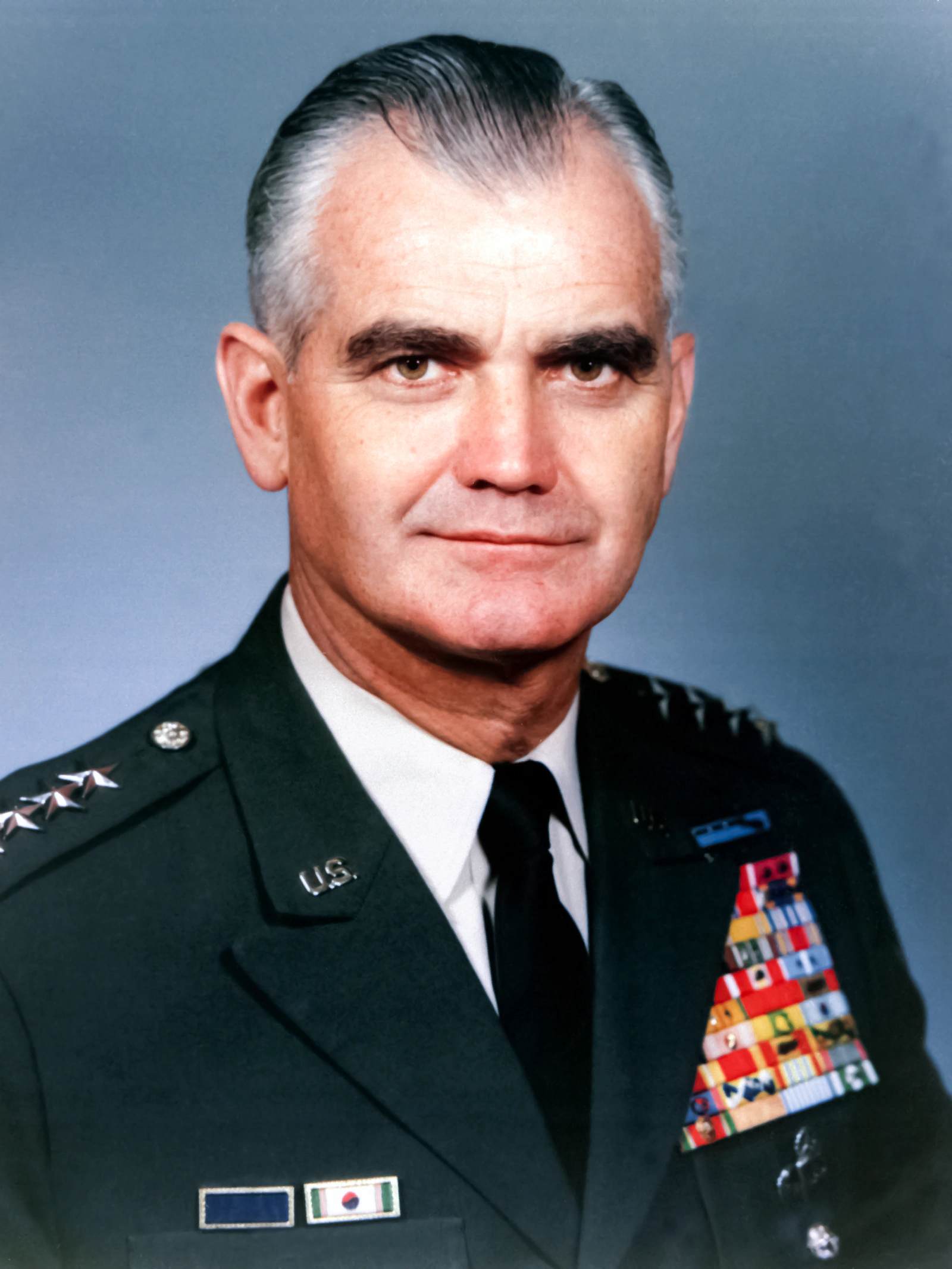
| 27 Quotes | |
| Born as | William Childs Westmoreland |
| Occup. | Soldier |
| From | USA |
| Born | March 26, 1914 Saxon, South Carolina, USA |
| Died | July 18, 2005 Charleston, South Carolina, USA |
| Aged | 91 years |
| Cite | |
Citation Formats
APA Style (7th ed.)
William westmoreland biography, facts and quotes. (2026, March 18). FixQuotes. https://fixquotes.com/authors/william-westmoreland/
Chicago Style
"William Westmoreland biography, facts and quotes." FixQuotes. March 18, 2026. https://fixquotes.com/authors/william-westmoreland/.
MLA Style (9th ed.)
"William Westmoreland biography, facts and quotes." FixQuotes, 18 Mar. 2026, https://fixquotes.com/authors/william-westmoreland/. Accessed 22 Mar. 2026.
Early Life and Background
William Childs Westmoreland was born on March 26, 1914, in Spartanburg, South Carolina, into a region still shaped by the aftermath of Reconstruction and by a civic culture that revered martial service and public duty. He grew up as the United States was learning to live with modern mass politics and modern mass war in the background - from World War I memory to the Great Depression - and he absorbed a Southern blend of propriety, ambition, and belief in hierarchy that would later mesh smoothly with the Army's professional ethos.Those who met him early often remarked on a composed, controlled manner: the look of a man who preferred systems to improvisation, and who trusted that competence, discipline, and steady advancement were virtues in themselves. That temperament helped him navigate the Army as it transformed from a small interwar institution into the global force of World War II and the Cold War, but it also left him exposed, later, to a conflict where political meaning, media narratives, and public patience could outweigh operational metrics.
Education and Formative Influences
Westmoreland entered the United States Military Academy at West Point and graduated in 1936, shaped by an academy culture that prized character, engineering-minded problem solving, and the conviction that war could be managed through planning and professionalism. Early assignments in field artillery and airborne-adjacent commands during a period of rapid doctrinal experimentation trained him to think in terms of organization and measurable results - the kind of mind that found reassurance in order-of-battle charts, body counts, and sustained pressure, and that tended to treat ambiguity as a problem to be reduced rather than a condition to be endured.Career, Major Works, and Turning Points
In World War II he served with distinction, including combat leadership in Europe (notably with the 9th Infantry Division), building a reputation as a hard-driving commander whose personal restraint concealed considerable ambition. The Cold War accelerated his rise: he commanded the 101st Airborne Division, then became superintendent of West Point, and by 1964 was in Vietnam as deputy commander to Gen. Paul D. Harkins before taking command of Military Assistance Command, Vietnam (MACV) in 1964-1968. His tenure culminated in the shock of the Tet Offensive of early 1968 - militarily costly for the communists, politically devastating for U.S. confidence - after which he returned to Washington as Army Chief of Staff (1968-1972), overseeing strain from Vietnam, domestic unrest, and an all-volunteer force in the making. In later years he fought a long, bruising public battle over his Vietnam record, including the high-profile CBS "The Uncounted Enemy" controversy, a struggle that revealed how deeply he felt the war's narrative had turned him from commander into symbol.Philosophy, Style, and Themes
Westmoreland's command style was managerial and analytic - a belief that warfare, like industry, could be optimized through resources, tempo, and pressure. Vietnam, to him, became a contest of endurance in which U.S. firepower and mobility would grind down enemy main forces faster than they could be replaced. That logic fit conventional operational thinking and produced real tactical successes, but it also invited strategic mismatch in a war where political legitimacy, rural control, and perception were decisive. His confidence in attrition metrics, and in the Army's ability to impose order, helped him maintain resolve under extraordinary stress; it also narrowed his ability to communicate the war's ambiguity to a skeptical public.His inner life, as it surfaces in his own reflections, shows a commander haunted by the gap between battlefield outcomes and public judgment - and by the new power of television. “It's the first war we've ever fought on the television screen and the first war that our country ever fought where the media had full reign”. In that sentence is both diagnosis and defense: he felt the informational environment could dissolve coherence, turning operational realities into competing impressions. He pressed the point more sharply when he argued, “Vietnam was the first war ever fought without any censorship. Without censorship, things can get terribly confused in the public mind”. The psychology is revealing: Westmoreland was a man of command who believed clarity must be curated, and who experienced uncontrolled scrutiny as disorder. Even his retrospective claim of tactical success - “Militarily, we succeeded in Vietnam. We won every engagement we were involved in out there”. - reads less like triumphalism than a plea for a measurable standard in a moralized debate.
Legacy and Influence
Westmoreland died on July 18, 2005, remembered as one of the most consequential and contested American generals of the 20th century. His legacy is inseparable from the Vietnam War's central lesson for U.S. civil-military relations: tactical brilliance and superior resources cannot substitute for political strategy, credible public communication, and an accurate understanding of the enemy's center of gravity. For supporters, he embodied duty under impossible conditions; for critics, he personified the limits of attrition doctrine and the costs of treating a revolutionary war as a conventional problem. Either way, his career became a case study taught in war colleges and debated in public history - not only about how wars are fought, but about how they are explained, remembered, and judged.Our collection contains 27 quotes written by William, under the main topics: Justice - Leadership - Freedom - War - Military & Soldier.
Other people related to William: Peter Arnett (Journalist)
Source / external links