
Winston Churchill Biography Quotes 148 Report mistakes
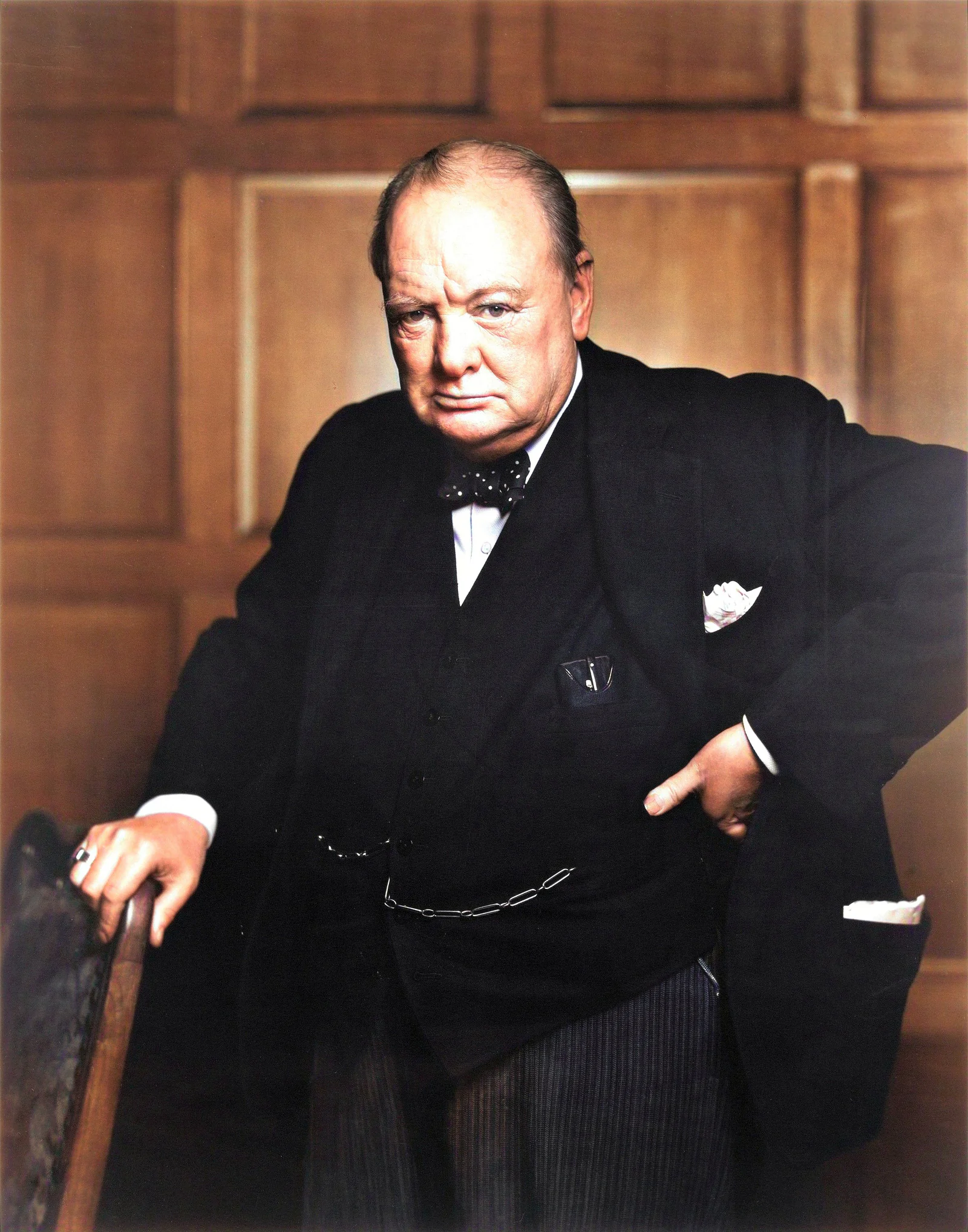
| 148 Quotes | |
| Born as | Winston Leonard Spencer-Churchill |
| Occup. | Statesman |
| From | England |
| Born | November 30, 1874 Blenheim Palace, Woodstock, Oxfordshire, England |
| Died | January 24, 1965 London, England |
| Cause | Stroke |
| Aged | 90 years |
| Cite | |
Citation Formats
APA Style (7th ed.)
Winston churchill biography, facts and quotes. (2026, February 2). FixQuotes. https://fixquotes.com/authors/winston-churchill/
Chicago Style
"Winston Churchill biography, facts and quotes." FixQuotes. February 2, 2026. https://fixquotes.com/authors/winston-churchill/.
MLA Style (9th ed.)
"Winston Churchill biography, facts and quotes." FixQuotes, 2 Feb. 2026, https://fixquotes.com/authors/winston-churchill/. Accessed 4 Mar. 2026.
Early Life and Background
Winston Leonard Spencer-Churchill was born on November 30, 1874, at Blenheim Palace in Oxfordshire, a gilded stage for a childhood that rarely felt secure. His father, Lord Randolph Churchill, a brilliant and volatile Conservative politician, moved in bursts of ambition and withdrawal; his American mother, Jennie Jerome, was charismatic, socially omnipresent, and often absent from daily care. The boy grew up amid servants, boarding routines, and the implied judgment of an aristocratic world that prized effortless success - a poor fit for a child who struggled early and nursed slights into resolve.The family drama sharpened his inner weather. Lord Randolphs decline and early death in 1895 left a looming example of talent undone by temperament and health. Churchill learned to fear waste - of gifts, of time, of national advantage - and to mistrust complacency in high places. He also developed an appetite for performance, words, and risk, searching for arenas where he could force recognition through willpower, bravery, and style.
Education and Formative Influences
Educated at Harrow, then the Royal Military College, Sandhurst, Churchill found his confidence less in classroom conformity than in history, English, and the idea of destiny shaped by individuals. He entered the 4th Queens Own Hussars and sought war zones as both soldier and correspondent - Cuba (1895), India, and the Sudan - absorbing empire at its harsh edge while discovering a second vocation: writing as a means to mastery, income, and self-definition.Career, Major Works, and Turning Points
After escape from Boer captivity made him famous, Churchill entered Parliament in 1900, crossed from Conservative to Liberal in 1904, and rose through the Edwardian ministries: President of the Board of Trade (labor reforms), Home Secretary, then First Lord of the Admiralty (1911). The Dardanelles disaster (1915) wrecked his position and drove him briefly to the trenches, a humiliation that deepened his hunger for redemption. He returned as Minister of Munitions, later Secretary of State for War and Air, then Chancellor of the Exchequer (1924-1929). In the 1930s he warned against Hitler as many sought accommodation, then became Prime Minister on May 10, 1940, leading Britain through its gravest war, forging the alliance with Roosevelt and Stalin, and crafting the rhetoric of national stamina. Defeated electorally in 1945, he returned as Prime Minister (1951-1955) amid Cold War anxieties, won the 1953 Nobel Prize in Literature for historical writing and oratory, and spent his final decade painting, dictating memoirs, and watching his century harden into legend until his death on January 24, 1965.Philosophy, Style, and Themes
Churchills inner life was a contest between melancholy and command. He named his depressions the "black dog", yet he treated emotion as something to be harnessed into action. His public creed fused historical imagination with moral realism: power mattered, and weakness invited catastrophe. The warning in “An appeaser is one who feeds a crocodile, hoping it will eat him last”. was not only a jab at rivals but a self-portrait of his mind - always scanning for predators, always convinced that postponing danger increases its price. For Churchill, leadership was less about purity than about facing ugly choices before they became fatal.His style was baroque but purposeful: muscular Anglo-Saxon phrasing set beside classical cadence, humor used as a weapon, and history deployed as a compass. “The price of greatness is responsibility”. captured his belief that rank without burden is decadence; it also explained his willingness to gamble reputation on unpopular forecasts. Equally revealing was his tenderness for continuity: “To build may have to be the slow and laborious task of years. To destroy can be the thoughtless act of a single day”. That sentence mirrors a personality addicted to urgency yet haunted by fragility - of institutions, alliances, and civilization itself - and it connects his wartime resolve to his lifelong love of craft, from prose to painting.
Legacy and Influence
Churchill endures as both statesman and author: the leader who refused to negotiate in 1940 and the storyteller who framed Britains ordeal as a moral epic in speeches, memoirs, and multi-volume histories. His record remains complicated - imperial assumptions, harsh strategic decisions, and partisan abrasiveness stand beside unmatched rhetorical leadership and a strategic sense of coalition war. Yet his core lesson persists: democratic societies survive when leaders speak hard truths early, accept responsibility without self-pity, and treat history not as ornament but as warning.Our collection contains 148 quotes written by Winston, under the main topics: Witty One-Liners - Motivational - Ethics & Morality - Wisdom - Truth.
Other people related to Winston: Bernard Baruch (Businessman), William Manchester (Historian), Clement Attlee (Leader), William Beveridge (Economist), Joseph P. Kennedy (Diplomat), Harry Hopkins (Diplomat), Arthur Bryant (Historian), Richard Attenborough (Actor), Earl Browder (Activist), Stanley Baldwin (Statesman)