
Wislawa Szymborska Biography Quotes 28 Report mistakes
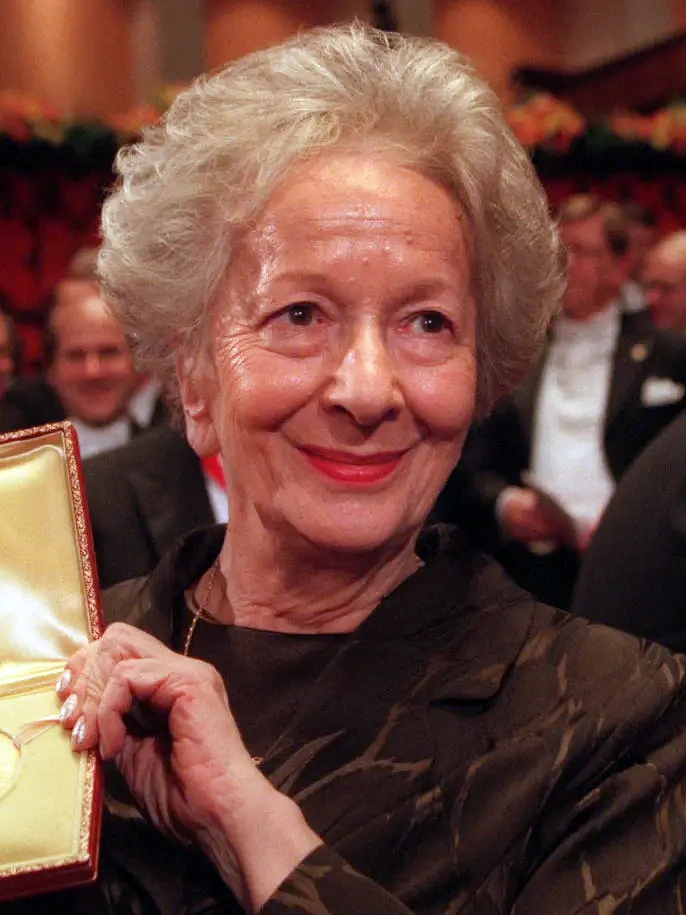
Attr: The New York Times
| 28 Quotes | |
| Born as | Maria Wisława Anna Szymborska |
| Occup. | Poet |
| From | Poland |
| Born | July 2, 1923 Prowent, Poland |
| Died | February 1, 2012 Krakow, Poland |
| Aged | 88 years |
| Cite | |
Citation Formats
APA Style (7th ed.)
Wislawa szymborska biography, facts and quotes. (2026, February 13). FixQuotes. https://fixquotes.com/authors/wislawa-szymborska/
Chicago Style
"Wislawa Szymborska biography, facts and quotes." FixQuotes. February 13, 2026. https://fixquotes.com/authors/wislawa-szymborska/.
MLA Style (9th ed.)
"Wislawa Szymborska biography, facts and quotes." FixQuotes, 13 Feb. 2026, https://fixquotes.com/authors/wislawa-szymborska/. Accessed 27 Mar. 2026.
Early Life and Background
Wisla wa Szymborska was born on 2 July 1923 in Prowent, near Kornik in western Poland, into a country barely five years restored to the map after partitions. Her father, Wincenty Szymborski, managed estates; her mother, Anna Rottermund, came from a family with intelligentsia ties. In 1931 the family moved to Krakow, a city whose libraries, cafes, and compressed history would become her lifelong habitat and a quiet counterweight to the century's catastrophes.Her adolescence was defined by occupation and improvisation. When Germany invaded Poland in 1939, formal schooling was banned; she attended underground classes while working to avoid deportation for forced labor, including clerical jobs on the railways. The war gave her what she later turned into method: a mistrust of grand language, an ear for the bureaucratic phrase that hides violence, and a sense that private life persists stubbornly inside public terror.
Education and Formative Influences
After 1945 she began studies at the Jagiellonian University in Krakow, first in Polish literature and then sociology, but she did not take a degree, choosing instead the demanding apprenticeship of editorial work and self-education. She published her first poems in 1945, entered the literary circles forming around postwar journals, and absorbed the competing pressures of reconstruction, Soviet-aligned cultural policy, and Poland's prewar modernist inheritance - from Skamander clarity to avant-garde compression - that she would later distill into a voice at once skeptical and intimate.Career, Major Works, and Turning Points
Szymborska's debut volume, Dlatego zyjemy (1952), and subsequent collection Pytania zadawane sobie (1954) were marked by socialist realist obligation; the moral discomfort of those years became an unspoken negative education. A decisive turn came with Wolanie do Yeti (1957), where she adopted the stance that made her unmistakable: a plainspoken witness who thinks on the page and refuses doctrinal certainty. From 1953 to 1981 she worked at the Krakow weekly Zycie Literackie, shaping Polish literary taste and becoming famous for her witty, stringent reviews. She gradually distanced herself from Party orthodoxy, resigning from the communist party in 1966, and in the 1970s supported dissident cultural life while keeping her own poems small enough to evade slogans. Key later books - including Koniec i poczatek (1993), Chwila (2002), and Dwukropek (2005) - deepened her repertoire of elegy, philosophical joke, and microscopic observation. In 1996 she received the Nobel Prize in Literature, which amplified her global readership even as she protected her privacy with the same tact she used to protect a poem from overexplanation.Philosophy, Style, and Themes
Her inner life, as it appears through the poems, is less confession than controlled astonishment. She writes as if the mind were a modest instrument trying to keep faith with what is in front of it: a stone, a photograph, a museum label, a dead insect, a wartime statistic. That fidelity is ethical as much as aesthetic. “All the best have something in common, a regard for reality, an agreement to its primacy over the imagination”. In Szymborska, imagination serves reality by re-seeing it, not by escaping it; she distrusts rhetoric that inflates the self, because the twentieth century showed how easily inflated language becomes a weapon.Her style is built from paradox and the conversational trap: a poem begins with an ordinary remark and ends by tilting the reader into metaphysics. She keeps tragedy and comedy in the same glass, not to soften pain but to show how cognition copes. “In every tragedy, an element of comedy is preserved. Comedy is just tragedy reversed”. This is the psychology of survival, a refusal to grant terror the last word. At the same time, her attention is possessive only for a moment, an ethic of looking that recognizes impermanence: “All is mine but nothing owned, nothing owned for memory, and mine only while I look”. The stance explains her recurring subjects - history's afterimages, the random mercy of chance, the strangeness of being one creature among many - and her preference for the conditional mood, the question, the footnote, the gently devastating aside.
Legacy and Influence
Szymborska died in Krakow on 1 February 2012, having become one of Poland's most translated poets and a touchstone for writers who want intellect without coldness. Her influence is visible in the contemporary lyric essay-poem, in poets who use humor as a moral instrument, and in readers who learned from her that a small poem can hold an entire historical conscience. In an era that rewarded loud certainty, she made disciplined doubt feel like courage, and her work endures because it offers not a system but a practiced way of being awake in the world.Our collection contains 28 quotes written by Wislawa, under the main topics: Witty One-Liners - Motivational - Wisdom - Mortality - Deep.
Wislawa Szymborska Famous Works
- 1996 The Poet and the World (Nobel Lecture) (Essay)
- 1996 View with a Grain of Sand (Collection)
- 1962 Salt (Book)
- 1952 That's Why We Are Alive (Book)
Source / external links