
Woodrow Wilson Biography Quotes 63 Report mistakes
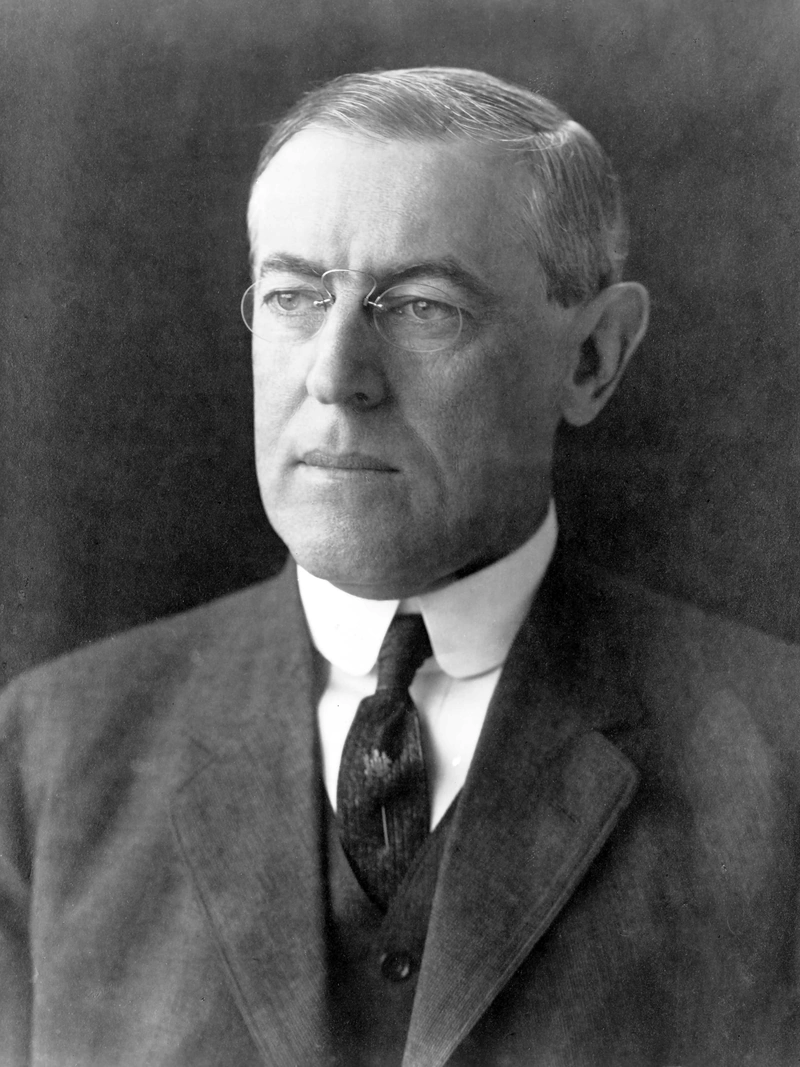
| 63 Quotes | |
| Born as | Thomas Woodrow Wilson |
| Occup. | Politician |
| From | USA |
| Born | December 28, 1856 Staunton, Virginia, United States |
| Died | February 3, 1924 Washington, D.C., United States |
| Cause | stroke |
| Aged | 67 years |
| Cite | |
Citation Formats
APA Style (7th ed.)
Woodrow wilson biography, facts and quotes. (2026, February 11). FixQuotes. https://fixquotes.com/authors/woodrow-wilson/
Chicago Style
"Woodrow Wilson biography, facts and quotes." FixQuotes. February 11, 2026. https://fixquotes.com/authors/woodrow-wilson/.
MLA Style (9th ed.)
"Woodrow Wilson biography, facts and quotes." FixQuotes, 11 Feb. 2026, https://fixquotes.com/authors/woodrow-wilson/. Accessed 5 Mar. 2026.
Early Life and Background
Thomas Woodrow Wilson was born on December 28, 1856, in Staunton, Virginia, into a slaveholding, Presbyterian manse on the eve of national rupture. His father, Joseph Ruggles Wilson, was a minister and theologian; his mother, Jessie Janet Woodrow, brought a Scottish-inflected discipline to domestic life. The Civil War marked his earliest memories not as abstract politics but as wounded bodies and broken civic order. Raised largely in Augusta, Georgia, he absorbed the moral certainty of pulpit culture alongside the lingering resentments and dislocations of Reconstruction.That Southern upbringing did not make him a simple regional partisan; it made him a man preoccupied with authority, legitimacy, and the management of conflict. He tended to translate social fracture into institutional problems to be solved by design and leadership. A late reader, possibly dyslexic, he compensated with prodigious will and a taste for structure - habits that later hardened into a belief that the right machinery, run by the right men, could redeem a chaotic republic.
Education and Formative Influences
After uneven early schooling, Wilson entered Davidson College in 1873 and soon transferred to the College of New Jersey (Princeton), graduating in 1879. He read law at the University of Virginia, practiced briefly in Atlanta (1882-1883), then turned toward scholarship, earning a PhD at Johns Hopkins University in 1886. His intellectual formation blended British constitutional history, American reform politics, and a Presbyterian sense of vocation; he married Ellen Louise Axson in 1885, and her artistic sensibility and emotional steadiness helped temper his intensity even as his ambitions widened.Career, Major Works, and Turning Points
Wilson rose as a political scientist and institutional reformer: professor at Bryn Mawr and Wesleyan, then at Princeton, where his books - notably "Congressional Government" (1885) and "Constitutional Government in the United States" (1908) - argued that party leadership and responsible administration, not fragmented committee rule, should animate democracy. As Princeton's president (1902-1910) he pursued curricular reform and battled entrenched elites, a rehearsal for later fights. Elected governor of New Jersey (1910), he moved swiftly against machine politics, then won the presidency in 1912. His first term delivered the Federal Reserve Act (1913), Clayton Antitrust Act (1914), Federal Trade Commission (1914), and tariff reform, and his administration also imposed segregation and racial exclusion across federal offices. World War I drove the central pivot: after keeping the US formally neutral, he led the nation into war in 1917, then framed peace through the Fourteen Points and the League of Nations. The Senate defeat of the Treaty of Versailles and League covenant broke his presidency; a catastrophic stroke in October 1919 left him disabled, with Edith Bolling Galt Wilson - whom he married in 1915 after Ellen's death - controlling access as his final years narrowed into seclusion until his death on February 3, 1924, in Washington, D.C.Philosophy, Style, and Themes
Wilson's inner life fused moral mission with a strategist's sense of institutions. He spoke in the cadences of sermon and lecture, treating politics as an arena where character should be made visible through policy. “There is no higher religion than human service. To work for the common good is the greatest creed”. That sentence captures both his noblest impulse and his danger: he could sanctify his own program as service, and treat dissent not merely as disagreement but as moral failure.His rhetoric oscillated between populist indignation and patrician confidence, a blend that served reform yet encouraged intolerance of obstruction. “A little group of willful men, representing no opinion but their own, have rendered the great government of the United States helpless and contemptible”. In domestic reform he aimed to discipline concentrated power, insisting that “Property as compared with humanity, as compared with the red blood in the American people, must take second place, not first place”. Yet the same administrative confidence that targeted trusts also expanded the machinery of wartime statecraft - censorship, surveillance, and prosecutions under the Espionage and Sedition Acts - revealing a recurring Wilsonian tension: a democratic ideal advanced through instruments that could constrict dissent.
Legacy and Influence
Wilson left a double inheritance. Institutionally, the Federal Reserve and modern antitrust administration helped define the 20th-century American state, and his vision of collective security reshaped global diplomacy; even after the League failed, the moral vocabulary and multilateral logic fed later internationalism, including the United Nations. But his record on civil liberties in wartime and his administration's reinforcement of segregation remain central to judging him. He endures less as a consistent democrat than as a case study in how lofty principle, personal certainty, and the pressures of total war can make reform and repression grow from the same roots.Our collection contains 63 quotes written by Woodrow, under the main topics: Witty One-Liners - Ethics & Morality - Wisdom - Justice - Friendship.
Other people related to Woodrow: Walter Lippmann (Journalist), Alice Paul (Activist), William Jennings Bryan (Lawyer), Woody Guthrie (Musician), Charles Evans Hughes (Judge), Ray Stannard Baker (Journalist), Dudley Field Malone (Politician), Jeanette Rankin (Politician), Warren G. Harding (President), Queen Marie of Romania (Royalty)