
Yuri Andropov Biography Quotes 5 Report mistakes
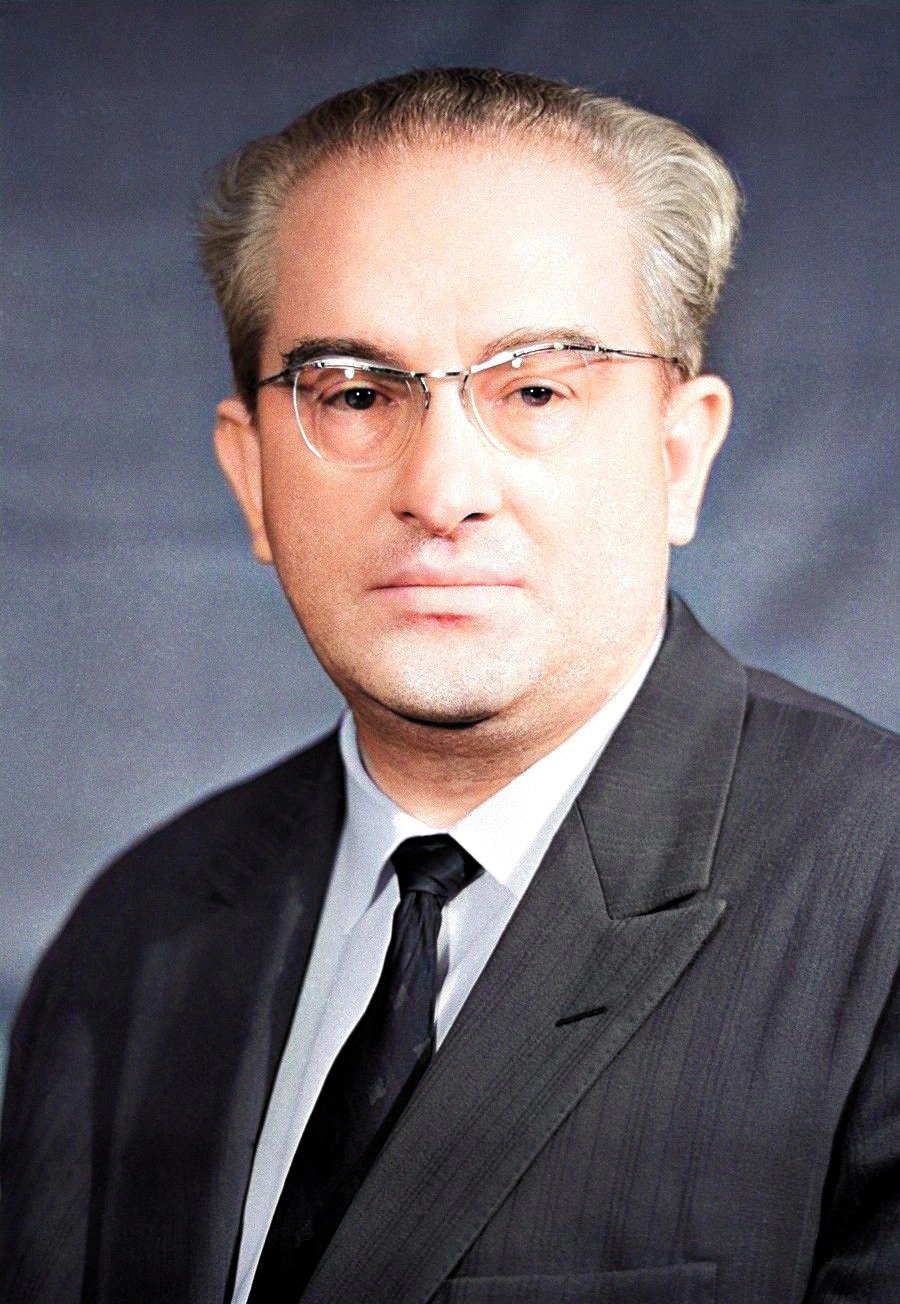
| 5 Quotes | |
| Born as | Yuri Vladimirovich Andropov |
| Occup. | Statesman |
| From | Russia |
| Spouse | Klavdiya Ivanovna Vlasova |
| Born | June 15, 1914 Stanitsa Nagutskaya, Stavropol Governorate, Russian Empire |
| Died | November 2, 1982 Moscow, Russian SFSR, Soviet Union |
| Cause | Kidney failure |
| Aged | 68 years |
| Cite | |
Citation Formats
APA Style (7th ed.)
Yuri andropov biography, facts and quotes. (2026, February 11). FixQuotes. https://fixquotes.com/authors/yuri-andropov/
Chicago Style
"Yuri Andropov biography, facts and quotes." FixQuotes. February 11, 2026. https://fixquotes.com/authors/yuri-andropov/.
MLA Style (9th ed.)
"Yuri Andropov biography, facts and quotes." FixQuotes, 11 Feb. 2026, https://fixquotes.com/authors/yuri-andropov/. Accessed 12 Feb. 2026.
Early Life and Background
Yuri Vladimirovich Andropov was born on June 15, 1914, in the southern Russian Empire, in the Stavropol region (often associated with the railway town of Nagutskaya). His early years unfolded amid the collapse of imperial rule, civil war, and the grinding improvisation of the new Soviet order. Later Soviet biographies emphasized humble origins and a childhood marked by scarcity and mobility, a pattern that suited the era's ideal of the self-made Bolshevik functionary and that also left him instinctively distrustful of disorder.In the 1920s and 1930s, as Stalin's state consolidated through collectivization, industrialization, and purges, Andropov came of age in a culture where survival depended on attentiveness to signals from above and caution in speech. Friends and colleagues later described him as controlled, reserved, and analytic - a temperament that matched the period's brutal incentives. The combination of provincial beginnings and a rapidly centralizing political system shaped in him an almost physiological preference for discipline, secrecy, and institutional loyalty.
Education and Formative Influences
Andropov trained in Soviet technical and party schools rather than in a classical university milieu, rising through Komsomol work in the 1930s and 1940s. The Komsomol was a leadership factory: it rewarded organizational competence, ideological fluency, and the ability to manage people under pressure. World War II and its aftermath reinforced for Andropov the primacy of state security and mobilization, while the postwar tightening of cultural and political control taught him that ideas could be treated as operational risks, not merely opinions.Career, Major Works, and Turning Points
His decisive ascent began in the northwestern republic of Karelo-Finland and then in Moscow-party work, but the crucial pivot came with his appointment as Soviet ambassador to Hungary in 1954. During the 1956 Hungarian Revolution he reported anxiously to the Kremlin and supported the hard reassertion of Soviet control - an experience that fused in him a lasting fear of political contagion and the belief that reform, if not tightly contained, could cascade into strategic loss. In 1967 he became chairman of the KGB, holding the post for 15 years and turning it into a sophisticated instrument of counterintelligence, surveillance, and political management, including the selective use of exile, psychiatric abuse, and pressure campaigns against dissidents. In 1982 he succeeded Leonid Brezhnev as General Secretary, launching a brief, austere anti-corruption and labor-discipline drive while probing limited economic adjustments; his failing health (kidney disease and long hospitalizations) and his death on February 9, 1984 curtailed what might have become a more coherent program of controlled renewal.Philosophy, Style, and Themes
Andropov's inner life is best approached through his characteristic tension: a security chief's suspicion paired with a technocrat's worry that the system was rotting from within. He read widely, prized competence, and privately recognized economic stagnation, yet he treated openness as a vulnerability. His politics were less visionary than diagnostic: identify weakness, isolate it, and restore controllability. That method produced a style that felt chilly even to allies - a preference for memoranda over oratory, for cadres over charisma, for prevention over persuasion.In foreign affairs he framed Soviet power as both shield and moral necessity, insisting that the nuclear age demanded disciplined restraint: "Responsible statesmen have only one choice - to do everything possible to prevent a nuclear catastrophe. Any other position is short-sighted; more so, it is suicidal". Yet he also carried the KGB chief's reflex to counterattack narratives that threatened legitimacy, lashing out at U.S. rhetoric as strategic provocation: "One must say bluntly that it is an unattractive sight when, with a view to smearing the Soviet people, leaders of such a country as the United States resort to what almost amounts to obscenities alternating with hypocritical preaching about morals and humanism". His most human public moment came in his reply to the American schoolgirl Samantha Smith, where state interest and paternal reassurance merged: "Yes, Samantha, we in the Soviet Union are trying to do everything so that there will not be war on Earth. This is what every Soviet man wants". The psychology behind these lines is revealing: anxiety about catastrophe, anger at humiliation, and a controlled desire to appear reasonable - all filtered through the imperative to protect the state.
Legacy and Influence
Andropov left no single doctrinal text, but he left a template: a Soviet leader who openly acknowledged decay while using security methods to contain it. His tenure at the KGB professionalized intelligence and repression, and his brief rule signaled to younger officials that discipline and limited modernization could coexist - an idea that influenced the late-Soviet reform generation even as it warned them of the system's fear of losing control. In memory he remains a paradox of late communism: a man who saw the abyss, tightened the perimeter, and ran out of time before deciding whether repair required more candor or more coercion.Our collection contains 5 quotes written by Yuri, under the main topics: Peace - Human Rights - War - Business.
Other people related to Yuri: Andrei A. Gromyko (Politician), Leonid I. Brezhnev (Statesman)
Source / external links